Web Development
Website Migration SEO Checklist: Before and After Launch
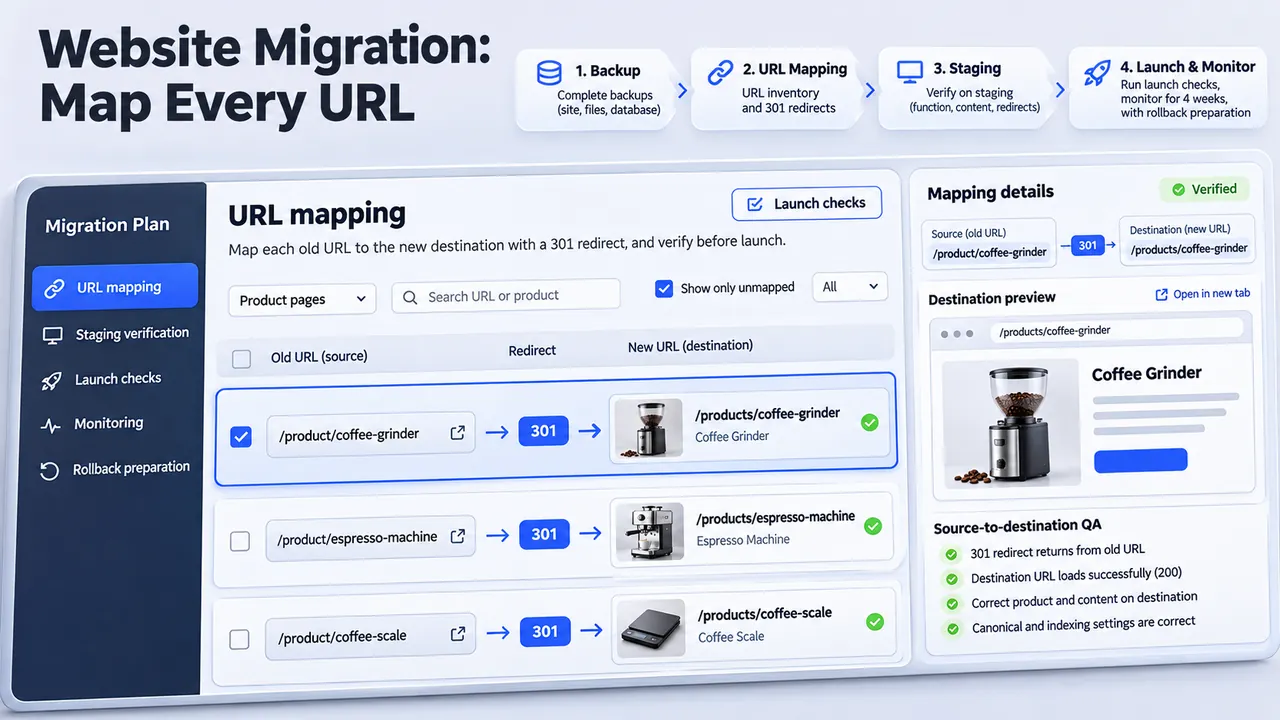
A website migration starts with a URL inventory, valuable content and performance baselines. Plan relevant redirects, indexing settings and launch checks, then monitor response codes, canonicals, language pairs, forms and search performance. No migration can promise zero fluctuation; documented checks and a workable rollback plan reduce avoidable risk.
To apply the approach to your website or marketing project, explore AUROO Digital’s SEO services, with scope, deliverables and review methods agreed around your needs.
Authoritative industry data indicates that more than 72% of website migrations during 2024–2026 contained verification omissions of varying severity. Among them, 41% experienced substantial traffic declines because of missing steps, redirect errors, or failed indexing controls, while 33% of commercial sites lost orders or displayed access errors, causing direct business losses. Most migration incidents stem less from technical complexity than from the absence of a standardized, comprehensive ultimate checklist aligned with 2026 algorithm rules. Teams complete the basic move while overlooking SEO equity, AI compatibility, data validation, rollback planning, and long-term monitoring.
The Ultimate Website Migration Check is a standardized verification framework aligned with 2026 search engine and AI distribution rules, covering every migration scenario, operating stage, and risk dimension. Beyond the basic steps found in simple migration tutorials, it focuses on retaining SEO equity, maintaining AI indexing compatibility, preserving complete site data, stabilizing user experience, enabling rapid rollback, and sustaining rankings. It addresses the traditional approach’s weakness of moving data without protecting authority or controlling risk. Beginners’ personal sites, small and midsize international stores, and large authoritative corporate sites can all use this checklist to achieve seamless migration with zero SEO damage, zero data loss, and no interruption to traffic.
This article organizes the latest comprehensive 2026 migration checks into four stages: preparation, implementation, immediate launch checks, and ongoing monitoring. It distinguishes requirements for different migration scenarios, identifies common fatal mistakes, outlines emergency rollback procedures, and explains how to preserve both AI and SEO signals. The resulting end-to-end workflow can be implemented directly, checked item by item, reused, and improved, helping operators avoid migration risks and retain as much existing authority, traffic, and commercial value as possible.
1. 2026 Website Migration Fundamentals: Redefining Verification Standards
Traditionally, most operators defined successful migration as moving all data and keeping the website accessible. Once pages, images, and articles had transferred without obvious errors, the migration was considered complete. With the comprehensive changes to algorithms and traffic distribution in 2026, those objectives have been reconstructed. Basic data transfer is only the minimum requirement. Retained authority, stable indexing, AI compatibility, a consistent experience, and controlled risk now define success. Misunderstanding this is the root of most incidents.
First, migration risk in 2026 has shifted from visible page errors to hidden losses of authority. Earlier problems—unavailable pages, broken images, and bad links—were obvious and easy to find and fix. Current algorithms detect subtler issues, including changed URLs, duplicate content, abnormal redirects, fluctuating trust, and missing E-E-A-T signals. These may cause no immediate visible errors but continually weaken the site’s authority, gradually lowering rankings, slowing indexing, and removing eligibility for AI citations. This hidden traffic collapse is much harder to repair than an obvious outage.
Second, migrations must now support both search and AI acquisition. In 2026, AI answers, intelligent summaries, and GEO aggregation account for a growing share of traffic. These incremental channels demand greater stability, content consistency, URL standardization, and structured data completeness than traditional search. A conventional migration designed only for Google’s crawler can lose structured data, disrupt page logic, and prevent AI crawling, wiping out incremental AI traffic. This is a new essential migration check for 2026.
Finally, algorithms have zero tolerance for duplicate content after migration. Redesigns, restructuring, and URL changes can create numerous duplicate, blank, low-quality, or broken pages. Google’s Helpful Content algorithm identifies and demotes these at scale, interpreting them as unstable content quality. This dilutes page equity, weakens sitewide authority, and destabilizes rankings across the site. Ultimate migration checks in 2026 must therefore include five advanced stages: deduplication, cleanup, standardization, compatibility, and stabilization.
1.1 Six Main Migration Scenarios and Their Specific Risks
Risks, verification priorities, and operating standards vary substantially by scenario. Applying one generic process inevitably leaves gaps. Based on mainstream website needs in 2026, migration can be divided into six categories, each with specific checks.
Server/hosting migration: Only the server or hosting provider changes; the domain, URLs, structure, and content remain unchanged. This is the lowest-risk scenario. Main risks include DNS delays, speed fluctuations, invalid SSL certificates, and crawling problems. There is no risk of major SEO equity loss; focus checks on stability and access compatibility.
HTTPS migration: An unencrypted HTTP site moves to HTTPS, changing URL prefixes. Main risks include duplicate indexing of old and new pages, browser security errors, interrupted backlink equity, and failed intelligent summaries. Sitewide 301 redirects and protocol standardization must be checked rigorously.
Domain migration: Moving to a new primary domain changes all site URLs. This carries the highest risk and impact, including interrupted authority transfer, broken backlinks, lost indexing, collapsing keyword rankings, and disrupted traffic. It requires complete URL mapping, redirects, backlink partner notifications, ownership updates, and ongoing stabilization monitoring.
CMS migration: Switching platforms, such as WordPress to Shopify, Zblog to WordPress, or a proprietary system to open-source software. Main risks include changed URL patterns, broken page structures, lost data, formatting errors, failed plugin functions, and missing structured data. Prioritize data completeness and standardized page compatibility.
Site structure/URL redesign: The domain and server stay the same, but directories, URL rewriting rules, or page naming conventions change. Main risks include widespread invalid old links, broken pages, duplicate indexing, and disconnected internal links. Verify every old-to-new URL mapping and omit no redirect.
Full site redesign and reconstruction: Comprehensive changes to design, section layout, and content constitute a major migration. Main risks include mismatched content, replaced core pages, inconsistent experience, and algorithmic reassessment of quality. Focus on preserving content, standardizing structure, matching old and new content, and maintaining user experience.
2. Stage One: Pre-Migration Ultimate Check—Avoid 90% of Upfront Risks
Eighty percent of fatal migration problems originate in inadequate preparation and missed checks. Standardized pre-migration verification is the most important part of the process, directly determining success and SEO retention. This stage covers five dimensions: backups, SEO baseline archives, environment checks, a finalized migration plan, and contingency planning. Verify every item and resolve all omissions before starting.
2.1 Complete Site Backup Checks: The Foundation of Zero Data Loss
Backups are the minimum protection for any migration, regardless of site size. Make two complete backups to prevent permanent data loss. A single backup can be damaged, incomplete, or unreadable. The 2026 standard calls for two complete backups stored in separate locations, verified as follows.
First, back up the complete database. Include articles, pages, users, comments, orders, settings, keywords, and custom fields. Do not back up only selected sections. Afterward, test extraction and data readability, confirming that the database is complete, undamaged, and able to restore the entire site.
Second, back up all website resources. Include themes, plugins, images, video attachments, CSS/JS files, layout templates, and custom code. Cover every static and dynamic resource to prevent missing images, broken styling, and lost functionality.
Third, retain backups in two locations: locally and in the cloud. This provides a recovery option if local files are damaged, deleted, or lost. Use consistent filenames specifying version, date, and site name for rapid retrieval and restoration.
Fourth, verify the incremental data freeze. Freeze content 24 hours before migration. Pause article publication, product listings, page edits, plugin changes, and code updates to prevent discrepancies between old and new data that could lose or duplicate new content.
2.2 Archive SEO Baselines: Compare Authority Before and After Migration
Archive every core SEO metric before migration to provide a baseline for recovery, troubleshooting, and verification. Without it, you cannot accurately determine whether traffic or authority was lost. These records also support later appeals and stabilization. Check the following items.
Indexing archive: Export all indexed URLs, pending URLs, and error links from Google Search Console. Save the complete list and record total indexed URLs, valid indexed URLs, and abnormal link counts for item-by-item comparison after migration.
Traffic archive: Save all GA4 traffic data, including visits to key pages, bounce rates, reading time, sources, and conversions. Record rankings, impressions, and clicks for primary and long-tail keywords. Identify top traffic, high-conversion, and high-authority pages: these are priorities for preserving migration equity.
Backlink and authority archive: Use Ahrefs, Semrush, or similar tools to save backlink counts, quality referring domains, anchor text distribution, and destination pages. Record DR/UR authority scores, domain age, and trust signals. After migration, prioritize complete equity transfer for pages with strong backlinks.
Structured data and AI signal archive: Save existing structured data, FAQ pages, breadcrumbs, hreflang tags, mobile compatibility tags, and AI summary materials. Keep AI recognition signals consistent after migration to avoid losing AI traffic.
2.3 Verify Old and New Environments: Prevent Compatibility Failures
Check compatibility between old and new servers, domains, and application environments in advance. Resolve issues before migration to prevent failed functions, access errors, major speed reductions, or crawling failures afterward.
Server environment: Verify PHP and database versions, runtime environment, permissions, memory, bandwidth, and access speed against the site’s requirements. Prevent version incompatibilities that cause errors or disable functions. Check the new server IP’s reputation and blacklist status so a compromised reputation does not harm indexing or rankings.
Domain and SSL: Confirm that the new domain resolves correctly and has no historical violations or contaminated reputation. Configure SSL in advance and complete HTTPS setup. Verify certificate validity, automatic renewal, and browser trust to avoid security warnings or expired certificates after migration.
Mobile and browser compatibility: Test the new environment on mobile and mainstream browsers—Chrome, Firefox, Safari, and Edge. Adapt layouts, resolutions, and interactions beforehand to prevent distorted mobile pages that undermine experience and mobile ranking signals.
2.4 Verify the Complete URL Mapping Table: The Key to Authority Transfer
URL mapping is central to retaining SEO equity. Ninety percent of authority loss results from omitted mappings, incorrect redirects, or mismatched destinations. Whenever URLs change, regardless of whether the domain changes, create an old-to-new mapping table with 100% coverage. Verify each entry for omissions, mismatches, and duplication.
Enter high-value pages first: Prioritize top traffic pages, high-conversion pages, pages with strong backlinks, and core category pages. Match each old and new link precisely to ensure 100% transfer of core equity. This is the highest stabilization priority.
Cover every page: Include articles, products, categories, about and contact pages, FAQs, archives, and detailed listing pages. Do not overlook niche or long-tail pages and create large numbers of unknown broken links.
Standardize redirects: Use sitewide permanent 301 redirects. Prohibit temporary 302s, chained redirects, incorrect destinations, and indiscriminate homepage redirects so authority transfers completely without loss. Avoid broad bulk rules that create duplicate indexing or semantic confusion.
2.5 Verify Contingencies and Responsibilities: Prevent Migration Incidents
Large migrations require an emergency plan and assigned responsibilities in advance. This prevents unhandled failures, confused operations, and delayed repairs that allow authority losses to continue after launch.
Define a rapid rollback plan: Establish the complete procedure and failure thresholds, such as collapsing indexing, widespread 404s, sitewide outages, or browser errors. Ensure the entire site can return to its original working state within 5–10 minutes to limit ranking damage.
Assign team responsibilities: Designate owners for implementation, SEO checks, data monitoring, customer inquiries, and emergencies. Keep everyone available during launch and monitor the site continuously to prevent operating mistakes and verification gaps.
Notify third parties: Inform the hosting provider, CDN provider, backlink partners, and marketing team of the migration window beforehand. Prevent conflicting external changes and reduce outside risks.
3. Stage Two: Mid-Migration Checks—Standardize Implementation and Prevent Omissions
After preparation, begin implementation. The goals are disciplined operations, complete data transfer, accurate configuration, and closed testing to resolve all visible and hidden problems before launch. Perform all work on a staging site. Never operate directly in production, where live traffic would be exposed to risk.
3.1 Verify Data Completeness on the Staging Site
After transferring the entire site to staging, check each data category against the original. Confirm there are no omissions, inconsistencies, duplicates, or damaged records.
Content: Sample articles, products, and illustrated content across all sections. Compare text, images, layout, formatting, custom fields, publication dates, and author information. Check for lost content, formatting errors, garbled characters, and broken images.
Functions: Test every interaction, including search, guest messages, form submissions, orders, member login, and comments. Confirm all functions work without errors or failures.
Page structure: Compare category layouts, navigation menus, breadcrumbs, headers, footers, and sidebars with the original. Ensure clear hierarchy, complete modules, and correct layouts.
3.2 Verify 301 Redirects Precisely: Preserve SEO Equity Transfer
Use the URL mapping table to configure sitewide permanent 301 redirects at server level. Avoid unstable plugin-level or page-level redirects. Verify every rule afterward.
Sample core pages in bulk: Enter old URLs individually for the TOP100 high-traffic pages and pages with strong backlinks. Confirm an automatic, immediate redirect to the exact corresponding new page, with no incorrect or missing redirects. The status code must be 301.
Avoid redirect mistakes: Do not send every page to the homepage, redirect categories arbitrarily, break internal redirects, or create loops. Each redirect must be an accurate one-to-one match with closely corresponding meaning and content.
Mobile redirects: Check old mobile links separately. Confirm mobile and desktop rules are consistent and mobile redirects are neither broken nor mismatched, preserving mobile equity transfer.
3.3 Verify Indexing Controls and Crawler Rules
Strict indexing controls on staging prevent test content from entering search results and creating duplicate or low-quality pages that contaminate the index and harm rankings after launch.
robots.txt: Block crawlers strictly on staging and prevent any page from being indexed. Remove restrictions only before the production launch, avoiding duplicate old and new content and indexing confusion during testing.
Password protection: Smaller sites can enable sitewide password protection through administration to block both crawlers and users completely. This prevents test content from leaking or being indexed and keeps the migration environment isolated.
Production crawler rules: Prepare robots.txt in advance to exclude invalid, blank, duplicate, administrative, and redundant archive pages. Improve crawl efficiency and concentrate authority on valuable core pages.
3.4 2026 AI Compatibility Checks: New Essential Requirements
To support GEO engines and AI summary traffic, explicitly verify AI-related elements during migration. Ensure recognition, extraction, and citation continue working afterward without losing incremental traffic.
Structured data: Confirm complete preservation of all Schema markup, including product, article, and FAQ data, without omissions, errors, or corruption. AI must be able to identify the page’s main content and value correctly.
Tags: Retain existing hreflang, mobile compatibility, and canonical tags. Define page priority clearly to prevent confusion about primary content, duplicate classifications, or dispersed authority.
Content logic: Keep wording, paragraph structure, core arguments, and practical steps consistent with the original. Avoid changes in logic or meaning that conflict with AI’s historical index and lead to lost citation eligibility.
3.5 Clean Up Broken Links, Incorrect Links, and Duplicate Content
Migration readily creates redundant links, dead links, and duplicate content. Remove these completely before launch to align with the 2026 Helpful Content algorithm and avoid low-quality-content penalties.
Broken link scanning: Crawl the whole site to identify every 404, 503, and invalid link. Add redirects according to the mapping table. Compile invalid links that cannot be redirected and submit them through GSC for removal after launch.
Duplicate content: Identify duplicate pages, similar content, blank pages, and poor-quality archives. Delete them or block indexing to avoid redundant, homogeneous pages that dilute overall authority.
Internal links: Review all internal links, replace old URLs with new ones, repair broken and incorrect links, and rebuild a complete internal linking network so crawlers and authority can move normally.
4. Stage Three: Go-Live Ultimate Check—Launch Without Failures
Once all tests pass, switch to production. Launch is the period of greatest risk and fastest change. Monitor continuously and verify each item to ensure a smooth switch, normal access, active rules, and orderly indexing, preventing problems at launch and the spread of hidden failures.
4.1 Verify DNS Resolution and Server Switching
Immediately after changing DNS and switching servers, check whether resolution has taken effect. This is the foundation of normal access.
DNS propagation: Use DNS tools to verify resolution across the network, including multiple geographic nodes and providers. Check for failed or incorrect responses and cache delays, allowing propagation to complete gradually worldwide.
Site access: Test the whole site continuously on desktop, mobile, and different browsers. Confirm every page opens correctly, without blank pages, errors, abnormal redirects, or broken styles.
CDN configuration: Refresh CDN caches and clear old site caches. Ensure users receive current content, with no stale pages or inconsistencies caused by cached material.
4.2 Remove Indexing Restrictions and Allow Crawlers
Immediately after launch, remove staging indexing restrictions and allow search crawlers to resume normal crawling and indexing, while managing crawl behavior.
robots.txt: Remove testing restrictions and restore production crawling permissions. Confirm the rules are correct and do not mistakenly block core pages.
Site ownership: Update the domain, ownership information, and sitemap in Google Search Console and GA4. Ensure platforms recognize the new site and restore analytics and index monitoring.
Latest sitemap: Generate and submit a new XML sitemap to GSC. Encourage crawlers to prioritize core pages, accelerate indexing, and shorten the traffic gap.
4.3 Final Sitewide Status Code and Redirect Sampling
After launch, sample core pages, long-tail pages, and redirects from old URLs in bulk. Confirm every rule is active and all status codes are appropriate.
Status codes: Core pages should return 200, while redirected pages should consistently return 301. Eliminate unexpected 404, 500, and 302 responses that could affect indexing and authority.
Redirect accuracy: Resample top-value pages to confirm precise one-to-one mapping, without arbitrary homepage destinations or mismatched content, ensuring complete equity transfer.
4.4 Verify User Experience and Commercial Functions
Commercial and conversion-focused sites must prioritize business functions after launch to prevent lost orders and customers.
Conversion functions: Test forms, inquiries, ordering and payment, member registration, and feedback. Confirm a smooth, error-free process that does not interrupt conversions.
Page speed: Use speed tools across the site and optimize images, code, and caches. Ensure mobile and desktop performance meets requirements and avoid slower loading that raises bounce rates.
Compatibility: Retest display across devices, browsers, and screen resolutions. Eliminate broken layouts, failed buttons, and distorted images.
5. Stage Four: Post-Migration 4-Week Checks—Stabilize Authority and Recover Quickly
Launch does not end the migration. Search engines in 2026 reassess migrated sites over 1–4 weeks, while AI index updates lag. Monitoring and stabilization in the first four weeks determine final equity retention. Most later traffic declines result from neglecting the site and failing to repair hidden issues promptly. This final stage schedules monitoring and optimization by week.
5.1 Week One: Real-Time Troubleshooting and Index Monitoring
Main objectives: Repair visible failures quickly, accelerate indexing of new pages, and remove invalid old links. Monitor GSC daily for crawl errors, indexing anomalies, 404s, and abnormal crawler activity. Fix issues the same day to prevent accumulation. Sample core page rankings, impressions, and clicks daily against the pre-migration baseline to detect authority changes promptly. Submit invalid old links in bulk to GSC’s dead-link tool to speed removal and replacement with indexed new URLs.
5.2 Week Two: Compare Authority and Optimize Content
Main objectives: Verify retained authority and repair hidden content problems. Compare rankings, traffic, indexing, and user behavior before and after migration. For pages losing rankings or traffic, improve content completeness, additional information value, and structured data. Strengthen internal links to direct equity toward valuable core pages and improve competitiveness. Check AI summary and citation recovery, adding any missing compatibility materials.
5.3 Week Three: Stabilize Backlinks and Authority Signals
Main objectives: Restore backlink equity and reinforce E-E-A-T signals. Review existing quality backlinks and ask partners to update links. Add a measured number of quality new backlinks to offset migration losses. Update brand information across the web, site registration records, author credentials, and industry endorsements. Strengthen the E-E-A-T signals central to 2026, improve trust, and support steady ranking recovery.
5.4 Week Four: Review Results and Consolidate Improvements
Main objectives: Assess the migration comprehensively and preserve the best site state. Compare all indexing, traffic, rankings, conversions, and AI traffic against the baseline. Evaluate results, identify remaining issues, and resolve them completely. Remove redundant data, invalid pages, and cache clutter; optimize speed and experience; and close the full migration cycle with stable long-term authority.
6. 2026 Migration Mistakes That Can Be Fatal
Numerous migration cases this year reveal ten especially common and damaging mistakes. These are leading causes of traffic collapses and lost authority. Avoid them strictly throughout the process.
Mistake 1: Moving data without 301 redirects. Many beginners transfer pages but configure no redirects, leaving every old link invalid and losing all authority and indexing. This is the most serious basic error.
Mistake 2: Using temporary 302 redirects or sending everything to the homepage. A 302 cannot transfer equity, while blanket homepage redirects create mismatched content and semantic confusion. Algorithms identify abnormal quality and demote the whole site.
Mistake 3: Allowing staging to be indexed. Crawled test content creates numerous duplicates, dilutes core page authority, and prevents the new site from improving its rankings.
Mistake 4: Ignoring AI structured data compatibility. Focusing only on basic page transfer loses Schema and FAQ markup, eliminates incremental AI traffic, and forfeits a major 2026 acquisition opportunity.
Mistake 5: Leaving broken links and duplicates after migration. Accumulated invalid links and duplicate content trigger low-quality classifications under Helpful Content and weaken sitewide authority.
Mistake 6: No monitoring or review after launch. Assuming the job is finished ignores authority fluctuations during the 1–4-week reassessment period, allowing small problems to grow into a large traffic collapse.
Mistake 7: Failing to update ownership and site details after changing domains. Outdated GSC and GA4 information causes inaccurate tracking, crawler confusion, and stalled indexing.
Mistake 8: Neglecting mobile compatibility and speed. Distorted, slow mobile pages drive up bounce rates and cause substantial mobile ranking losses.
Mistake 9: An ineffective content freeze creates data discrepancies. New content added during migration is not synchronized, leading to lost data, missing material, and reduced page value.
Mistake 10: No rollback plan to limit failures. Without rapid rollback when indexing collapses or the site displays widespread errors, authority keeps falling and losses increase.
7. Rapid Rollback and Repair Plans for Migration Failures
Unexpected failures can occur even after comprehensive checks. Prepare rapid recovery methods to limit losses and restore authority.
Sitewide outage or widespread errors: Immediately activate the rollback plan. Restore the original server, DNS configuration, and site data, returning access within 5–10 minutes. Diagnose the cause before trying migration again.
Large numbers of 404s: Immediately compare the URL mapping table and add missing 301 redirects. Submit broken links to GSC in bulk, update the sitemap, and encourage recrawling.
Stalled indexing or collapsing rankings: Check for accidental robots.txt blocks, missing structured data, and incorrect status codes. After targeted repairs, request crawling and update pages with additional useful information.
AI traffic disappears: Repair Schema markup and FAQ sections, move core points earlier, and optimize structure for extraction. Wait for AI engines to recrawl, index, and restore citations.
Duplicate indexing: Use canonical tags to identify authoritative pages, block redundant duplicate pages from indexing, remove invalid content, and consolidate page equity.
8. Conclusion: Standardized Checks Are the Key to Migration Without Loss
Website migration in 2026 is far more than moving data. It is an integrated undertaking combining data security, SEO equity, AI traffic, user experience, and commercial value. Traditional undisciplined approaches no longer fit current algorithmic reviews and AI distribution. Even a small omission can trigger cascading traffic problems and lasting, irreversible authority loss.
The Ultimate Website Migration Check covers preparation, implementation, launch, and post-migration monitoring through a standardized process. It addresses data loss, lost authority, collapsing traffic, failed AI compatibility, and disrupted experience, turning uncontrolled risks into predictable, avoidable, repairable, and manageable operations. Personal blogs, international stores, and large authoritative corporate sites can all use it to migrate smoothly, safely, and without loss, preserving as much original traffic, authority, and commercial value as possible.
In 2026, traffic competition is increasingly precise, algorithmic reviews stricter, and AI traffic central to incremental growth. Migration capability depends on verification accuracy, rather than operating speed. Replace undisciplined work with comprehensive standardized checks to avoid migration risks, protect accumulated content assets and traffic advantages, and support stable site development and lasting growth.