Content Marketing
How to Choose a Content Marketing Agency: A Checklist
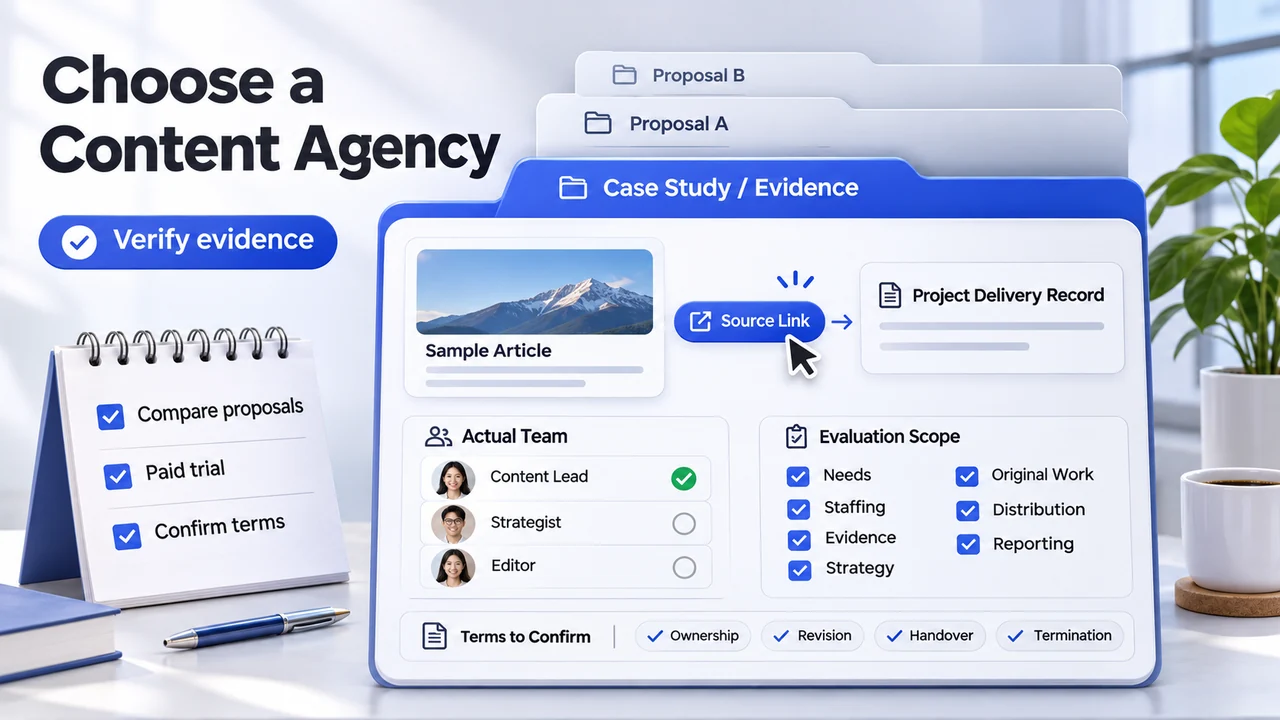
Define your audience, content purpose and sales follow-up before comparing agencies. Assess industry understanding, sample quality, fact-checking and delivery processes. For B2B work, ask each agency to demonstrate how one product topic becomes an evidence-backed article connected to a relevant product or service page.
To apply the approach to your website or marketing project, explore AUROO Digital’s SEO services, with scope, deliverables and review methods agreed around your needs.
Content agencies provide end-to-end strategy, topic planning, copywriting, video production and editing, multichannel distribution, SEO/GEO optimization, data reviews, audience development, and branded content. They help businesses establish standardized marketing faster and more cheaply, improving exposure, traffic, lead conversion, and audience retention. However, the market ranges from comprehensive providers and industry specialists to small studios and individual contractors, with enormous differences in capability, professionalism, compliance, delivery, and after-sales support.
Businesses commonly struggle to assess expertise, distinguish genuine cases from packaged examples, understand pricing, and avoid inconsistent delivery, content disconnected from business, fabricated data, poor communication, unclear responsibilities, inadequate support, or unfinished engagements. Industry research shows that over 60% of first agency engagements fail to meet expectations. Nearly 40% of businesses choose the wrong provider, wasting budgets and missing the best window for brand content development; poor content can even harm reputation and trigger platform compliance risks.
The underlying problem is a lack of standardized hiring processes and assessment criteria. Businesses partner blindly on sales claims, superficial cases, or low prices, leading to failure. Drawing on mature overseas industry standards and practical hiring experience from over a thousand Chinese businesses, this article explains how to hire a content agency through a comprehensive practical system covering needs definition, agency categories, credentials, case verification, pricing risks, interviews and negotiation, contracts, onboarding, ongoing management, renewal and termination, and common pitfalls. It helps businesses build a process from scratch to select cost-effective, well-matched, reliable providers and maximize commercial value. Its rigorous structure, practical workflow, and clear standards support marketing departments, business training, academic reference, and overseas content development for foreign-trade businesses.
1. The essential prerequisite: define needs and partnership goals
The first step is not blindly searching providers but reviewing internal needs, defining partnership boundaries, and establishing core goals . Every strong partnership rests on precise alignment. Unclear needs and confused goals are the leading causes of poor agency selection and disappointing results. Businesses that approach providers without clarifying their model, goals, audience, and budget often receive content disconnected from their operations and objectives: attractive content without traffic, exposure without conversions, or output without lasting assets.
Before hiring, businesses must clarify four core requirements to guide screening, assessment, and negotiation.
1.1 Define service types and business scenarios
Agencies vary greatly in expertise, services, and formats; no provider fits every situation. Match service needs to the business and select relevant specialists. Eight main areas are brand content, SEO search content, AI-compatible GEO content, short video and livestream production, overseas social content, specialist B2B white papers and solutions, ecommerce discovery and conversion content, and owned-channel retention content.
For example, industrial, technology, and consulting B2B companies need expert, detailed, authoritative industry knowledge, solutions, and cases, fitting B2B specialists. Ecommerce, consumer goods, and beauty brands need contextual, persuasive short videos and visual posts that drive purchase, fitting ecommerce agencies. Export businesses need original English content, Google SEO, and coordinated social channels, fitting overseas specialists. A generic provider can easily produce insufficiently expert, abstract content unsuited to the industry.
1.2 Set clear, measurable goals
Replace the vague belief that content simply means publicity or exposure with measurable, assessable, reviewable goals. Distinguish branding goals—share of voice, industry credibility, lasting online content assets, and reputation—from performance goals such as organic traffic, qualified leads, inquiries, conversion rates, and owned-channel audience development.
Different objectives demand different selection criteria, content directions, and KPIs. For branding, emphasize planning, brand voice, and depth of original content. For acquisition and conversion, assess SEO, keyword planning, pain-point content, and data-led optimization. Clear goals prevent the fundamental mismatch where agencies focus on output quantity while clients expect traffic and conversions.
1.3 Set a reasonable budget and engagement period
Content marketing is a long-term strategic project, offering neither cheap instant success nor short-term windfalls. Set appropriate monthly or quarterly budgets according to business scale and clarify duration. Standard agency engagements include monthly basic management, quarterly in-depth service, and annual comprehensive management, each with significantly different scope, deliverables, and pricing.
Startups or light requirements can use monthly basic updates and exposure. Small and medium businesses pursuing steady growth can choose quarterly services balancing quality and traffic. Medium and large companies developing brands across channels can use annual comprehensive management for strategy, creation, distribution, review, and iteration. Defining budget and duration filters providers quickly and avoids wasted discussions with unaffordable premium firms or inexpensive providers unable to meet quality requirements.
1.4 Map internal resources and collaboration
Agency work is not complete delegation; both parties must collaborate. Identify internal contacts, brand documentation, product materials, credentials, core strengths, prohibited promotional claims, and compliance requirements. Agree communication frequency, workflows, and approvals. Without an internal owner, timely materials, or efficient review, even a leading agency cannot deliver quality and results. Preparing collaboration resources enables effective implementation.
2. Main agency categories: match your needs precisely
Agencies differ in form and positioning. Understanding strengths, weaknesses, use cases, and price ranges enables proper matching and prevents waste. Four main types suit different businesses and engagements.
2.1 Leading comprehensive multichannel agencies
Large, fully staffed agencies with mature systems provide branding, complete content programs, distribution, SEO/AI optimization, analytics, public relations, and coordinated new-media channels. Clients are typically medium and large businesses, major brands, listed companies, and overseas-expanding brands. Strengths include professional strategy, standardized processes, quality, controlled risks, support, and long-term strategic alignment. High prices and entry thresholds make them unsuitable for light, low-budget, temporary work. They suit well-funded medium and large companies with long-term branding and multichannel needs.
2.2 Industry-specialist agencies
These specialize in sectors such as B2B technology, healthcare and education, ecommerce and consumer goods, foreign trade, or local services. They understand industry concerns, audience needs, platform rules, compliance, keywords, and competitors deeply. Compared with generalists, they offer stronger expertise, closer business alignment, more precise conversions, and better value. Their narrow scope limits cross-industry work. They suit small and medium niche businesses seeking targeted results and industry-specific material, making them the mainstream best-value option.
2.3 Small studios and outsourced teams
Small, lean, inexpensive teams offer basic copywriting, video editing, and simple distribution. Low barriers to entry make them numerous. Their advantages are very low prices and flexible delivery; weaknesses include no specialist strategy, standardized workflow, deep planning, analytics, or guaranteed support, along with repetitive content, turnover, and unfinished work. They suit temporary volume support, short-term material needs, and minimal-budget transitions rather than lasting brand development or acquisition.
2.4 Overseas content specialists
Serving exporters, cross-border ecommerce, and internationally expanding brands, these agencies focus on original English content, overseas social accounts, Google SEO, foreign-market short videos, reputation management, and international content compliance. Knowledge of overseas algorithms, audience preferences, and advertising rules helps avoid common expansion risks. They suit cross-border companies, international brands, and export B2B/B2C businesses; ordinary domestic agencies cannot replace their expertise.
3. Core selection system: ten dimensions of agency quality
After clarifying needs and categories, begin substantive screening. Most failures arise from judging by prices, case covers, and sales language without a standardized, practical, verifiable assessment system. Overseas hiring standards and domestic experience yield ten substantive assessment dimensions covering credentials, teams, cases, strategy, delivery, data, compliance, pricing, communication, and support to progressively filter weak providers.
3.1 Industry experience, credentials, and reputation
Operating history, sector experience, and reputation underpin stability. Content marketing requires accumulated knowledge of platforms, algorithms, preferences, and industry approaches. Agencies under two years old commonly lack experience, mature processes, resilience, and stable teams. Prefer established providers operating for more than three years, focused on content marketing, without extensive negative coverage, contract disputes, or customer complaints.
Verify credentials through Qichacha, review platforms, and industry communities, checking for misleading promotion, breaches, and service fraud. The agency’s own branding, website, and educational output demonstrate capability. If its own content is disorganized, unprofessional, or long neglected, it inevitably cannot manage a client’s content well.
3.2 Team composition and professional capability
People determine service quality. Some contractors have sales staff but no dedicated planning, editing, operations, design, or video personnel, and subcontract projects after winning them, causing uncontrolled quality, communication gaps, and unclear responsibility. Quality agencies need a complete project team: dedicated project manager, industry strategist, experienced writers and editors, designers and video editors, analytics operators, and compliance reviewers.
During hiring, businesses must meet the people who will actually execute the work rather than sales alone. Verify years of practice, industry experience, and past projects, and confirm no subcontracting or outsourced posting. Pay particular attention to strategists: without professional strategy, content is merely ineffective words rather than a source of traffic and conversions.
3.3 Genuine, verifiable industry cases
Cases are central evidence and the easiest element to fake. Most agencies package false examples, reuse publicly available major-brand content, or combine others’ achievements; screenshots alone can mislead. The key is not case quantity but whether genuine, traceable implementations exist in the same industry, at similar scale, and in the same field 。
Businesses should request the full chain: client website or account links, complete content collections, operating periods, original reports, before-and-after comparisons, and customer feedback. Examine style, keywords, traffic growth, and lead conversion in relevant cases rather than attractive covers. Avoid cross-industry examples and borrowed major-brand associations: large-brand projects usually receive premium comprehensive service unavailable to smaller clients, limiting their relevance.
3.4 Strategy and customization
Low-end contractors use templates, repetitive content, mass copying, and identical topics and outlines for every client, without relevance or industry depth. Such output fails to fit brand voice and needs. A quality agency’s central advantage is customized strategic capability that translates brand positioning, product strengths, audiences, goals, and platform rules into a tailored content system, topic portfolio, publishing rhythm, and optimization plan.
During selection, request a preliminary free diagnosis and phased operating strategy and assess expertise, relevance, and practicality directly. Weak proposals consist of generic language without implementation detail, data, or problem analysis. Strong proposals identify existing content gaps, competitor strengths, and user concerns, then offer clear, feasible topics, formats, optimization paths, and assessment metrics.
3.5 Original content quality, compliance, and risk control
Originality, expertise, and compliance are essential. Platforms, search engines, and AI distribution systems now crack down on copying, disguised plagiarism, and poor compilations. Weak content not only fails to attract traffic but risks site demotion, account restrictions, brand violations, and reputational problems. Verify originality mechanisms, review procedures, and compliance standards rigorously.
Quality agencies use a complete three-stage review and proofreading process: writer self-checks, editorial review, and final compliance review, supported by duplication tools, prohibited-word checks, and industry validation. This prevents plagiarism, copying, misleading promotion, prohibited language, and exaggeration. Review samples for reasoning, expertise, formatting, and originality, rejecting mass compilation, filler, and heavily templated providers. In highly regulated healthcare, education, finance, and government work, scrutinize sector compliance experience particularly closely.
3.6 Multichannel distribution and algorithm compatibility
Content needs targeted distribution to deliver value; agencies that only create cannot grow traffic. Modern marketing must accommodate search SEO, generative engine GEO, short-video platforms, social networks, and owned channels. Quality providers understand recommendation mechanisms, indexing, traffic, and preferences, optimizing structure, keywords, tags, and timing to maximize exposure and indexing.
They also need comprehensive distribution: create once, adapt across formats, and synchronize across websites, search, short videos, social accounts, and AI question-and-answer entry points. Assess whether the agency understands AI-era traffic and can deliver GEO optimization for new opportunities. Traditional providers capable only of basic posting no longer fit current marketing needs.
3.7 Analytics and iterative optimization
Operating without reviews and iteration is blind. Quality agencies must establish a refined, data-driven operating system that regularly tracks exposure, indexing, readership, engagement, leads, conversions, and retention through standardized weekly, monthly, and quarterly reports. Reviews identify successful topics, improve structure, adjust strategy, and remove weak content for steady results.
Ask explicitly about report formats, review frequency, and optimization mechanisms. Reject labor-only outsourcing that delivers content without data or improvement. Genuine content service evolves and improves; unchanging templates cannot generate long-term growth.
3.8 Transparent pricing and cost structure
Reputable agencies provide clear, itemized pricing explaining each service, quantity, standard, staffing allocation, and added benefit without hidden charges, later increases, or manipulative fees. Weak agencies lure clients with low prices, then add charges, bundle purchases, or shrink delivery. Initial quotes fall well below industry averages, followed by fewer items, lower quality, and extra optimization, distribution, or review fees.
Compare industry averages carefully: excessively low prices necessarily mean reduced service, while excessive prices waste money on premiums. Request detailed quotations specifying standards, quantities, revision rounds, included services, and paid extras to avoid hidden costs.
3.9 Responsiveness and collaboration efficiency
Efficient communication is essential. Frequent needs discussions, revisions, updates, and problem-solving mean responsiveness, attitude, comprehension, and cooperation directly affect outcomes. Strong agencies provide a dedicated manager, timely weekday responses, accurate understanding, efficient solutions, and proactive updates without repeated reminders.
Slow responses, major misunderstandings, indifference, aggressive selling, or refusal to discuss details during selection predict communication gaps, late delivery, and blame shifting after signing. Eliminate these providers early.
3.10 After-sales support and contractual performance
Reputable agencies define support covering delay compensation, revisions for unsatisfactory work, responsibility for noncompliant content, data anomaly optimization, continuity after staffing changes, and end-of-contract handover. This protects against unfinished work, disappearing personnel, unhandled violations, and unsupported problems. Microbusinesses and individual studios generally lack guarantees and offer poor stability, requiring particular caution.
4. A standardized hiring process: from screening to signing
The assessment dimensions above and practical business needs form a standardized, directly actionable end-to-end agency hiring process with six checkpoints: initial screening, detailed discussions, proposal verification, sample trials, negotiation, and signing, minimizing selection risks.
4.1 Broad initial screening
Gather candidates through industry platforms, recommendations, peers, and reputable provider channels. Screen operating history, credentials, reputation, and basic fit, eliminating unqualified, new, poorly reviewed, irrelevant, or case-poor providers. Retain 3–5 strong candidates for detailed assessment rather than dispersing attention across too many and complicating decisions.
4.2 Detailed one-to-one discussions
Verify team composition, actual personnel, workflow, deliverables, review systems, compliance, and support while clarifying needs, goals, budget, and duration. Avoid sales-language traps and focus on practical capability and service detail, particularly subcontracting, template delivery, and a dedicated execution team.
4.3 Request customized proposals and compare expertise
Ask every candidate for a phased content plan based on the brand’s situation, competitors, and audience. Comparing proposals reveals strategic ability, expertise, and practicality, identifying providers who understand the industry, business, and operations while eliminating generic, unconsidered templates.
4.4 Paid sample trials to verify delivery
After proposal approval, avoid immediately signing a long engagement. Start with a small paid trial involving limited content and short-term operations. Directly test quality, speed, communication, attention to detail, originality, and compliance before committing substantial funds. Move to a longer contract if standards are met; otherwise change agencies promptly to minimize experimentation costs.
4.5 Negotiate details and establish service standards
After a successful trial, agree scope, delivery standards, KPIs, revisions, support, compensation, pricing, invoicing, and handover. Reject oral promises: document all services, additional benefits, optimization mechanisms, and compensation to prevent later reductions or evasion of responsibility.
4.6 Sign a rigorous contract protecting both parties
Contracts ultimately protect business rights. Review scope, quantity, quality, timing, revisions, reporting, breach responsibilities, delay compensation, copyright ownership, confidentiality, termination, and refunds clause by clause. In particular, confirm that the business owns the content copyright to avoid later disputes. Prohibit subcontracting, copying, disguised plagiarism, and noncompliant content, and agree compensation for violations to protect the business comprehensively.
5. Common hiring mistakes and pitfalls
Many failed engagements reveal eight frequent, damaging mistakes during selection and cooperation. Avoid them to eliminate ineffective investment.
5.1 Mistake 1: choosing solely on low price and ignoring quality
Many small and medium businesses assume content services are similar and choose the cheapest provider. But quality follows price: quotes far below industry averages necessarily mean mass templates, plagiarism, copying, fewer staff and deliverables, or canceled review and optimization. The resulting weak content fails to grow the business, harms reputation, and wastes marketing time.
5.2 Mistake 2: trusting famous agencies without considering fit
Many businesses assume larger brands provide better service. Leading agencies concentrate resources on major comprehensive clients, while smaller accounts often receive junior teams, templates, and insufficient resources, with less attention than specialist smaller firms. For small and medium businesses, smaller specialists offering close industry fit, attentive service, and practical execution provide far better value than premium leading agencies 。
5.3 Mistake 3: believing sales promises instead of execution capability
Weak agencies exaggerate and promise instant followers, rankings, sales, or hugely profitable traffic to secure contracts. Content marketing compounds over time without shortcuts, and all promises of short-term windfalls are misleading. Reject quick-fix thinking and trust verified cases, reports, samples, and written terms rather than verbal fantasies.
5.4 Mistake 4: counting cases without verifying them
The belief that more cases mean greater capability overlooks fabricated, borrowed, and assembled examples. Without verifying implementations, workflows, and data, clients are easily misled by polished agencies. A case’s value is genuine, traceable work in the same industry, not sheer quantity.
5.5 Mistake 5: assuming team continuity
Content depends heavily on execution staff. Businesses may meet senior personnel before signing but receive inexperienced or part-time replacements afterward, sharply reducing quality. Contracts must establish a fixed project team with advance discussion and renewed capability checks for replacements, preventing service collapse when key staff leave.
5.6 Mistake 6: unclear KPIs and no service standards
Many disputes stem from unclear assessment: clients see poor outcomes while agencies believe they delivered. Define quantified KPIs before signing, including quality, timeliness, indexing rate, update frequency, revisions, and review frequency, giving standards, evidence for evaluation, and grounds for accountability.
5.7 Mistake 7: overlooking copyright and compliance risks
Weak agencies may copy, disguise plagiarism, or use unauthorized images, exposing clients to copyright complaints, platform penalties, corrective compliance work, and reputational risks. Contracts must specify originality, licensing, and compliance responsibility, with agencies fully liable for losses caused by their violations or infringement.
5.8 Mistake 8: disengaging completely after outsourcing
Some clients stop providing material, reviewing, monitoring progress, or refining strategy and leave everything to the agency. Agency work is collaborative rather than complete delegation. Without client support, even excellent providers cannot produce relevant, precisely converting content, resulting in disappointing performance.
6. Efficient management after signing: maximize partnership value
Selecting the right agency is only the foundation. Effective ongoing collaboration unlocks value. Even good providers underperform when coordination, operations, and reviews are weak. Establish standardized management around four tasks.
6.1 Set regular communication and information updates
Fix daily progress updates, weekly reviews, and monthly strategy meetings. Share new products, business adjustments, campaigns, and compliance requirements promptly so content reflects current operations rather than lagging or disconnected information. Respond quickly to requests for materials, documentation, and approvals to preserve delivery efficiency.
6.2 Review quality strictly and provide timely feedback
Assign a content reviewer to request changes when work fails to match brand voice, industry positioning, or business needs. Encourage iterative improvement until style, topics, and publishing rhythm fit the company, making output increasingly relevant to the business and its users.
6.3 Integrate business operations and complete the conversion journey
Guide content around core products, operations, pain points, and high-conversion situations rather than ineffective exposure alone. Include traffic acquisition, audience retention, leads, and owned-channel management in the partnership. Connect creation, exposure, inquiry, purchase, and repeat buying so content produces tangible revenue growth.
6.4 Review regularly and adjust the engagement
Assess monthly and quarterly goal completion, data growth, quality changes, and cooperation. Deepen long-term relationships and expand scope for agencies showing steady growth, stable service, and efficient collaboration. Terminate underperforming, shrinking, error-prone, or evasive engagements promptly and replace the provider.
7. New agency selection criteria in the AI era
As AI transforms content marketing and traditional service models evolve, hiring needs AI-specific standards aligned with new traffic rules and operating trends. Modern quality agencies need end-to-end AI capabilities to improve topics, quality, GEO compatibility, and efficiency while avoiding low-quality AI risks.
Assess three capabilities: compliant human–AI creation of original, in-depth, high-quality content rather than unrefined AI filler; GEO optimization suited to AI answers and new free traffic; and AI analytics and intelligent iteration using large-scale data to understand preferences and refine strategy. Traditional agencies without AI compatibility will increasingly fail to meet modern needs.
8. Conclusion: choose agencies systematically to build lasting business growth
With digital and intelligent marketing widespread, a professional content agency is the optimal low-overhead, low-cost, efficient route to systematic marketing, digital assets, audience influence, and compounding growth. Success depends not on luck but on a complete process of clear needs definition, standardized screening, rigorous contractual risk control, and efficient ongoing collaboration .
How to hire a content agency is fundamentally about matching marketing resources professionally, precisely, and controllably to development needs. A strong agency is more than an outsourced delivery team: it is a long-term digital growth partner whose strategy, mature systems, and reliable quality reduce experimentation costs, build assets, overcome bottlenecks, and establish competitive barriers.
Only by abandoning bargain hunting, instant-success thinking, and blind selection, establishing standardized hiring and management, matching the right provider, and sustaining systematic content investment can businesses unlock commercial value, differentiate in a repetitive competitive market, maintain initiative in the AI era, and achieve sustainable, high-quality long-term growth.