GEO
GEO Topic Research: Turn Customer Questions into Content
Key takeaways
- Preserve customers’ own words and identify usage contexts, constraints, and expected outcomes.
- Merge questions addressing the same need to avoid duplicate topics.
- Specify evidence, applicable conditions, and the reader’s next step for each topic.
Collect customer questions from enquiries, comparisons and product use, then group different phrasings by the underlying need. Define the audience, scenario, answer boundaries and evidence for each topic, linking it to an existing product or service page. Create a new article only where a real information gap remains.
To apply this approach to your website or marketing project, explore AUROO Digital’s generative engine optimization services, with scope, deliverables and review methods agreed around your needs.
SEO keyword research helps identify topics but rarely captures the entire context of a need by itself. In generative search, users’ questions to AI may also include budgets, usage conditions, and personal concerns.
Question length does not reveal depth of need: a brief question may concern a clear purchase decision, while a long description may leave the goal unclear. Content research must identify context, constraints, and expected outcomes to determine how far the article should answer.
Find GEO topics in usage scenarios
In an automatic feeder buying guide, capacity, materials, power supply, and connectivity help explain the product, but users often worry about specific situations:
- Will the device still follow its schedule after a power or internet outage?
- When several people share care duties, how can they confirm the pet has eaten?
- Which parts need regular cleaning, and is the process convenient?
Questions about outages, shared care, and maintenance need answers based on specific model and feature documentation. Specifications and scenarios serve different purposes; connecting them helps readers judge whether the product suits their lives.
Preserve both users’ original wording and editorial categories during research. Original language reveals concerns, misconceptions, and constraints; categories organize content. Compressing all questions into a few industry terms too early may remove the most valuable details.
Break a broad question into answerable parts
For a broad topic, first identify specific judgments: which comparisons must a buying guide address, which operations need separate explanations, and which specifications belong on the product page?
Organizing content around relationships between questions produces a clearer system than writing separate articles for every synonymous phrasing.
Merge differently worded questions with the same need
Start by collecting twenty genuine questions from customer service, sales, or user reviews. Label scenarios, goals, and concerns, then combine similar needs.
If ten phrasings all concern reliable feeding without internet access, produce one evidence-based explanation rather than ten similarly worded articles.
After selecting topics, ask whether the article would still help readers understand the issue without introducing a specific product. If not, the content may remain a sales pitch.
A GEO topic library should document product limitations. If a customer’s conditions exceed product capabilities, explain why the purchase is unsuitable and what needs further verification.
Priority topics should address a clear situation and help readers make a specific decision. Regularly merge duplicate needs and add new questions so content efforts focus on unresolved issues.
Turn customers’ words into clearly bounded article topics
For “Will the feeder still work if my home internet goes down?”, label the scenario as an outage, the goal as confirming scheduled feeding, and the key conditions as model and offline capabilities. A suitable topic is “Which functions remain available without internet access?” rather than a broad smart feeder introduction.
Verify separate operating conditions for scheduled dispensing, remote control, and status alerts. If documentation confirms only one, answer only that function and ask product staff for evidence on the others. One customer question can generate multiple verification tasks without requiring multiple near-duplicate articles.
Give each topic an assessable writing assignment
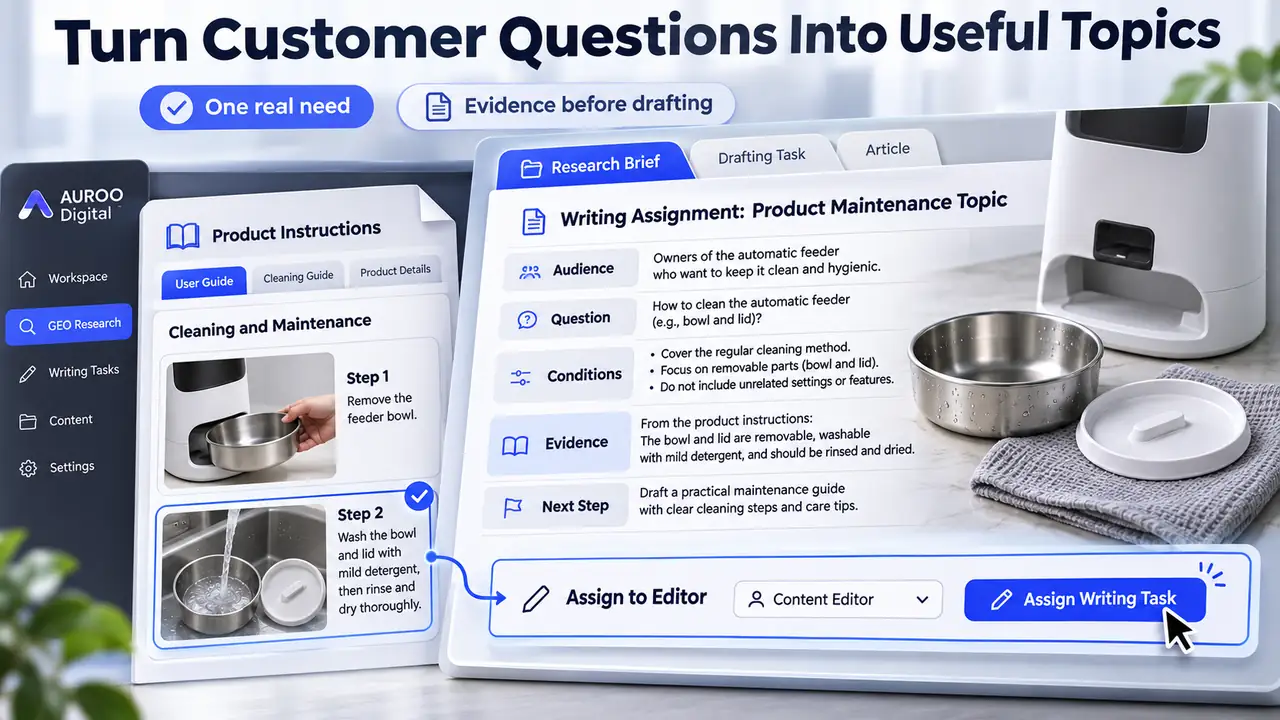
After collecting questions, specify the audience, main issue, necessary conditions, available materials, and reader’s next step for every topic. The team can then decide whether to create an article or supplement an existing page.
For example, “How should frequent travelers arrange meals for a cat?” requires considering trip duration, equipment reliability, water, and care arrangements. If brand materials cover only scheduled dispensing, narrow the topic rather than promising a product introduction can solve every care issue.
- Check the need: preserve the customer’s wording, confirm it comes from real communication, and distinguish purchase comparisons from operating faults.
- Check the evidence: list product instructions or validation records supporting the answer; send unsupported critical questions to relevant staff for verification first.
- Check the next step: explain which feature to compare, which instructions to read, or whom to ask about applicability.
After publication, compare follow-up customer service questions with the original topic. If readers still ask about covered issues, check answer discoverability; if new usage conditions arise, expand the original or add a section. AI tests can reveal omissions, but topic priorities should still reflect actual customer demand.