Content Marketing
Content Refresh and SEO: A Practical Guide to Updating Old Articles
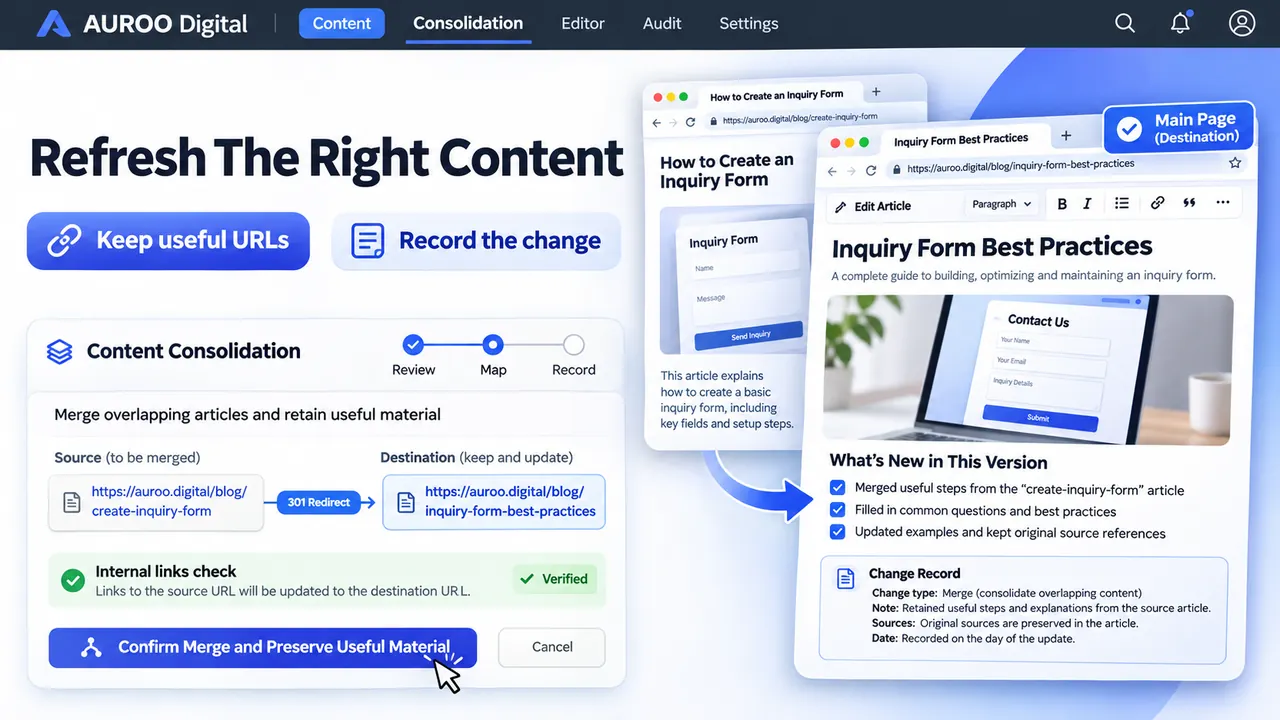
Content refresh and SEO work involves correcting outdated information, filling answer gaps and improving page structure while preserving useful existing content. When an old article loses traffic, distinguish changes in demand, technical issues and content problems before choosing to update, merge or retain it. Changing the publication date alone does not solve those problems.
Content marketing depends on maintaining useful assets. A guide that once generated inquiries may now describe discontinued features or invalid steps. Regular website content updates help keep the information reliable instead of making maintenance an emergency response to declining traffic.
Recognize content decay without overreacting
Content decay is a gradual loss of relevance, accuracy or performance. Lower traffic is one signal; declining inquiry quality, changing search needs and broken links are others. Use an observation period that fits the business cycle rather than treating short-term fluctuations as a lasting decline.
Compare impressions, clicks, important queries and business actions. Lower impressions may involve demand or visibility. Similar impressions with fewer clicks may reflect search presentation or competition. Stable visits with fewer inquiries require a closer look at intent and conversion paths. Average ranking is supporting evidence, not a complete diagnosis.
Rule out technical and seasonal causes first
Check whether the page opens normally, whether indexing restrictions were added accidentally, whether its canonical URL is appropriate, and whether important internal links work. If a whole section changes at once, investigate site-level issues before rewriting individual articles.
For holidays, events and seasonal buying topics, compare equivalent periods and longer trends. A decline after an unusual spike can simply mean demand has normalized. Invest substantial editing time when demand remains and a specific improvement opportunity exists.
Run a page-level Search Console diagnosis
Open the search results performance report and filter to the article URL. Compare equal-length periods while keeping search type, country and device definitions consistent, then inspect the query mix. CTR is clicks divided by impressions. Google Search Console performance report guidance
- Record page impressions, clicks and CTR; add year-over-year context for seasonal topics.
- Inspect whether established queries lost demand, new queries imply a different intent, or multiple pages answer the same need.
- Use URL Inspection to check indexing and the Google-selected canonical, alongside actual page accessibility.
- Check outdated facts, missing answers, mobile reading and working inquiry routes.
- Record the main hypothesis, planned changes and review date before editing.
Use the indexed-version information to inspect the Google-selected canonical. A live test checks the current page and cannot predict canonical selection. Google URL Inspection documentation
Connect observations with specific actions
The following figures are invented solely to demonstrate analysis. They are not customer results, normal-variation thresholds or industry benchmarks. Both periods cover 28 days; check seasonality, query composition and other changes before drawing conclusions.
| Metric | Earlier period | Later period | Further investigation |
|---|---|---|---|
| Impressions | 10,000 | 8,000 | Demand and visibility for the main queries |
| Clicks | 500 | 240 | Separate impression changes from CTR changes |
| CTR | 5% | 3% | Position and result presentation for comparable queries |
| Qualified inquiries | 8 | 3 | Small sample; inspect intent, form function and qualification rules |
Both impressions and CTR fall in this illustration. A title edit alone cannot establish that the issue is solved. If query composition is stable, inspect competing results and answer quality. If unrelated queries have expanded, reassess positioning first.
| Confirmed issue | Priority action | Verification record |
|---|---|---|
| Broken links or inquiry form | Repair the working journey | Before-and-after checks and date |
| Current demand but obsolete information | Refresh facts, steps and examples | Sources, change scope and comparable measures |
| Substantially overlapping pages | Select a main page and assess consolidation | URL mapping, internal links and redirects |
| Fundamentally changed demand | Reassess positioning before rewriting or retaining | Evidence of the new need and the decision rationale |
Prioritize old articles with business value
Start with articles connected to core services that previously attracted suitable customers, still answer a real need and contain identifiable gaps. Record business relevance, problem severity, improvement cost and the existing audience base to make prioritization consistent.
A guide to international website inquiry forms might deserve a refresh if it still receives relevant search exposure but lacks mobile examples. An article about a discontinued service needs a different decision: determine whether it retains historical value before adding an explanation or considering an appropriate replacement destination.
Decide whether to update, merge or rewrite
Update the existing page when its topic and audience need remain appropriate but facts, examples or steps are incomplete. Keeping the URL is often practical; revise the title and body, repair sources and internal links, and avoid unnecessary address changes.
Consider merging articles that answer the same question and substantially overlap. Select the main page, consolidate useful material, and use an appropriate redirect if a URL is retired. Update internal links. Sending every weak page to the homepage is not a meaningful consolidation strategy.
Rewrite when the article's purpose no longer fits the business or its explanation rests on obsolete assumptions. Before deleting a page, consider external links, historical uses and visitor needs. Low traffic alone is not sufficient grounds for removal.
Make refreshed content clear for readers and AI systems
Open with the question, intended audience and main answer. Keep important conditions close to conclusions, then explain steps and exceptions. Use search phrases such as how to update old blog posts where they fit the question; avoid repeating one keyword in every heading.
Check the source and date of prices, specifications, rules and research. A newly edited article should not present old evidence as current. Record actual substantive updates and preserve the original publication date. Clearer structure supports understanding but does not automatically produce rankings or AI citations.
Evaluate the refresh using a change record
Save the baseline and note exactly what changed. Allow an opportunity for recrawling, then observe relevant impressions, clicks, qualified inquiries and reader feedback. Record other changes such as campaigns, seasonal shifts or site redesigns.
Similar unedited pages can provide context for broader trends. If results do not improve, revisit intent and diagnosis. Avoid repeatedly changing several major factors together, which makes the outcome difficult to interpret.
Frequently asked questions
Can changing the date alone improve SEO?
A date change does not repair obsolete information or guarantee better rankings. The displayed date should reflect a real update to the content.
How often should old articles be reviewed?
Review frequency depends on how quickly the information changes. Product, price and rule-based content needs more frequent checks than stable methods. Review sooner when sources change or readers report a problem.