Content Marketing
How Content Marketing Supports Sustainable Business Growth
As digitalization permeates business, corporate marketing is undergoing a fundamental transformation. Traditional direct advertising, paid traffic, and offline selling deliver diminishing marginal returns. High advertising costs, fleeting exposure, passive reach, and very low conversion and retention rates have become growth bottlenecks for countless businesses. Micro, small, and medium enterprises in particular face limited budgets, low brand awareness, and narrow acquisition channels, becoming trapped in a cycle of “spending heavily for traffic, struggling to monetize it, and failing to generate repeat purchases.”
Meanwhile, content marketing’s low costs, lasting impact, engagement, and business value have elevated it from a supporting tactic to core growth infrastructure. The American Marketing Association (AMA) defines content marketing as a strategic approach centered on user needs: consistently creating and distributing valuable, audience-relevant content to build trust, shape brand perceptions, guide purchase decisions, and ultimately deliver sustainable commercial growth. Where traditional marketing broadcasts messages and pushes sales, content marketing builds mutual understanding and lasting value, fundamentally reshaping connections between businesses and users.
With widespread AI adoption and changing information habits, content marketing is no longer reserved for large enterprises. It is a broadly applicable solution for overcoming growth challenges across industries and company sizes. Consumer brands and B2B manufacturers, startups and mature businesses can all use a quality content system to strengthen branding, acquisition, conversion, retention, cost efficiency, and competitive defenses. This article examines commercial value, advantages, implementation, examples, mistakes, and trends to answer whether content marketing can improve business operations and growth.
1. What Content Marketing Means and Why It Matters Today
1.1 The Fundamental Difference Between Content Marketing and Traditional Marketing
Understanding commercial value begins with moving beyond the idea that content marketing simply means writing copy, filming videos, or promoting products. Traditional marketing follows a traffic-driven, sales-driven mindset: “pay for exposure, turn exposure into visitors, and hope visitors convert.” It essentially captures short-term traffic. Advertising, field promotions, pop-ups, and product placements push selling points at users regardless of their needs or willingness to listen, primarily seeking a quick, one-time transaction.
Content marketing follows a user-centered, asset-building mindset: “educate through value, retain through trust, and convert through brand preference.” Its essence is long-term asset accumulation. Rather than seeking immediate sales, it uses practical knowledge, industry insights, contextual solutions, brand stories, and customer cases to address problems, questions, and needs. Users voluntarily follow, recognize, and trust the brand, eventually purchasing, repurchasing, and referring others.
The differences span four dimensions. First, reach: traditional marketing pushes broadly, while content attracts the right audience. Second, relationships: traditional marketing centers on a one-time buyer-seller transaction, while content builds shared value and ongoing support. Third, longevity: paid exposure ends when spending stops, while content can be created once, reused, and attract traffic over time. Fourth, costs: traditional traffic has high marginal costs that rise annually, while content’s marginal costs decline and quality assets compound in value.
1.2 Why Content Marketing Is Indispensable in the Digital Era
Consumer decision-making has changed fundamentally. When information was scarce, users relied on advertising and sellers controlled information. In an age of overload and AI, users actively search, consult social platforms and AI answers, review industry content, compare brands, and verify credentials before deciding. According to Newrank’s 2026 AI Content Marketing Landscape Report, more than 85% of users proactively consult brand-related content, practical industry information, and reviews before purchasing; content quality directly affects brand choice and trust.
This shift makes content a core digital asset. Quality content is more than a communication medium: it provides infrastructure for credibility, sustained free traffic, brand preference, and competitive defenses. Products represent a company’s hard capabilities, while content represents its soft capabilities. The former determines retention; the latter determines attraction and differentiation. With functions, prices, and services converging across most industries, content becomes the only breakthrough point for differentiated brand competition and a central route to sustained low-cost growth.
2. Six Ways Content Marketing Supports Business Development
Content marketing does more than increase traffic. It improves the entire chain of branding, acquisition, conversion, retention, costs, and competitive defenses, systematically addressing operating problems and improving business results.
2.1 Shape Brand Perception and Build a Distinctive Identity
A brand’s core competitive strength is its share of consumers’ minds, and content is the vehicle for winning that share. Many businesses are trapped in price competition because they lack brand recognition: users can differentiate only by price, squeezing profits. Traditional promotion creates awareness of a name but does not necessarily make users remember or value it.
A structured content system can continually reshape perceptions, attach distinctive associations to a brand, and create a unique identity. Practical industry content establishes authority; brand stories convey humanity; customer cases demonstrate product value; contextual content addresses user needs. Users progress from knowing a brand to recognizing, trusting, and preferring it.
For example, Nongfu Spring moved beyond product selling points to publish content about nature, public welfare, and water sources, establishing associations with naturalness, health, and responsibility. Red Bull uses extreme sports and inspirational content to convey energy and determination. Their strengths extend beyond products to brand perceptions built through sustained content, supporting strong pricing power and loyalty in homogeneous markets. SMEs can also establish memorable identities and gradually challenge major brands through consistent quality content without large advertising budgets.
2.2 Reduce Acquisition Costs and Build Sustained Free Traffic
High acquisition costs and unstable traffic constrain profitability. Paid traffic is effectively rented: customers arrive during campaigns, but traffic disappears when spending stops. Intensifying competition drives bidding costs upward each year and lowers acquisition ROI. Businesses can appear to have healthy revenue while spending most profits on traffic, effectively working for platforms.
Content marketing builds owned traffic with a strong long tail and compounding value. Blog posts, reports, educational videos, answers, and guides remain online after publication, continuing to receive recommendations from search engines, AI answers, and social platforms and generating free, targeted traffic. Data indicates that quality content can attract visitors for 3-5 years. A single valuable industry article can generate more cumulative traffic than one paid campaign without further payment.
Content is also more targeted than broad traditional promotion. Material built around problems, industry keywords, and purchasing contexts attracts prospects with genuine, relevant needs and very little irrelevant traffic. Compared with broad paid exposure, these visitors are more qualified and motivated, reducing acquisition costs at their source and improving traffic utilization. Sustained content marketing can progressively reduce paid dependence, build an independently controlled acquisition system, and loosen platform constraints.
2.3 Improve Conversion and Shorten Decision Journeys
Purchasing is fundamentally a trust decision. Direct sales pitches put users on the defensive, creating high trust barriers and slow, difficult conversion. Content marketing puts value before transactions. Consistent useful material educates users, answers questions, resolves concerns, and gradually builds trust, allowing sales to follow naturally.
Content can serve each decision stage precisely. Educational material awakens needs among prospects; comparisons, reviews, and solutions help interested users evaluate alternatives and recognize advantages; cases and testimonials reassure hesitant buyers; after-sales guidance and tutorials improve customer experience. Comprehensive coverage substantially shortens decision cycles and improves overall conversion.
This is particularly important in B2B, where decisions take longer, involve more stakeholders, and require greater trust. Direct advertising rarely converts on its own, while professional white papers, solutions, implementation cases, and technical education establish authority and persuade procurement decision-makers. Research indicates that B2B companies practicing content marketing achieve conversion rates over 40% higher than traditional marketing models and shorten sales cycles by an average of 35%.
2.4 Strengthen Retention and Build Owned Audiences with High Repeat Purchasing
The central growth principle is that retention matters more than acquisition: acquisition drives short-term growth, while retention supports long-term profit. Businesses that focus only on the front end and neglect customer care produce one-time purchases and high churn. Continual acquisition followed by continual loss results in low customer lifetime value.
Content marketing is an effective way to maintain relationships and engagement. Buying guides, usage tips, industry developments, and exclusive benefits continue delivering value after purchase, so customers feel supported rather than abandoned. Long-term content support makes the brand feel less like a seller and more like a valuable partner, strengthening goodwill and loyalty.
Content also attracts and activates owned audiences. Useful resources, exclusive reports, and quality courses can move interested users from public platforms into owned communities and WeCom. Regular content then maintains contact, uncovers latent needs, and generates repurchases, additional purchases, and referrals. A complete content operating cycle turns awareness into actual sales and maximizes customer value.
2.5 Adapt to AI and Capture Emerging Traffic Opportunities
In 2026, generative AI is taking over the user decision journey. Instead of browsing search results individually, users obtain authoritative answers, compare brands, and select solutions through AI. This change has created a new content marketing field—generative engine optimization (GEO)—in which quality content underpins AI traffic distribution.
AI platforms depend on high-quality information available online. Consistent professional, compliant, precise industry content can be crawled, indexed, and integrated by AI. When relevant questions arise, brand information can be prioritized in answers, creating sustained free exposure. Compared with traditional SEO, GEO content marketing offers lower competitive barriers, more targeted traffic, and longer-lasting value, helping businesses capture new opportunities and build digital marketing defenses. Investing in AI content marketing means investing in core traffic resources for the next 3-5 years.
2.6 Build Competitive Defenses and Sustainable Compounding Growth
Competitors can quickly copy products, prices, and channels, but cannot readily reproduce content systems, brand perceptions, and trust built over time. Advantages based on discounts, promotions, and temporary channel opportunities disappear when those opportunities end, causing performance to decline. Content marketing instead builds enduring, stable, sustainable defenses.
As content accumulates, companies gain extensive digital assets, stable exposure, mature brand recognition, and loyal audiences. This creates a flywheel: content attracts traffic—trust accumulates—sales convert—customers repurchase and refer—more content is created. More content stabilizes exposure, strengthens trust, and improves results, ultimately enabling steady acquisition and profit without intensive advertising. This explains why leading brands can remain ahead, withstand market fluctuations, and resist competitors.
3. Main Content Marketing Formats and Implementation Strategies
Content marketing is a systematic, multichannel operation using multiple formats. Businesses must choose formats suited to their sector, audience, and objectives and establish standardized operations to realize commercial value and avoid unfocused, ineffective production.
3.1 Main Formats and Suitable Uses
Business content marketing spans text and images, video, audio, documents, and livestreams. Different formats suit different sectors and situations:
First, written and visual content, including WeChat Official Account articles, Zhihu answers, Xiaohongshu posts, industry blogs, website news, and sponsored editorial. Easy to produce and index, it works well with search and AI crawling and forms a basic content presence. It suits education, insights, product explanations, cases, and brand stories across sectors, especially professional services, manufacturing, and technology B2B brands seeking authority.
Second, short video, including Douyin, WeChat Channels, Kuaishou, and Bilibili. Its visual impact, rapid distribution, and broad reach suit contextual demonstrations, practical product use, reviews, behind-the-scenes brand content, and education. It works well for consumer goods, beauty, home products, education, and local services, quickly improving exposure and public awareness.
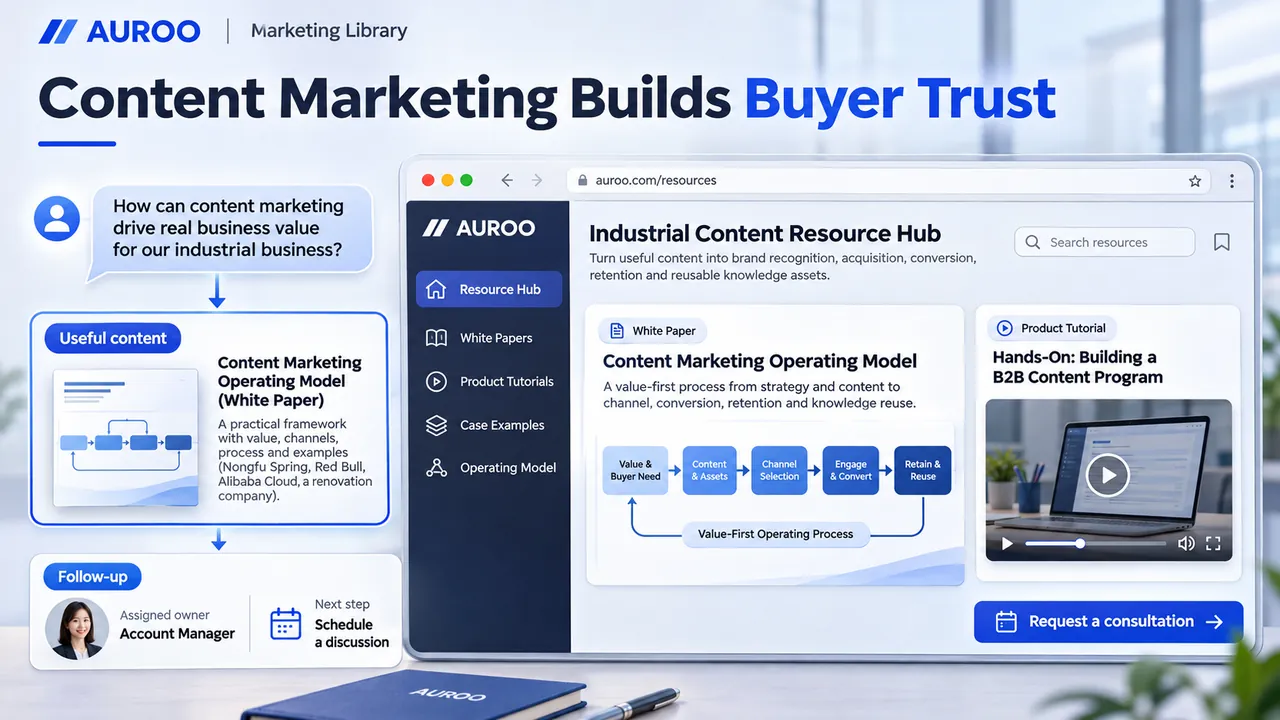
Third, professional documents, including white papers, research reports, practical manuals, solution PDFs, and course materials. Their expertise, information density, and precise audiences make them central to B2B acquisition, owned audience development, and authority building. They efficiently identify high-intent prospects and improve conversion among premium clients.
Fourth, livestreams and long-form video, including industry broadcasts, open courses, product explanation streams, and documentary brand videos. They suit in-depth value, live questions and answers, and credibility building, quickly strengthening relationships and trust for high-value products and services requiring considered decisions.
3.2 Core Implementation Strategies
Many businesses underperform because they create fragmented content without a system, precise positioning, or links to commercial objectives. To make content drive growth, implement standardized strategies:
First, define users precisely and match their needs. User value comes before self-promotion. Map audience profiles, problems, needs, search habits, and decision barriers, then build topics around them. Avoid self-indulgent content. Every piece should solve a specific problem by providing useful knowledge, a solution, or emotional value, making it appealing, understandable, and rewarding.
Second, unify brand personality and memorable associations. Maintain consistent style, tone, values, and brand identifiers across content. Written and video material should reflect core strengths and character. Repeated, consistent publication strengthens memory so users associate relevant subjects with the brand, creating a distinctive perception.
Third, distribute across channels to maximize exposure. A single platform offers limited reach. Publish quality material across the company website, search, social media, short video, industry media, and AI content platforms, creating once and gaining exposure and traffic everywhere. Combine SEO and GEO techniques to improve visibility in search results and AI answers and obtain free targeted traffic.
Fourth, complete the content cycle to monetize traffic. A full system covers attraction, audience capture, conversion, and repurchase. Free practical content attracts public-platform traffic; exclusive resources and deeper content bring users into owned channels; cases, solutions, and reviews guide purchases; regular content maintains existing relationships. This complete commercial cycle turns traffic into results.
Fifth, iterate continuously using data. Regularly track exposure, reads, shares, traffic generated, inquiries, and conversion rates. Identify valuable topics and formats, retire ineffective content, and continually improve quality and strategy so performance rises steadily.
4. Successful Content Marketing Examples
Large brands and SMEs alike can achieve breakthroughs through systematic content. The following examples across different fields illustrate its business value.
4.1 Consumer Brand: Nongfu Spring—Content Builds a Brand Premium
Drinking water is highly homogeneous, leaving many brands in low-price competition with thin margins. Nongfu Spring used intensive content marketing to break through price barriers and establish a substantial premium. It rarely relies on direct product advertising, instead consistently publishing around nature, ecology, health, and responsibility. Water-source documentaries, nature education, public welfare initiatives, and brand stories communicate natural origins, quality commitments, and social responsibility.
These materials do not directly sell products but continually reshape perceptions, closely associating Nongfu Spring with naturalness, quality, and reliability. Trust built through content gives it stronger pricing power and loyalty than low-cost alternatives, maintaining a leading market share. Its success comes from replacing direct ads with content and product pushing with shared value, growing both brand equity and business performance.
4.2 B2B Brand: Alibaba Cloud—Professional Content Builds Industry Defenses
Cloud computing involves technically demanding decisions, and simple sales pitches cannot persuade corporate buyers. Alibaba Cloud has invested in content marketing for years, building a comprehensive system of digital transformation white papers, cloud education, enterprise implementation cases, industry solutions, and public technical courses.
Extensive professional content establishes authority and gives businesses in different sectors free digital transformation references, addressing their problems and questions. Decision-makers use it to understand trends, learn technology, and examine implementation, gradually trusting Alibaba Cloud and choosing its services. Content marketing has helped it move beyond price competition, maintain a leading position in China’s cloud sector, accumulate influence, and build formidable industry defenses.
4.3 SME Example: A Local Renovation Business—Low-Cost Growth
Small local renovation companies have limited budgets and awareness and cannot match national chains’ advertising. One local business abandoned field promotions, flyers, and paid campaigns to focus on local needs. On short video platforms, local communities, and Zhihu city sections, it consistently published local floor-plan redesigns, renovation pitfalls, budgeting advice, real construction cases, and before-and-after finished projects.
Authentic, practical, accessible content precisely addressed local homeowners’ problems and quickly attracted attention. Free guidance generated inquiries; real cases resolved concerns; owned-channel content supported follow-up. Within one year, without major advertising spending, inquiries and conversion rates doubled, outpacing local competitors. This example demonstrates content marketing as an effective route for SMEs to overcome competition cheaply and achieve targeted growth.
5. Common Content Marketing Mistakes and How to Avoid Them
Content marketing offers substantial value, but results are not automatic. Many businesses fall into ineffective routines and waste effort. Avoiding the following mistakes is essential to effective content and sales growth.
5.1 Mistake One: Prioritizing Exposure Over Value and Creating Self-Indulgent Content
Many businesses chase output and exposure, publishing in bulk daily while ignoring quality and user value. Product introductions, corporate publicity, and promotional announcements can become empty and repetitive, offering nothing useful. Such material fails to attract interest or build trust and can damage reputation. Value must come first: only consistent useful content can build an audience and accumulate trust.
5.2 Mistake Two: Seeking Quick Returns and Immediate Monetization
Some companies equate content marketing with livestream or short-video selling, expect immediate transactions, and abandon it when short-term results disappoint. Content marketing is a long-term undertaking whose value lies in branding, trust, and sustained acquisition, rather than instant paid-ad-style returns. Its initial impact may be slower, but its compounding value, cost advantages, and competitive defenses exceed short campaigns. Impatience and quitting early are major causes of failure.
5.3 Mistake Three: Disorganized Content Without Positioning or a System
Unplanned companies post products one day, motivational messages the next, and industry news after that. Inconsistent styles and topics lack unified positioning or structure. Fragmented, illogical content cannot create memorable associations, build brand preference, or establish a growth flywheel. Plan a framework in advance and consistently publish focused, precise, systematic material around core strengths and user needs.
5.4 Mistake Four: Distributing Without Managing Users or Conversion
Some companies focus only on production and distribution, neglecting audience management, traffic capture, and sales follow-up. Exposure and inquiries go to waste without responsible staff or a clear conversion path. Commercial growth is the goal, so a complete operating cycle must capture traffic, maintain users, convert inquiries, and activate repeat purchases to turn content value into business value.
6. Future Content Marketing Trends in the AI Era
As AI and big data develop, content marketing is changing again. It will become more specialized, intelligent, precise, and asset-focused, forming a strategic core business function.
First, AI will support the entire content lifecycle: creation, topic optimization, distribution, analytics, and audience matching. This will lower production barriers and operating costs while improving precision and efficiency. GEO will also replace traditional SEO as the central acquisition field, with quality content suited to AI answers capturing mainstream traffic entry points.
Second, specialized content will become a core competitive strength. In an oversupplied market, shallow, repetitive general material will cease to work. Content with industry depth, professional value, exclusive insights, and real implementation will drive differentiation. Expertise will determine traffic attraction and monetization.
Finally, content will become fully strategic and asset-based. Rather than supporting marketing, it will be a core digital asset. Systematic libraries and continual accumulation will build defenses in brand perception, traffic, and audiences, producing sustainable compounding growth. Content marketing will become a central long-term strategic investment.
7. Conclusion: Content Is the Answer to Long-Term Growth
Can content marketing improve business operations and development? Yes. In the digital and AI era, it has moved from an optional tactic to a requirement for survival and growth.
Traditional marketing advantages are fading. Paid traffic is costly, short-lived, and easily replicated, limiting its ability to support stable long-term growth. Content marketing centers on user value, establishes trust through expertise, replaces short campaigns with lasting traffic, and builds competitive defenses through brand preference. It addresses branding, acquisition, conversion, retention, costs, and differentiation together. For major businesses strengthening brands and defenses, or SMEs seeking affordable growth and targeted prospects, it offers excellent value, durability, and stability.
Content marketing’s appeal lies in long-term compounding rather than a brief traffic surge. Every quality article is a digital business card; every useful contribution deepens brand perception; every accumulated asset strengthens resilience and continued growth. As traffic opportunities shrink and competition intensifies, businesses must invest in content, build value, and nurture users to escape destructive price competition, reduce traffic dependence, and achieve sustainable, high-quality long-term development.