Content Marketing
B2B Content Marketing Lead Generation: From Readers to Inquiries
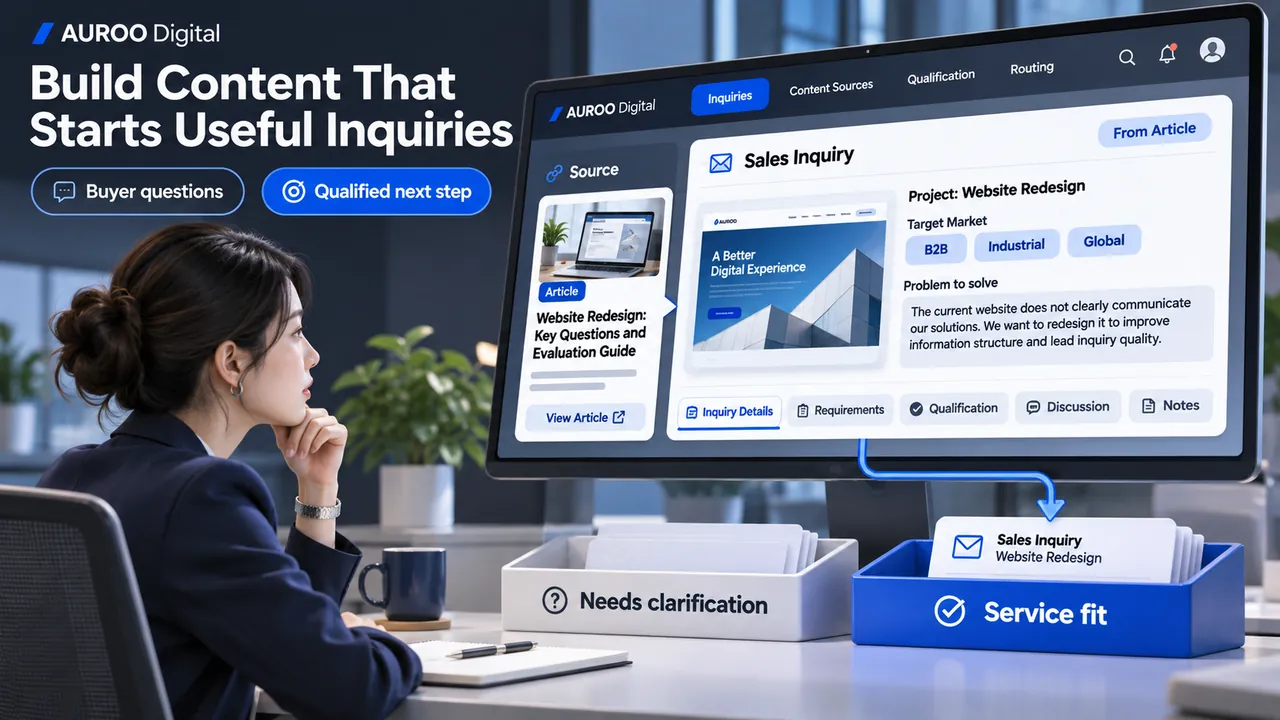
B2B content marketing lead generation uses useful information to help buyers understand a problem, compare approaches and take a suitable next step. Article views do not automatically become qualified inquiries. The topic, evidence, resource offer and sales follow-up must address the same customer need, and results should be judged by lead quality.
When a company publishes regularly but cannot connect content with sales, its topics may be too far from buying decisions. Alternatively, interested readers may lack a useful next step. Improving content conversion starts with understanding why a particular buyer needs the article.
Define a qualified inquiry before counting leads
Qualification should reflect the customers and projects the business can serve. A company providing websites for international businesses might consider target markets, requirement type, timing and project fit instead of counting email addresses alone.
Marketing and sales should agree on the criteria and retain a category for suitable but early-stage prospects. Research-stage buyers may need more information before they have a budget. Record why unsuitable inquiries do not fit so the content team can improve targeting.
Organize content around purchasing questions
At the problem-awareness stage, buyers need to assess their situation and understand risks. During comparison, they need differences between approaches, implementation conditions and cost components. Near supplier contact, they need delivery details, responsibilities and preparation requirements.
For example, one article can explain why overseas visitors do not submit inquiry forms; another can compare inquiry routes; a preparation checklist can help someone brief a website redesign. Link these resources where relevant, while ensuring each page answers its own question independently.
Follow one website redesign journey from question to inquiry
Hypothetical example: an exporter receives website visits but incomplete requirements. The buyer is deciding whether a redesign is necessary. Content should help clarify that decision instead of pushing an immediate purchase.
| Buyer question | Useful content | Main next step |
|---|---|---|
| Why does traffic fail to produce suitable inquiries? | Explain traffic fit, information gaps, form friction and follow-up | Use a public self-check |
| Redesign or improve existing pages? | Compare conditions and required evidence | List unresolved questions |
| What should we prepare for a supplier discussion? | Show markets, languages, pages and inquiry-flow requirements | Submit necessary details for a requirements discussion |
| Does the provider understand our situation? | Show an analysis example, scope and acceptance method | Agree the next assessment step |
A copyable website redesign requirements checklist
- Business objective and the type of inquiry that matters.
- Priority markets, language versions and use cases.
- Current website, important pages and materials to retain.
- Entry routes, form recipients and sales follow-up process.
- Expected start, internal contact and known constraints.
An offer to obtain a checklist needs a real checklist behind it. If a downloadable resource is unavailable, publish the checklist in the article for readers to copy rather than creating an empty download promise.
| Form field | Suggested approach | Purpose |
|---|---|---|
| Name and work email | Collect usable contact details and explain their purpose | Respond to the requirement |
| Website or business description | Allow a short description if no site exists | Understand the project context |
| Problem to solve | Request a brief description | Assess service fit |
| Markets and timing | Optional initially or clarified later | Support planning |
| Marketing subscription | Keep separate from the inquiry and make it a choice | Do not infer subscription from contact |
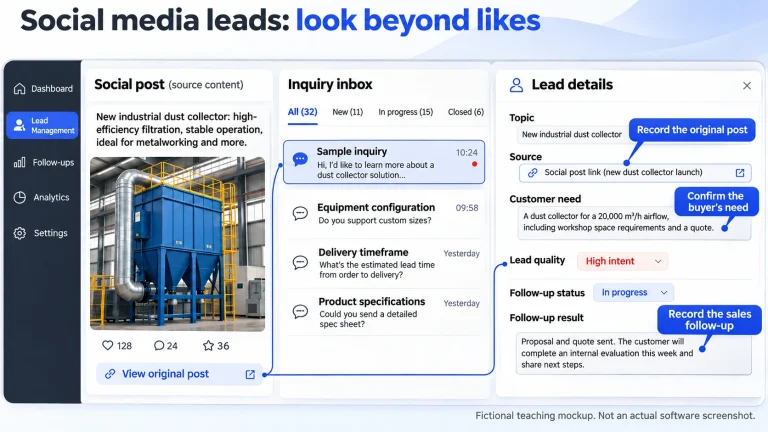
Use one shared qualification record
| Dimension | Illustrative note | Next action |
|---|---|---|
| Service fit | An actual international website requirement | Clarify the scope |
| Problem clarity | A language, page or inquiry-quality problem can be described | Request relevant materials |
| Readiness | An internal contact exists; timing remains uncertain | Agree follow-up or useful resources |
| Mismatch | Job applications, unrelated selling or out-of-scope needs | Classify separately from business inquiries |
These are discussion criteria, not an automated score. An unconfirmed budget does not automatically invalidate a suitable requirement.
Provide evidence that supports a decision
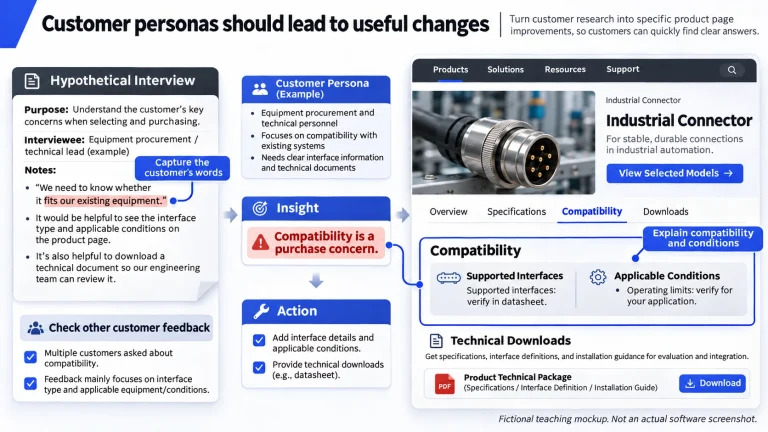
Explain the basis for claims rather than saying that a service works. Useful evidence can include appropriately anonymized analysis, process explanations, deliverable samples and real cases with relevant conditions. Do not present unverified figures or unauthorized customer information as results.
For example, compare a form that asks only for contact details with a page that first explains which project information to prepare. The demonstration clarifies the design logic; actual conversion outcomes still require evidence.
Match the next step to the reader's stage
An introductory article might offer a self-check, a comparison guide might provide an evaluation worksheet, and a purchasing-stage article might invite a requirements discussion. Prioritize one main action so the reader understands what happens next.
Make the offer specific. A website redesign requirements checklist that organizes target markets, language versions and existing pages is clearer than a vague promise of professional resources. Keep basic answers public and offer supplementary tools for readers who need more help organizing a decision.
Remove unnecessary friction from inquiry forms
Collect information needed to deliver the resource and assess the initial requirement. Asking for an address, annual revenue and a complete procurement plan to download an introductory checklist may discourage readers or produce unreliable entries. Gather further details during a relevant conversation.
Explain how submitted details will be used, what contact to expect and whether subscription is optional. Provide a clear confirmation and resource access after submission. Test mobile input and error messages, and make the content source understandable to the person following up.
Continue helping through lead nurturing
Follow-up should extend the reader's original question. Someone downloading a redesign checklist could receive requirements guidance and a comparison article rather than unrelated high-frequency promotions.
Use recurring sales questions to improve the relevant resources. Make opting out straightforward. The aim is to advance appropriate business conversations, not force every downloader into an immediate purchase.
Measure content conversion and lead quality separately
Track visits to the next relevant page, resource requests, qualified inquiries and projects entering further evaluation. As a calculation example, 8 qualified inquiries out of 20 total inquiries equals a 40% qualified-inquiry rate. This is an illustration, not an industry benchmark.
State the reporting period and attribution method. A customer may encounter search, social posts and referrals before contacting the business. Reading one article does not prove that it independently caused a sale.
Frequently asked questions
How long does content marketing take to generate inquiries?
Timing depends on demand, the existing audience, buying cycles and distribution. First verify relevant readership and meaningful actions, then evaluate progress using the business's own data.
Should every resource require a form?
No. Make basic explanations accessible. A template or individualized evaluation with clear additional value may justify an appropriate form. Decide according to user value and business needs rather than maximizing contact counts.