Content Marketing
AI-Personalized Content Marketing That Builds Customer Trust
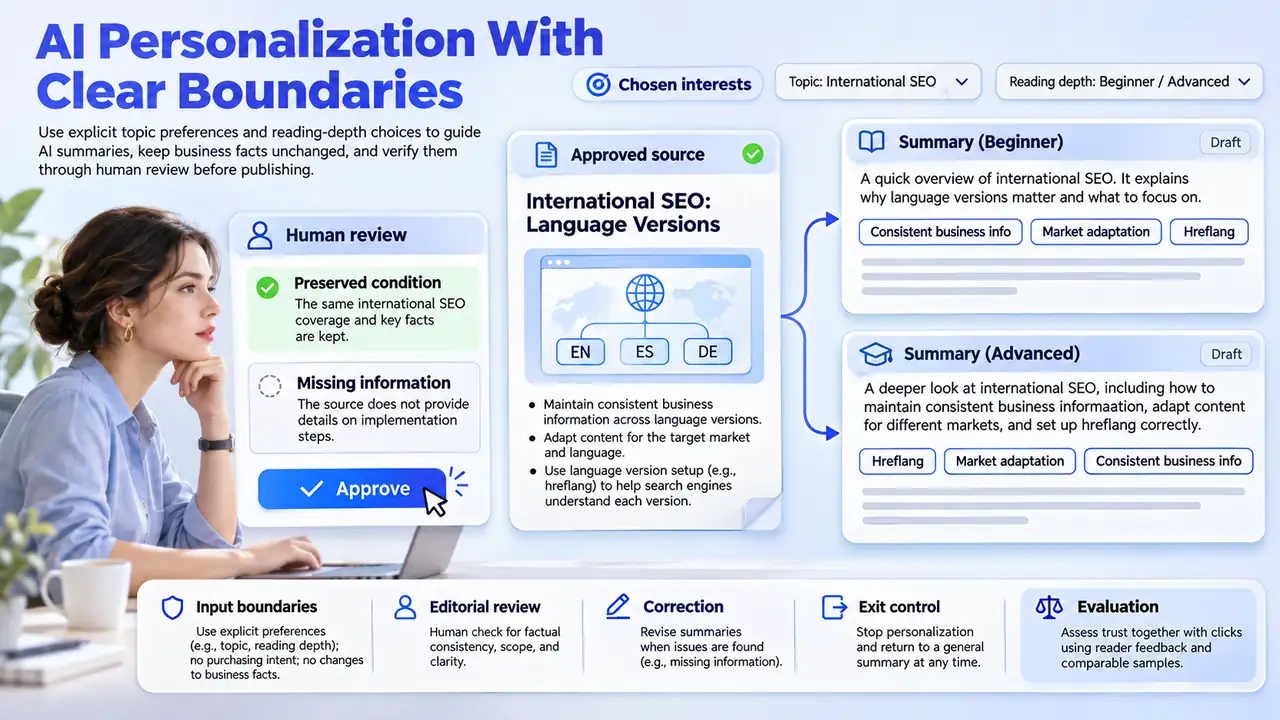
AI-personalized content marketing uses artificial intelligence to adapt topics, order or presentation according to expressed needs or appropriately used interaction information. Customer trust depends on understandable recommendations, editable preferences and a clear distinction between model predictions and confirmed facts. Personalization should help people find useful information.
Interest in international websites does not prove someone has decided to buy. Downloading one resource does not mean a reader wants every marketing message. Separate declared preferences, observed actions and inferred interests when designing a personalized content strategy.
Start with preferences people choose themselves
For many teams, explicit topic selection is easier to explain and maintain than a complex profile. A subscription form might offer international websites, SEO and content marketing, or advertising, then send materials connected to the selected topic.
Let readers choose language, region or frequency where relevant. Keep the options manageable and allow later changes. People who do not select preferences can receive general content instead of being assigned a guessed identity or purchasing stage.
Collect information needed for a clear purpose
For every additional field, explain the experience it will improve. If location helps show appropriate service information, make that use clear. If personal information has no role in the recommendation, there is little reason to collect it simply to complete a profile.
Specific data-processing requirements depend on the business and its markets. Operationally, document sources, access permissions, retention and service-provider arrangements. Information the team can obtain is not automatically information it should submit to an AI tool.
Make the reason for a recommendation understandable
Recommended because you selected SEO is clearer than we know what you need. Explain the main basis for recommendations without exposing irrelevant internal system details, and show how readers can change their preferences.
Avoid stating an unconfirmed inference as fact, such as you are replacing your supplier. A conditional introduction—if you are comparing suppliers, this checklist may help—provides similar information without making an unsupported claim about the reader.
Choose suitable AI personalization tasks
AI can help organize selected interests, prepare summaries at different levels of detail or suggest alternative introductions to the same guide. A beginner may need definitions, while an experienced operator may want diagnostic steps first.
Keep core facts, service scope and commitments consistent. Different versions can change the example or presentation order, but must not invent project results, discounts or guarantees. Product and commercial information should remain grounded in verifiable records.
Separate inputs, generation, outputs and review
Continue the hypothetical reader-selected international SEO scenario. With a small subscriber list and only a few topics, manual groups may be sufficient. Consider AI when maintaining different reading-depth versions creates an actual workload.
| Stage | Illustrative action | Boundary |
|---|---|---|
| Input | Chosen topic and reading depth; approved public article text | Exclude email addresses, private customer material and guessed buying intent |
| Generation | Produce beginner or advanced summaries from the same facts | Do not invent figures, results, prices or commitments |
| Output | Define terms first for beginners; lead with diagnosis for experienced readers | Change order without changing facts, conditions or destinations |
| Review | Compare claims, limitations and next steps with the approved original | Revise failures or use the general version |
| Feedback | Allow preference changes, reduced frequency or exit | Apply those choices to later messages |
An adaptable brief for an AI summary
Example brief: Use only the approved article below to summarize international SEO for a subscriber who selected a beginner reading level. Explain the relationship between markets and language versions, then list preparation materials. Preserve conditions. Do not infer budget, supplier relationships or buying stage. List missing information instead of inventing facts.
Only provide material the team has confirmed is appropriate for the tool. The brief does not replace review of data-processing arrangements, and instructions do not guarantee compliant output. Human checking remains necessary.
Adapt depth while keeping the facts consistent
| Shared fact | Beginner presentation | Advanced presentation |
|---|---|---|
| Confirm target markets and service capability before language planning | Explain that countries and languages are different, then list planning inputs | Review existing URLs, markets and language coverage before listing gaps |
| Business information must remain accurate across languages | Use a product name or delivery condition to explain translation checks | Check versions, units, service boundaries and update responsibilities |
These are presentation examples, not personal profiles or changed commercial conditions. Pilot one topic with a few versions, then record comprehension, corrections and actual maintenance time before expanding.
Design controls for incorrect recommendations
Readers should be able to reduce messages, change interests or leave personalized recommendations. Provide usable unsubscribe and preference links in email and a route back to general content on the website. Check that downstream systems respect those choices.
When a reader reports an error, correct the preference or recommendation rather than sending more content based on the same inference. A correction record can reveal classification rules that repeatedly misunderstand customer needs.
Review the experience through a realistic scenario
Consider this hypothetical example: a reader selects international SEO and downloads a multilingual website checklist. Suitable follow-up could cover language planning, translation review and implementation preparation. It would be inappropriate to claim, without confirmation, that their current agency is performing badly or that the download proves a purchase decision.
Ask three questions during review. Can readers understand why they received the material? Does it help with their chosen topic? Can they easily correct an inaccurate inference? These checks are more useful than producing additional recommendation variants without a clear need.
Evaluate trust alongside clicks and inquiries
Track unsubscribes, complaints, preference changes and reported recommendation errors as well as engagement. More clicks may reflect a provocative headline rather than stronger trust. Interviews or brief feedback can help determine whether recommendations feel relevant and comfortable.
Where appropriate data is available, compare personalized and general versions and report the sample, observation period and other changes. A short-term improvement does not establish higher customer loyalty.
Frequently asked questions
Does a small business need a sophisticated AI recommendation system?
No. Start with topic subscriptions, simple classification and clear preference management. Add AI when it can solve an actual workload or reading-experience problem.
Is more precise personalization always better?
No. Relevance, an appropriate information basis and user choice also matter. Conditional recommendations are more reliable than overconfident assumptions about needs the customer has not confirmed.