Content Marketing
AI Content Marketing: Fact-Checking and Transparency
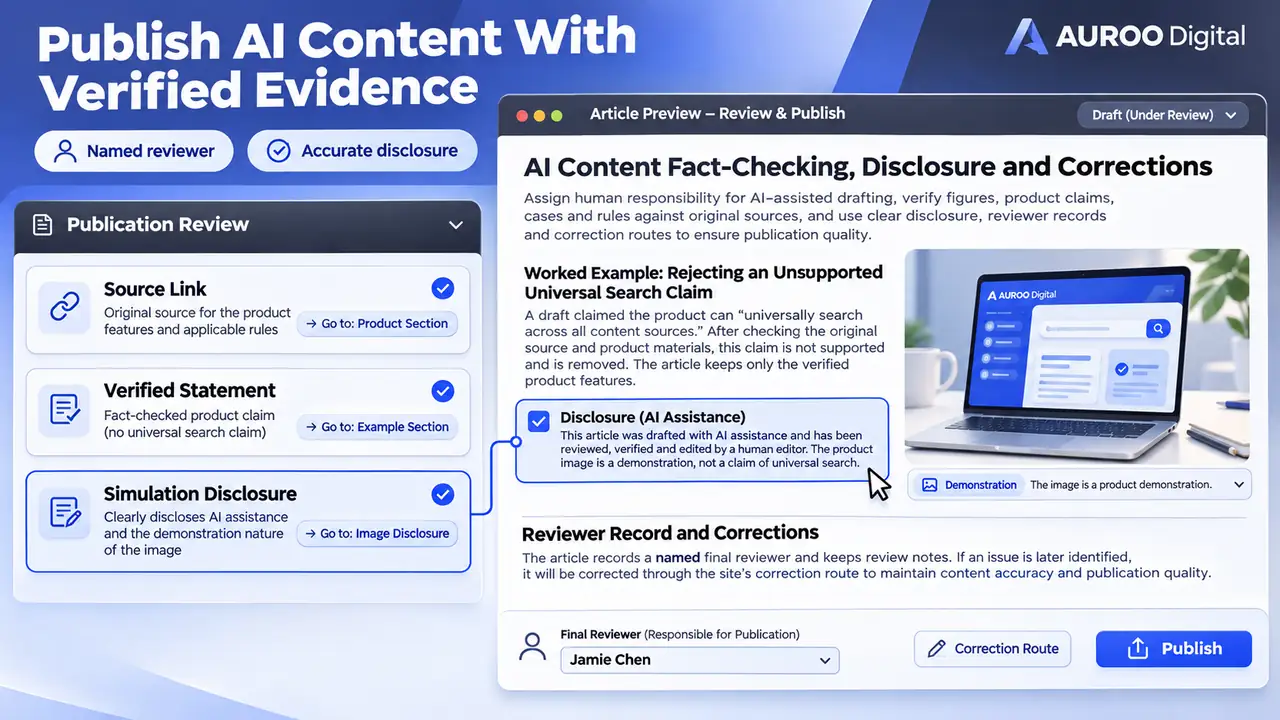
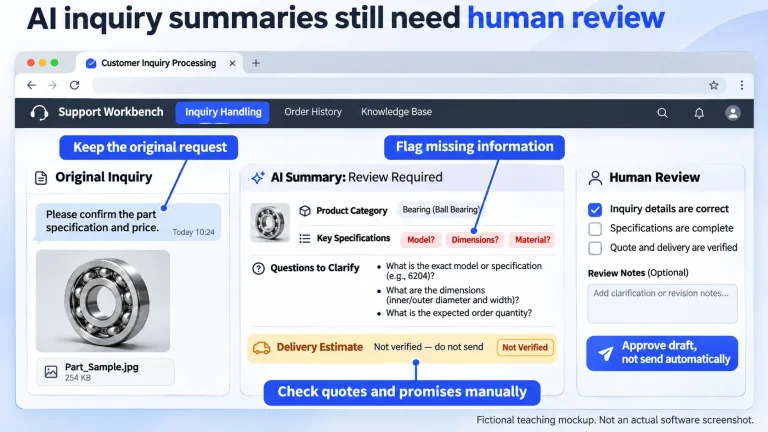
Transparency in AI content marketing helps readers understand who is responsible for the material, what supports key facts and whether AI involvement affects how the information should be interpreted. When AI helps draft an article, an identifiable editor should verify facts, cases and references and explain relevant AI involvement where appropriate. Generated text is not evidence.
AI can organize research and produce drafts, but it can also turn speculation into facts, confuse product information or invent sources. When content affects customer decisions and business promises, readable language needs traceable information behind it.
Define which editorial tasks involve AI
Separate topic research, outlining, language editing, factual explanations and case writing. Different uses require different checks: editing should preserve the intended meaning; product descriptions need verified capabilities and limitations; customer cases require reliable records and permission.
Maintain an internal record of the source material, the parts AI helped produce and the final reviewer. The entire process does not need to appear publicly, but the team should be able to trace a statement when a question or correction arises.
Verify content facts against original sources
Identify figures, quotations, product claims and statements about rules. Open the sources and check them individually. A real source is not enough: it must support the exact conclusion, cover the right population and time period, and remain applicable.
A survey of respondents in one market cannot automatically describe all consumers. If a figure cannot be verified, remove it or replace it with a supported qualitative explanation. Do not ask AI for another plausible percentage to fill the gap.
Keep cases and testimonials from becoming misleading
Verify the project background, the work actually performed and how results were measured. If there is no suitable public case, use an explicitly hypothetical example to explain the method. Do not invent customer names, personal quotations or growth outcomes.
Readers should also understand when images, scenarios or conversations are simulated. Where a demonstration could reasonably be mistaken for evidence of a real project, explain its nature beside the material rather than hiding the explanation at the bottom of the page.
Work through a fact-checking example
Suppose a draft states: Google demotes every AI-generated article, so businesses must say that all writing was done by humans. This is a hypothetical editorial error, not a claim about how often models make mistakes. Separate the two assertions before reviewing them.
| Review step | Action | Decision |
|---|---|---|
| Separate claims | Check the universal ranking claim and the disclosure requirement independently | Each needs its own support |
| Consult the original guidance | Read Google Search Central on generative AI content | Identify its discussion of accuracy, quality, relevance and abuse |
| Check scope | Look for support for every and must | Remove unsupported absolute statements |
| Rewrite and review | Explain quality responsibility and describe the real production process | Retain the source and obtain editorial confirmation |
A better statement is: AI-assisted content still needs checks for accuracy, quality and relevance, and any explanation of production should match the work actually performed. Do not invent human review to make an article appear credible. This is editorial guidance, not a prediction of rankings. Google guidance on generative AI content
Use a publication review checklist with named responsibilities
| Material | Record to retain | Suggested reviewer |
|---|---|---|
| Numbers and research | Original URL, date, sample and scope | Editor |
| Products and service promises | Approved documentation and confirmed conditions | Business owner |
| Cases and testimonials | Project evidence and publication permission; label demonstrations | Project owner and editor |
| Images and simulations | Nature of the asset, usage basis and necessary explanation | Content owner |
| AI disclosure | Actual AI tasks and completed review steps | Final editor |
| Corrections | Affected pages, changes, date and owner | Article owner |
Add passed, unresolved and not applicable columns when using the checklist. An unresolved factual claim needs evidence, qualification or removal; a generic disclaimer is not a substitute. Record completed work rather than adding decorative trust labels.
Disclose AI involvement accurately
Whether and how to disclose AI use depends on applicable requirements, platform rules and how readers would reasonably interpret the material. Operationally, use a clear statement that describes the actual process. A generic AI label does not transfer responsibility for quality.
For an article that genuinely followed this process, a statement could read: AI assisted with the initial draft; an editor checked sources and revised the article. Do not use that wording if the source review never happened. Identify hypothetical scenarios directly where they appear. Disclosure should match what the team actually did.
Build a practical AI-generated content review workflow
First, define the reader's need and provide the source material, limiting factual claims to what can be supported. Second, separate facts, interpretations and recommendations and keep their conditions clear. Third, ask a knowledgeable business owner to review products, delivery terms and commercial commitments.
Fourth, have an editor check sources, titles, image descriptions and next-step links. After publication, maintain a correction route and update substantive errors promptly. Where necessary, explain the correction. Responsibility belongs to an identifiable author or editorial team, not a tool name.
Write answers that preserve meaning when extracted
Keep the subject, conclusion and conditions together. For example, a small team without complex recommendation needs can start with topic subscriptions is more independently understandable than this is the best method.
Place relevant references near the claims they support. Use real author information, accurate dates and accessible links when publishing. Clear structure and sources help people assess the material, but they do not guarantee AI citations or replace checks that the website can be accessed and crawled.
Frequently asked questions
Does an AI-generated label remove the need for human review?
No. Disclosure explains production; review checks information. The published material still affects how customers judge the business.
Can an AI rewrite of another website's article be published directly?
A rewrite is not independent research. Verify facts, retain appropriate attribution, develop your own problem structure and analysis, and check that source and asset use is appropriate. Replacing wording alone adds little reader value.
What should happen when an article contains an error?
Correct the original and affected derivative materials, assess the scope and inform the responsible people. For changes that materially affect a reader's judgment, retain an appropriate correction explanation.