GEO
AI-Citable Content: Clear Subjects, Conditions and Evidence
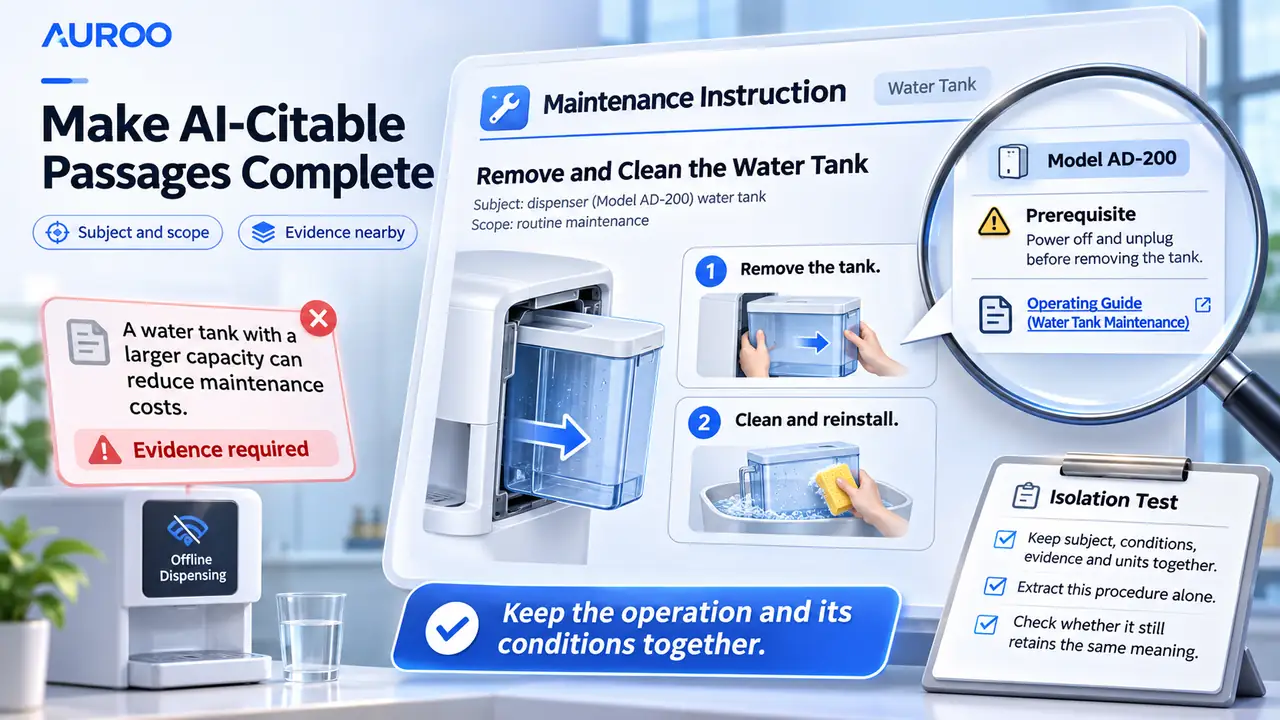
Key takeaways
- Make key definitions, steps, and comparison conclusions understandable independently.
- Keep subjects, evidence, units, and applicable conditions close together.
- Extract sections for review to reduce misunderstandings outside their context.
An independently understandable passage identifies its subject, conclusion, conditions and evidence. Avoid references such as “the method above” that become unclear outside the surrounding text. Read key passages in isolation and check numbers and limitations. Clearer writing supports understanding but does not guarantee AI citation.
To apply this approach to your website or marketing project, explore AUROO Digital’s generative engine optimization services, with scope, deliverables and review methods agreed around your needs.
For material that may be cited in search results, AI answers, or customer service replies, independently understandable passages are an important GEO content check.
In generative search, AI answers may cite only part of an article. Building each section around a clear question reduces dependence on preceding text.
Users jumping into the middle, colleagues placing an excerpt in a proposal, and customer service staff copying instructions all need the subject, conclusion, and conditions. Omitting any one can change the intended meaning.
Key passages suitable for independent AI citation are typically definitions, sets of instructions, or conditional comparisons. GEO editors should prioritize these units rather than turning every paragraph into a miniature article repeating the brand introduction.
Clarify the subject and basis for the judgment
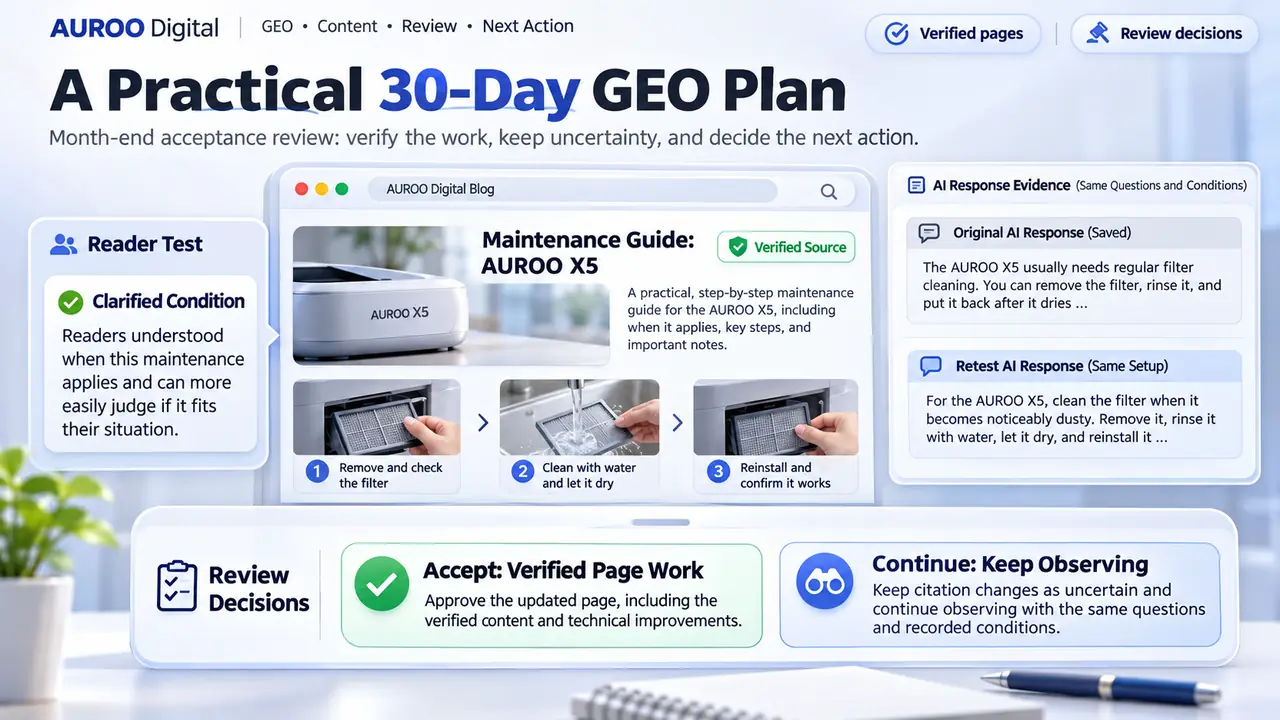
Consider fictional maintenance copy: “It can reduce maintenance costs and suits the above scenarios” depends on preceding text and lacks evidence. Add the specific model, verified functionality, and links to operating materials rather than simply changing “it” to “this device.”
If model documentation confirms a removable tank, describe supported disassembly and cleaning operations and link to the relevant guide. “Reduced maintenance costs” needs additional evidence; removability alone does not establish it.
Add conditions to information likely to be excerpted
Independent readability does not require repeating the whole article’s background in every paragraph. Prioritize information likely to lose meaning when extracted:
- Operating instructions: name the subject instead of relying only on references such as “it” or “this step.”
- Product specifications: retain units, the corresponding model, and necessary test conditions.
- Comparison conclusions: identify the subjects and conditions under which the conclusion holds.
- Statistics: place sources, timing, and sample scope nearby.
Full product names, brand introductions, and basic definitions need not recur constantly. Add information when it reduces misunderstanding rather than making every paragraph a shortened product introduction.
Data explanations need particular care. Detached from sample, method, and timing, a test result may be mistaken for a universal conclusion. Removing limitations for easier citation harms credibility. Readers should be able to tell from the relevant passage whether the conclusion applies to them.
Organize independently readable sections around user tasks
Select key passages by considering what readers are most likely to copy, share, or follow directly. Ask what problem the passage solves, then check whether subject, answer, and conditions are in the same section. Background stories and transitions can remain connected rather than becoming independent units.
A suitable independently cited unit is usually a full section, explanatory paragraph, or set of steps; every sentence need not become an article in itself. Definitions need terms and scope; instructions need subjects, prerequisites, and steps; comparisons need visible comparison conditions.
For example, “Can scheduled dispensing continue without internet access?” should describe offline functions and prerequisites for a specific model. Saying only “supports scheduled dispensing” while putting offline conditions elsewhere can mislead readers about functionality. If model documentation is unconfirmed, explicitly require verification rather than inventing capabilities.
Check key sections in isolation before publication
After drafting, randomly extract three sections, hide surrounding content, and ask colleagues to identify the subject, question answered, and basis for the conclusion. Frequent returns to earlier sections indicate excessive references; a bare confident assertion suggests evidence or conditions are too far away.
Checking independent readability does not require converting the article into mechanical questions and answers. Retain narrative, examples, and transitions, while keeping key definitions, operating steps, comparisons, and data explanations as complete as possible. The standard is that reasonable extraction preserves meaning and makes the conclusion’s boundaries clear.
For acceptance, copy one definition, one set of steps, and one comparison conclusion, including headings, into a blank document. Ask colleagues to identify each passage’s subject, main conclusion, and conditions, then mark words requiring earlier context. Add missing information nearby.
Also check whether lists depend on introductory text. Prerequisites may precede a list, but an isolated step should not appear universally applicable.
After revision, repeat extraction with the same sections to confirm added context introduces neither repetition nor contradictions. The particular service still determines AI citation; the team controls whether reasonable extraction preserves meaning and clear limitations.