Content Marketing
Newsletter Writing: Subject Lines, Calls to Action and Conversion
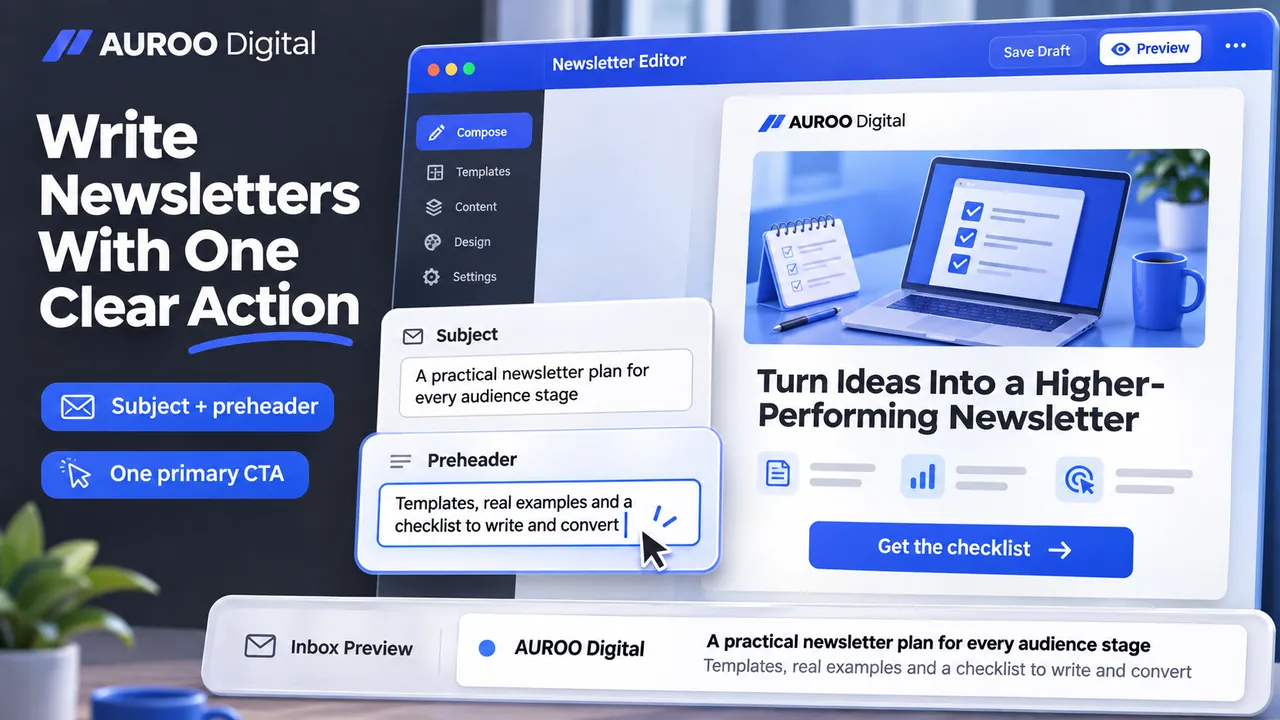
Effective newsletters start with a defined subscriber group and one primary task. Use a clear subject, relevant content and a main call to action. Check permission, mobile rendering, links and landing pages before sending, then review clicks, unsubscribes and actual enquiries; opens or send volume alone do not establish business value.
To apply this approach to your website or marketing project, explore AUROO Digital’s website development and landing page optimization, with scope, deliverables and review methods agreed around your needs.
Email, social and advertising results depend on audience, offer and measurement definitions. Compare qualified actions and business outcomes under consistent conditions rather than assuming one channel has a universal conversion advantage. Yet most creators’ and marketers’ newsletters fail to convert effectively: opens are weak, clicks approach zero, unsubscribes rise, and readers move on immediately. Lists may contain thousands or tens of thousands of subscribers while providing little monetization or retention value.
The problem is not that newsletters have stopped working. Most publishers still use outdated, templated, advertising-heavy writing that delivers little value, ignoring the transformation in reading habits, content expectations, and conversion psychology in 2026. Writing newsletters that convert readers is more than producing an email to send. It means building a content marketing system that uses carefully targeted, personal, value-first content to accumulate trust, reveal needs, guide behavior, and generate natural conversions. Successful newsletters use content and trust for lasting customer relationships and conversion, rather than aggressive selling.
Drawing on 2026 email marketing rules, reader psychology, conversion principles, and numerous successful international newsletters, this guide explains practical techniques across fundamentals, segmentation, structure, subject writing, value delivery, conversion guidance, pitfalls, and data-led iteration. It covers beginners, advanced optimization, and monetization, helping marketers create newsletters that retain, persuade, and convert readers and unlock the commercial value of their owned email audience.
1. 2026 Newsletter Fundamentals: Move Beyond Ineffective Mass Sending
To write newsletters that convert, first rethink traditional mass email assumptions. Many operators equate newsletters with advertising, notifications, or bulk content distribution, expecting regular sends, product links, and promotions to generate conversions. In 2026, audiences have higher expectations, inboxes overflow with spam, and resistance to advertising is much stronger. This indiscriminate writing and delivery approach produces fatigue, mass unsubscribes, and blocked messages, eventually making the owned audience ineffective.
A newsletter that converts follows value first, trust second, conversion afterward. People subscribe for exclusive insights, useful material, special benefits, and industry expertise, rather than advertisements. The competitive advantage is not ornate prose or enticing ads. It is consistently delivering distinctive value, building trust in a recognizable person or brand, addressing real needs, and naturally guiding action.
International email marketing data from 2026 identifies four shared characteristics of successful newsletters. These underpin every writing technique that follows.
First, a human personality and restrained marketing. Successful newsletters have a clear personal or brand identity, with friendly, authentic, warm language that distinguishes them from automated bulk messages. They emphasize practical advice, experience reviews, insights, and exclusive material, without hard advertising or forced selling. Readers sense a real conversation rather than a machine broadcast, substantially reducing resistance.
Second, exclusive, irreplaceable value. Ordinary newsletters repeat public information and basic news. High-converting newsletters provide additional value available only to subscribers: exclusive techniques, deep industry reviews, unpublished knowledge, special tools and resources, targeted pitfall guides, and niche insights. Readers feel they would miss out by ignoring them, encouraging opens, careful reading, and retention.
Third, precise alignment with subscriber segments. Needs, knowledge, and purchase stages differ: beginners need fundamentals, experienced users need advanced techniques, prospects need decision support, and customers need added services. Successful newsletters avoid one-size-fits-all distribution and tailor content to different groups, greatly improving conversion potential.
Fourth, gentle conversion guidance suited to the context. Conversion comes from content preparation, recognizing problems, and matching value, encouraging people to click, inquire, or buy voluntarily. Guidance is light, natural, and contextual, fitting the reading rhythm without harming experience and enabling unobtrusive monetization.
The central principle of writing newsletters that convert in 2026 is therefore to center user value, build a barrier through personal trust, use precise segmentation as the foundation, and pursue low-pressure conversions through a lasting, stable, compounding email content system.
2. Prepare for Conversion: Subscriber Segmentation and Topic Strategy
Mismatched topics and insufficient audience relevance can contribute to poor newsletter conversion. Many operators follow fashionable topics and send the same material to everyone, overlooking differences among new beginners, loyal long-term readers, hesitant prospects, and existing customers. Uniform distribution leaves beginners confused, experienced readers unimpressed, prospects unmoved, and customers without added value. The result is little conversion and widespread unsubscribing.
The first step is subscriber segmentation and precise topic selection, rather than drafting copy. Match content to each stage so every email addresses a real need and prepares for conversion. Mainstream international newsletter frameworks suggest four primary segments, each requiring its own topics and content logic.
2.1 New Subscribers: Days 0–7—Prioritize Retention and Initial Trust
New subscribers have limited understanding of the brand, creator, and content offering and have not yet developed trust. Do not send advertising, product pitches, or paid content at this stage. Focus on keeping them, delivering value, building goodwill, and establishing a reading habit to support later conversions.
Suitable topics include beginner advice, industry fundamentals, an introduction to the publication’s content system, subscriber benefits, common beginner questions, and step-by-step introductory guides. Keep material simple, useful, and actionable so the first reading quickly confirms the subscription is worthwhile, substantially reducing seven-day unsubscribes.
2.2 Active Observers: Days 7–30—Deepen Value and Reveal Needs
These subscribers regularly open and read but have not clicked, inquired, or bought. They offer strong conversion potential. They recognize the content’s value but lack purchase intent or still have concerns, making this a critical window. Strengthen the expert identity, explore pain points, reveal latent needs, and establish product or service value.
Suitable topics include advanced techniques, recurring problems, pitfall guides, practical case reviews, competitor strengths and weaknesses, and industry trends. Deep practical material reinforces expertise and addresses difficulties, helping readers recognize their needs and shortcomings and gradually seek solutions.
2.3 High-Intent Subscribers: 30+ Days and Frequent Clicks—Focus on Solutions and Decisions
Long-term active readers who frequently click product or service links and revisit practical material have clear needs but hesitate to decide. Less basic education is required. Focus on resolving concerns, showing advantages, providing exclusive benefits, and encouraging prompt conversion.
Suitable topics include product tutorials, customer success stories, decision mistakes, exclusive offers, detailed after-sales protection, and comparative results. Center content on solving problems, reassuring readers, and showing distinctive value to help them convert.
2.4 Existing Customers: Add Value, Retain, and Encourage Repeat Purchases and Referrals
Converted customers are the highest-value group; retaining their business costs much less than acquiring new customers. Increase loyalty, provide added services, encourage repeat purchases and word-of-mouth growth, and introduce upgraded products and advanced services.
Suitable topics include advanced advice, paying-customer resources, product update tutorials, exclusive internal information, loyalty benefits, and membership upgrades. Continued added value retains customers, generates repeated purchases and referrals, and magnifies compounding audience value.
3. A Standard High-Converting Newsletter Structure: The 2026 Framework for Successful Issues
Structure directly influences opens, completion, clicks, and conversions. Disorganized, lengthy, dull, or unfocused emails drive readers away even when the topic and underlying value are strong. The framework below can be adapted for educational issues, case reviews, promotions, product recommendations and benefit announcements. Test its relevance and performance with the intended subscribers.
3.1 Subject and Preheader: The Keys to Open Rates
Opening is the first step toward conversion. The subject and preheader are all readers see before opening and directly determine whether they proceed. High-converting subjects in 2026 reject exaggerated clickbait and empty promotional language. Follow four principles: clear value, precise pain points, natural concision, and no sales-heavy tone, balancing clicks and goodwill.
Four subject-writing techniques matter. First, state the reader’s benefit explicitly rather than using vague wording. Second, connect with pain points and curiosity to create appropriate recognition and interest. Third, keep the subject short enough for complete mobile display. Fourth, remove aggressive advertising, sales, and pressure language to reduce resistance.
The preheader supplements the subject by specifying value, increasing appeal, and resolving uncertainty. Do not repeat the subject. Add one sentence describing the core benefit, exclusive feature, or scarce opportunity to strengthen the desire to open.
Reusable approaches include a pain-point question, a clear benefit, exclusive advice, a case review, or a pitfall guide. Examples: “3 Email Marketing Mistakes Quietly Hurting Your Conversion Rate” and “Exclusive Review: A Beginner’s Complete Process for Converting an Owned Audience at Zero Cost.” Both are concise, specific, valuable, and engaging.
3.2 A Personal Opening: Build Connection and Retain Readers Quickly
Poor-converting emails often open with a cold list of tips, advertisements, or information. Successful newsletters follow empathy first, useful content second, guidance afterward. Conversational, personal language closes the distance and removes the stiffness of automated bulk sending.
Start with a recent industry development, a common reader question, a personal practical insight, or a real-world difficulty. Use a few sentences to create recognition, then move naturally into the main content. Avoid corporate language, excessive jargon, and forced setup. Keep the relaxed feel of a real conversation so readers experience a personal exchange rather than a bulk message.
3.3 Main Content: Concentrated Value, Clear Logic, and Practical Use
The body determines reading experience, trust, and willingness to convert. In 2026, its standards are high information density, low reading effort, strong practicality, and no padding. Unlike long WeChat articles or blogs, email is primarily read in short mobile sessions. Readers have little patience for lengthy, complicated, disorganized, or abstract material and quickly move on.
Follow three rules. First, use short sentences and paragraphs, with no paragraph exceeding 3 lines. Avoid dense blocks and bold key material for easy scanning. Second, build a logical sequence from pain point to problem analysis, method, practical steps, supporting cases, and pitfall summary, matching how readers understand. Third, prioritize useful, additional information: exclusive experience, techniques, warnings, and solutions to specific scenarios. Avoid generic material repeated across the web, ensuring each email has irreplaceable value.
3.4 A Gentle CTA: The Conversion-Focused Ending
Conversion guidance is essential to monetization and a common source of mistakes. Weak emails either omit a CTA and waste attention or rely on aggressive ads, pressure, and stiff language that provoke unsubscribes. Effective CTAs follow natural placement, contextual relevance, gentle guidance, and low-pressure action.
Place the CTA only at the end or after delivering the value, rather than interrupting practical content. Use mild, natural wording without pressure, exaggeration, or manipulation, extending the subject’s value into a relevant next step. Include only 1 primary CTA per email: multiple links and directions scatter attention, while one action improves clicks.
Suitable wording includes: “If you need a more detailed checklist, you can get it through the link below” or “For the complete case and advanced techniques, see the dedicated guide.” These invitations balance experience and conversion.
3.5 A Distinctive Signature: Reinforce Identity and Lasting Trust
Many publishers overlook endings, closing abruptly or leaving them blank. A consistent, personal signature reinforces the creator or brand, builds long-term trust, and increases engagement. Add no new lesson; briefly restate the main value, offer a personal good wish, identify the creator, and leave a way to respond. This completes the issue and strengthens recall.
4. Core Newsletter Writing Techniques: 2026 Implementation Guidelines
A standard structure is the foundation; careful writing drives better conversion. Even with identical topics and structures, different prose can produce severalfold differences in opens, readership, and conversion. Drawing on many successful international cases, the following eight techniques apply across newsletter types to improve quality and persuasive power.
4.1 Write with a Human Personality Throughout
Readers in 2026 readily recognize and strongly resist templated, AI-generated bulk emails. Successful newsletters must abandon corporate, formulaic, homogeneous styles and maintain a real person’s perspective, conversational expression, and individual character.
Include appropriate personal observations, practical lessons, mistakes, and judgments to give the content a clear identity. Avoid stock phrases, universal templates, and empty language. Replace stiff formality with relaxed, sincere, grounded communication. Even industry education and data analysis can be explained in everyday language, conveying warmth and building trust quickly.
4.2 Put Pain Points First and Make Benefits Tangible
During fragmented mobile reading, the first 3 seconds determine whether people continue. Put reader problems, core benefits, and exclusive value at the beginning, immediately clarifying what the email will solve and what the reader will gain.
Avoid long setup, irrelevant detail, and background introductions. Address a current recurring problem, offer an exclusive resource, or explain a confusing issue directly. Make abstract value concrete: replace “improve marketing performance” with a verifiable task such as “identify irrelevant topics and check whether the main link leads to the promised resource.” Visible, understandable benefits strengthen motivation to read.
4.3 Add Exclusive Information and Make the Subscription Irreplaceable
The central barrier protecting a newsletter is additional value exclusive to subscribers. If it merely repeats blogs, social posts, and public websites, people have no reason to subscribe or read, little reason to convert, and may unsubscribe.
Keep public content introductory and email content deeper. Every issue should add unpublished implementation details, practical reviews, pitfall summaries, dedicated tools, internal data, niche solutions, or personal expertise. Use public channels for fundamentals and reserve deeper practical material for email, establishing the expectation that the subscription is exclusive and becomes more valuable over time. This supports retention, trust, and eventual conversion.
4.4 Use Clear, Lightweight Formatting for Mobile
Check how the actual subscriber audience reads the newsletter, including mobile clients. Dense, disorderly layouts increase abandonment even with good content. Follow lightweight, structured, highly readable formatting principles.
Use short sentences and paragraphs, each centered on one point. Bold main arguments, important data, and key techniques for scanning. Organize complexity into bullets or numbered sequences with clear hierarchy. Leave space and limit images; avoid irrelevant pictures and decoration that slow loading and clutter the page. Clean, focused formatting reduces reading effort and improves completion.
4.5 Support Trust and Persuasion with Cases and Data
Readers pay for genuine results, practical solutions, and real cases rather than empty theory. Purely theoretical or educational newsletters struggle to convert. Authentic data, implementation examples, customer feedback, and results reviews substantially improve trust and conversion potential.
Support each major point, method, or advantage with relevant evidence: current industry data, personal implementation cases, customer successes, before-and-after comparisons, or common execution mistakes. Concrete evidence demonstrates feasibility, genuine value, and dependable outcomes, resolves decision concerns, and encourages voluntary action.
4.6 Limit Marketing Frequency and Prioritize Value
Too much advertising and too little value are primary causes of weak conversion and high unsubscribes. Publishers eager to monetize often send a hard advertisement every 2–3 issues. Frequent marketing produces fatigue and destroys trust, eventually causing mass departures.
Prioritize useful value with restrained, relevant promotion; there is no fixed content ratio that guarantees conversion. Consistently publish free advice, exclusive insights, and practical techniques, occasionally introducing relevant products, services, and events naturally. Only after continued value and deep trust will readers willingly pay, click, or inquire. Excessive marketing spends down trust and destroys long-term conversion.
4.7 Encourage Interaction to Increase Engagement and Loyalty
A successful newsletter is a two-way conversation. Continuous one-way publishing lowers engagement and loyalty, turning subscribers into silent, inactive names with little conversion potential. Add occasional questions, requests for needs, and answers at the end to reactivate readers and strengthen connection.
Effective approaches include asking what readers want next, answering frequent replies, inviting practical experiences, and researching their biggest difficulties. Interaction improves loyalty and reveals precise needs, informing topics, content improvements, and product development so relevance and conversion continue improving.
4.8 Follow Email Filtering Rules to Improve Delivery and Visibility
In 2026, Gmail, Outlook, and other providers continually refine algorithms and scrutinize spam, marketing, and low-quality messages more strictly. Even good content can land in spam because of problematic wording, formatting mistakes, or sensitive keywords, preventing delivery and conversion.
Avoid frequently flagged promotional words, exaggerated language, keyword repetition, and excessive links. Do not fill messages with advertising, false promises, or inflated claims. Limit links and ensure they are safe and compliant. Maintain a consistent schedule rather than frequent bulk blasts. Reliable delivery and relevant exposure are prerequisites for conversion.
5. Conversion Writing Templates for Four Main Newsletter Types
Different newsletters require different writing logic, structural emphasis, and conversion approaches. These four templates reflect common international scenarios—education, case reviews, product recommendations, and promotions—and can be reused to produce effective content quickly.
5.1 Educational Newsletter: Build Retention
Use for regular updates, retention, and trust building. This foundational, frequent format prepares long-term conversions. Structure: pain point → problem analysis → step-by-step implementation → pitfalls → summary → gentle CTA. Emphasize practical application and value without aggressive sales, building trust, reducing unsubscribes, and improving engagement.
5.2 Case Review Newsletter: Strengthen Trust
Use to demonstrate expertise, resolve concerns, and prepare conversion. Structure: genuine case → problem background → implementation review → main strengths → mistakes → reusable lessons → action guidance. Real cases demonstrate results and professional ability more persuasively than theory alone, increasing trust and willingness to act.
5.3 Product Recommendation Newsletter: Convert Relevant Prospects
Use for product promotion, service monetization, and paid conversions. Structure: empathy with a problem → limitations of existing solutions → core product value → differentiated advantages → real evidence → exclusive benefits → low-pressure CTA. Stay centered on solving the customer’s problem, without forced selling or exaggerated results. Product value emerges naturally and supports decisions.
5.4 Promotion and Benefit Newsletter: Drive Short-Term Action
Use for holidays, limited-time offers, giveaways, and short-term volume. Structure: scarce benefit announcement → campaign value → intended audience → participation steps → deadline and scarcity reminder → clear CTA. Emphasize limited time, exclusivity, scarcity, and accessible participation to encourage immediate action and a short-term conversion surge.
6. 2026 Newsletter Mistakes That Can Be Fatal to Conversion
Many newsletters fail because recurring mistakes continually erode trust, damage reading experience, and weaken content standing, rather than because the underlying content is poor. Numerous cases this year reveal nine especially damaging pitfalls. Avoiding them can directly improve overall conversion performance.
Mistake 1: Formulaic bulk distribution with identical content. Generic templates without personalization, additional value, or identity create fatigue and declining engagement, eventually leaving an inactive subscription list.
Mistake 2: Long openings and unclear priorities. Irrelevant background and empty language delay the main value. Readers move on within seconds, leaving very low completion rates.
Mistake 3: Excessive advertising and marketing. Frequent ads, product links, and promotions with inadequate value remove the reason to subscribe, prompting mass unsubscribes and blocking.
Mistake 4: No segmentation and uniform distribution. Beginners, loyal readers, prospects, and customers receive the same content despite different needs, producing little resonance or conversion.
Mistake 5: Chaotic formatting and dense text. Ignoring mobile produces crowded content, unclear emphasis, and confusing hierarchy, raising reading effort and abandonment.
Mistake 6: Too many CTAs and conflicting directions. Multiple links and requests split attention, create indecision, and can result in no clicks or conversions.
Mistake 7: Empty, exaggerated clickbait subjects. False hooks and inflated claims win opens but badly mismatch the content. Disappointed readers lose trust completely.
Mistake 8: No long-term plan and irregular updates. Inconsistent scheduling, unsystematic content, and illogical topics prevent stable reading habits and steadily reduce loyalty.
Mistake 9: Publishing without reviewing data. Ignoring opens, clicks, unsubscribes, and conversions perpetuates low-value, irrelevant content without improvement and leads to lasting poor performance.
7. Improve Results Through Post-Publication Data and Iteration
High-converting newsletters develop through ongoing analysis and optimization rather than one successful draft. Every issue provides evidence for better writing and conversion. Precise reviews and targeted fixes refine the content system, steadily improving opens, clicks, and conversions and maximizing compounding audience value.
7.1 Review the Core Metrics
Monitor four measures: open rate, click-through rate, unsubscribe rate, and conversion rate. Low opens indicate problems with subjects, preheaders, or send times; improve appeal and timing. Low clicks suggest insufficient value, weak CTAs, or mismatched needs. High unsubscribes suggest excessive promotion, declining quality, or poor relevance. Low conversions indicate inadequate trust, insufficient recognition of pain points, or weak action wording.
7.2 Apply Targeted Improvements
For underperforming issues, address the specific weakness. Refine subjects and test send times to improve opens. Shorten the body, add distinctive value, and improve CTA wording and placement to increase clicks. Reduce marketing, increase useful content, and refine segmentation to lower unsubscribes. Add cases, pain-point analysis, and trust signals to improve overall conversion.
7.3 Refine the Content System Over Time
Retain topics, structures, wording, and templates that generate strong readership and conversion. Remove formats with weak resonance, reading, or results. Gradually develop a distinctive high-performing newsletter system. Use replies and requests to refine direction continuously so content better matches needs and conversion keeps improving.
8. Conclusion: Quality Content Protects Lasting Newsletter Conversion
In 2026, fluctuating public-platform algorithms and expensive paid traffic make newsletters a central international owned-marketing channel because of their stability, longevity, compounding value, and conversions. Their competitive strength lies in the ability to write consistently valuable, high-quality, personal, precisely relevant content, rather than sending tools, frequency, or promotional tricks.
Writing newsletters that convert means abandoning opportunistic marketing and returning to user value. Precise segmentation, strong topics, comfortable reading, gentle action guidance, and accumulated trust help each email persuade, retain, and convert. Strong conversion comes from the compounding effects of long-term value, trust, and careful operations rather than a single promotion.
For independent stores, international brands, overseas bloggers and B2B teams, this approach offers a starting point for testing subscriber relevance, useful content and appropriate follow-up. Assess retention and business outcomes using actual data, including production and customer-service costs.