Content Marketing
Content Marketing Benefits: Measuring Traffic, Leads and Cost
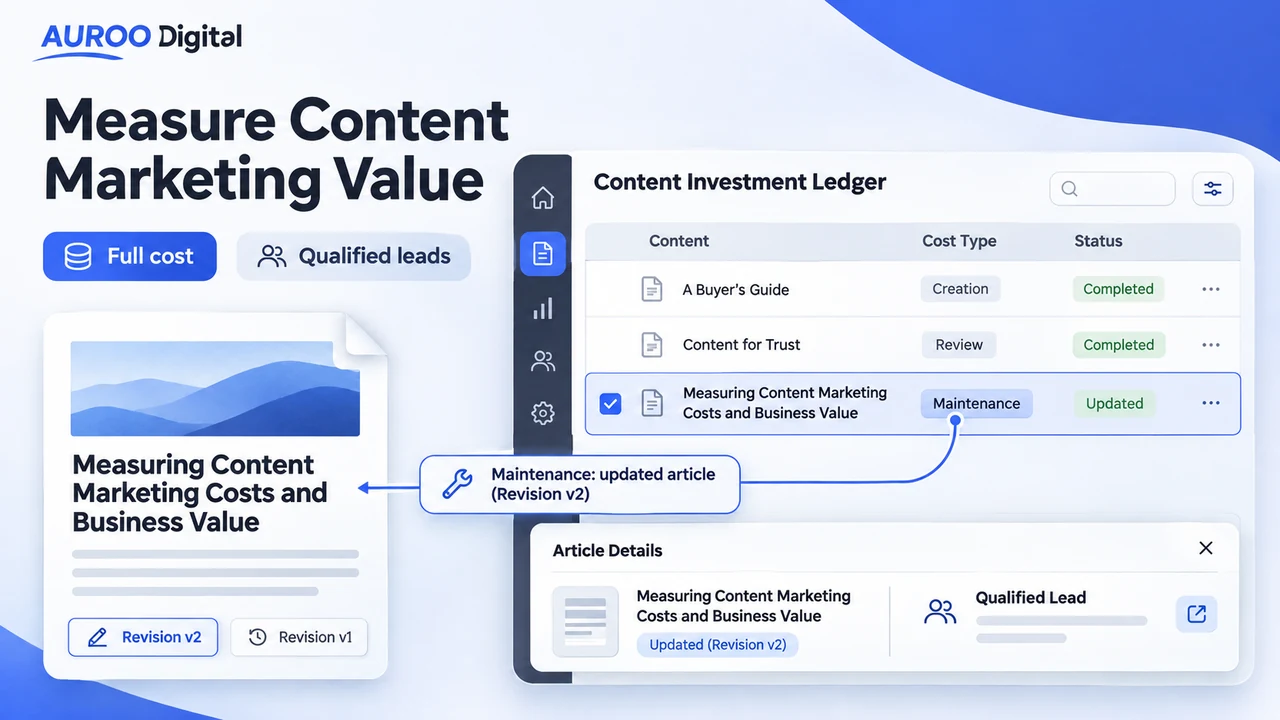
Evaluate content marketing across the buying journey: does it answer questions, attract relevant visits, support sales and generate qualified enquiries? Record production and maintenance costs, sources and lead maturity together. The absence of an advertising click charge does not mean content acquisition is free.
To apply the approach to your website or marketing project, explore AUROO Digital’s SEO services, with scope, deliverables and review methods agreed around your needs.
The American Marketing Association (AMA) defines content marketing as a strategic marketing approach: consistently creating and distributing high-quality, relevant, valuable content to reach a target audience, educate users, build trust, establish brand recognition, and guide purchasing, ultimately generating sustainable business growth. Unlike traditional marketing’s one-way messaging, forced exposure, and immediate monetization, content marketing centers on user value and long-term accumulation. It creates a constructive cycle in which brands proactively deliver value, users willingly recognize the brand, and transactions follow naturally.
Extensive industry data and practical cases demonstrate content marketing’s clear advantages. HubSpot’s 2025 industry report indicates that it generates customers at 3 times the efficiency of traditional marketing, reduces overall investment costs by 62%, and can deliver 300% ROI over 18 months. In B2B, more than 60% of customers complete most of their purchasing decision through content before first contacting a vendor. A 2025 digital marketing white paper reports that companies with systematic content marketing achieve brand asset growth 63% higher than traditional approaches and improve retention by 47%. These figures show that content marketing is no longer an optional enhancement. It is essential to reducing costs, improving efficiency, escaping destructive competition, building barriers, and sustaining growth.
This article systematically examines content marketing benefits across eight dimensions: costs, traffic, branding, conversions, customer operations, competitive barriers, adaptation to the AI era, and long-term compounding. Industry data, practical cases, and comparisons explain both immediate operational benefits and lasting strategic value: why contemporary businesses need content marketing, how it improves business performance across the board, and how its advantages support sustainable growth. Its comprehensive structure, coherent reasoning, and detailed supporting arguments make it suitable for academic reference, business presentations, coursework, and industry reviews.
1. Cost Optimization: Substantially Reduce Marketing Costs Across the Business Lifecycle
Excessive marketing costs and an imbalance between investment and returns are central problems for most businesses today. Traditional paid marketing rents traffic: companies must continually pay substantial sums for exposure and visits. Traffic arrives while ads run and disappears when they stop. Prices rise each year and marginal costs keep increasing, leaving many companies with substantial revenue but thin profits, effectively working for the platforms. Low costs, low marginal expenditure, and strong compounding returns are content marketing’s most immediately apparent and fundamental advantages.
Content marketing improves efficiency and reduces costs throughout the lifecycle and funnel. First, it substantially lowers acquisition costs. The cost per customer from search ads, feed ads, and offline promotion continues to rise; much of this traffic is broad or low-intent, creating significant waste. Practical content, industry explainers, solutions, and case analyses attract relevant people who actively search, follow, and have genuine needs. With little irrelevant traffic, cost per lead is far lower than conventional paid acquisition. Industry data shows that content marketing reduces cost per lead by more than 50% compared with traditional outbound marketing, while long-term practitioners can steadily reduce acquisition costs by 40%–60%.
Second, content is highly reusable and long-lived, overcoming traditional marketing’s limitation of a one-time investment producing a one-time return. Once published, quality articles, videos, white papers, guides, and tutorials remain online and continue to be discovered and recommended by search engines, AI answer services, and social platforms, bringing free traffic and relevant inquiries for years. Creating once, reusing repeatedly, and monetizing over time progressively reduce marginal costs. As content assets accumulate, overall marketing returns improve. Many businesses still receive steady inquiries from practical industry content published three years ago—a lasting value traditional display advertising cannot deliver.
Finally, content marketing substantially reduces labor and operating costs. Traditional approaches require large sales teams, field promoters, and advertising specialists to pursue acquisition continually, with high labor costs and low efficiency. Quality content replaces much repetitive explanation, customer Q&A, and product education, automatically educating visitors and answering their needs. Before contacting sales, customers have already learned about the product, resolved questions, and recognized its value. This reduces repetitive work, increases team productivity, and lowers operating costs. For small and micro businesses with limited budgets and no large marketing team, content marketing offers an accessible, high-return way to break through: consistent quality content alone can generate stable leads and exposure without a substantial advertising budget.
2. Traffic Growth: Build a Lasting, Independently Controlled Source of Free Traffic
Traffic underpins business operations, but traditional paid traffic is highly unstable. Platform rule changes, rising bid prices, malicious competition, or campaign errors can cause a sudden collapse. Businesses remain dependent on third-party platforms without independent control. A central content marketing benefit is helping them escape paid traffic dependence and build a controllable, continuously growing, inexhaustible pool of free traffic.
Content generates traffic: this is a fundamental principle of the digital era. As information habits change, people no longer simply accept advertising pushed at them. They actively find information through search, browsing, AI questions, and content platforms. Quality content is the primary material discovered by public platforms, search engines, and AI distribution engines. Compliant, professional, structured content continues to receive organic recommendations, indexing, and search rankings, generating stable organic traffic. Unlike paid traffic’s immediacy, content traffic has a pronounced long-tail compounding effect. The longer content remains available, the more stable its accumulated traffic becomes, supporting steadily increasing overall volume.
Content marketing also brings highly relevant traffic, resolving traditional marketing’s broad targeting, low precision, and heavy waste. All content addresses the target audience’s pain points, needs, search habits, and decision difficulties, matching purchasing and practical needs. It attracts interested, relevant customers with quality far above broad paid traffic. Paid acquisition buys scale with money; content marketing uses value to qualify audiences, leading in traffic conversion, inquiry quality, and close rates.
With AI now widely adopted, the traffic advantage is growing further. Generative AI has become a key decision entry point: users ask industry questions, compare brands, and select solutions through AI services, whose answers draw entirely on high-quality online content reserves. Companies that consistently publish professional content gain priority inclusion, synthesis, and recommendations for their brand information, product advantages, and solutions. They capture new GEO (generative engine optimization) opportunities and establish the next generation of acquisition channels while competitors still rely on traditional bidding, creating differentiated traffic advantages.
Companies that maintain content marketing over time develop a growth flywheel: more content → more stable traffic → more customers → better content iteration. They progressively reduce or even eliminate dependence on paid campaigns, gaining control over free traffic across channels and resolving unstable traffic, difficult acquisition, and high traffic costs.
3. Brand Building: Establish Recognition and Differentiated Brand Barriers
Similar products, prices, and services are the root of today’s intense competition across industries. Most businesses offer closely comparable products, pricing, and services, making brands difficult to distinguish through the product alone. Customers default to price, creating a destructive cycle of discounting and shrinking profits. Content marketing’s strategic advantage is to break this sameness, create a differentiated brand perception, establish a place in customers’ minds, and build distinctive, difficult-to-copy brand strengths.
Traditional advertising produces superficial exposure, making people aware of a brand without necessarily helping them remember, trust, or prefer it. Product-focused ads primarily communicate functions, prices, and offers. Similar messages across brands create few distinctive memory cues. Content marketing goes beyond selling products. Practical industry information, expert insights, brand stories, customer cases, scenario explanations, and educational content shape a complete personality and tone, giving the brand warmth, expertise, credibility, and uniqueness.
Consistently publishing quality content establishes lasting associations: professional, reliable, experienced, approachable, and understanding of users. When a relevant need arises, customers first recall a trusted brand with substantial expert content rather than the cheapest product. This is the value of establishing a place in their minds. For example, in the highly commoditized bottled water industry, Nongfu Spring avoids competing on low prices. Content about nature, ecology, public welfare, and craftsmanship creates a distinctive identity and supports a substantial brand premium. Home furnishing, education, and B2B technology brands similarly use systematic content to escape price wars and establish industry authority.
Content marketing also accumulates brand assets, increasing public credibility and influence within an industry. Companies that consistently publish industry viewpoints, solutions, and deep insights become content benchmarks, recognized and cited by customers, peers, and media, gradually establishing authority. This reputation and influence cannot be acquired quickly through advertising or copied by competitors. Advertising briefly increases visibility; content builds lasting value, elevating a general brand into an industry authority with stronger pricing power, loyalty, and competitiveness.
4. Conversion Efficiency: Shorten Decision Journeys and Improve Sales Performance
Purchasing decisions fundamentally depend on trust, rather than price. Traditional marketing sells directly to users who are defensive and resistant, creating high trust barriers, long decision cycles, difficult sales, and high returns. Content marketing follows value first, trust second, and sales afterward. Delivering value in advance answers concerns, reduces the trust threshold, shortens the decision journey, and improves conversion efficiency throughout.
Content can cover the entire purchasing lifecycle. During need recognition, educational material helps prospects understand their needs and industry problems, stimulating purchase intent. During comparison, product explanations, solution comparisons, and reviews clarify brand advantages and differences from competitors. During hesitation, genuine cases, reviews, pitfall guides, and evidence of results resolve concerns and decision difficulties. After purchase, tutorials, operational advice, and industry updates improve usage and reinforce brand approval. This complete coverage creates a smooth path from unfamiliarity, observation, and hesitation to acceptance, purchase, and repeat purchase.
The conversion advantage is especially strong in B2B, premium services, and major purchases, where prices are high, cycles long, and decisions demanding. B2B purchasing frequently involves multiple stakeholders and evaluation criteria over several months. Sales pitches alone rarely persuade a procurement team. Professional white papers, technical proposals, implementation cases, industry research, and digital solutions demonstrate expertise while meeting requirements for credential checks, proposal assessments, and risk verification, substantially shortening the sales cycle. Research indicates that systematic content marketing reduces B2B sales cycles by an average of 35% and increases overall conversion rates by more than 40%.
Quality content also reduces customers’ inclination to negotiate prices and limits destructive discounting. Once buyers recognize a brand’s expertise, service strengths, and industry experience, they become less price-sensitive and more willing to pay for brand value, professional support, and dependable protection. This helps companies improve individual product margins and overall profitability. Content marketing therefore generates more than traffic: it produces growth in qualified, high-intent, high-margin sales.
5. Customer Operations: Deepen Relationships, Retention, and Lifetime Value
Modern marketing has shifted from constant acquisition toward deep retention. Acquisition drives short-term growth; retention supports long-term profit. Customer lifetime value (LTV) is the central measure of business quality. Many companies remain trapped in continual acquisition and churn, with acquisition costs consuming profits, because they focus on attracting traffic and neglect relationships afterward. Without ongoing value or emotional connection, customers make one purchase and show little loyalty. Content marketing is the best means of maintaining relationships, stimulating engagement, and increasing retention and repeat purchases.
Content supplies ongoing value to existing customers, moving beyond a relationship that ends at checkout. In traditional transactions, customers receive no additional value after purchase, and brands contact them mainly during promotions, which can provoke resentment. Regular tutorials, operational tips, industry updates, advanced guides, and exclusive resources let customers continue benefiting after buying. The brand becomes a partner in their growth, reducing the emphasis on selling and strengthening ongoing support, substantially increasing goodwill and loyalty.
Content is also central to precise management of owned customer channels. Useful articles, exclusive materials, and reports encourage interested users from public platforms to join private communities or WeCom contacts. Regular content and value maintain engagement, uncover latent needs, and support repeat purchases, upgrades, cross-selling, and referrals. Traditional owned-channel operations rely on repetitive advertising and promotions, encouraging unfollows, blocking, and churn. Value-centered content encourages voluntary retention, interaction, and sharing, producing conversion rates far above conventional approaches.
Long-term content support builds emotional connections and communities of brand advocates. Ordinary customers buy products; fans also pay for the brand’s value, philosophy, and reputation. They actively spread awareness, recommend customers, and tolerate minor flaws, generating ongoing free acquisition and repeat business. Content marketing helps companies move from selling products toward cultivating relationships, trust, and assets, maximizing lifetime value and continuing to monetize the existing customer base.
6. Competitive Barriers: Build a Lasting Business Moat That Cannot Be Copied
In fiercely competitive markets, most advantages are temporary, replicable, and replaceable. Rivals can quickly copy features, undercut prices, capture channels, and imitate promotions. Growth based on temporary opportunities cannot sustain long-term stability; performance declines quickly when those opportunities disappear. The content assets, brand recognition, customer trust, and industry influence created through content marketing form distinctive, difficult-to-copy long-term barriers.
Content assets are highly cumulative and distinctive. Large libraries of quality content, webwide coverage, search rankings, AI indexing, and customer familiarity develop gradually; competitors cannot catch up quickly. Rivals may reproduce products, prices, and campaigns, but cannot replicate years of accumulated content, reputation, and customer perception. While peers still buy traffic through discounts, promotions, and advertising, content-led businesses already use their own assets for stable acquisition, easier sales, and stronger margins, creating a structural competitive advantage.
Content marketing also strengthens industry influence and market leadership. Companies consistently producing deep analysis, original perspectives, solutions, and research become benchmarks and preferred choices, shaping industry discussion and user understanding. When people develop relevant needs and encounter the brand as the source of quality content across the web, a dominant advantage in awareness and traffic follows naturally. Dominance in recognition, traffic, and reputation forms a powerful commercial barrier, helping companies withstand volatility, rival attacks, and price competition while developing steadily over time.
From a long-term business perspective, content marketing is a central route from price competition to value competition. Discounting compresses industry profits and erodes brand equity in an endless cycle. Competing through content value instead draws on expertise, customer trust, and accumulated assets, allowing businesses to escape that cycle, retain pricing power and initiative, and achieve sustainable, high-quality growth.
7. Adaptation to the AI Era: Capture the Next Generation of Digital Traffic Opportunities
As AI is deployed broadly, online traffic rules and customer decision processes are being reconstructed. Traditional bidding, advertising, and SEO tactics are gradually losing effectiveness, while AI answers, smart recommendations, and content aggregation become primary ways to find information, choose brands, and compare services. Within this new landscape, content marketing’s adaptability and forward-looking strengths make it a central means of participating in the AI era and capturing emerging traffic opportunities.
AI distribution rests on the principle that content is king. AI platforms do not produce information themselves; their answers, recommendations, and synthesis all derive from high-quality, original, expert, structured online content assets. AI engines continually crawl, include, index, and integrate businesses’ content. When users ask relevant questions, the brand appears prominently in AI answers, gaining free, relevant, frequent exposure and capturing new GEO opportunities.
Compared with traditional methods, content marketing closely fits the AI era’s accessible, intelligent, value-driven operations. AI tools assist with topic selection, copywriting, formatting, compliance checks, and data reviews, reducing production barriers while improving output and quality. This lets smaller companies build strong content systems inexpensively. Traditional advertising and offline promotion fail to fit AI distribution logic; their traffic shrinks and acquisition costs rise as they gradually become obsolete.
Systematic content assets also underpin digital and intelligent transformation. Content accumulated across channels can feed intelligent customer service, AI in owned channels, virtual presenters, and smart marketing systems, enabling automated answers, need matching, content delivery, and targeted promotion. Businesses without content reserves cannot connect effectively to AI marketing and will lose initiative in the next phase of digital competition. Investing in content marketing therefore means investing in the next 3–5 years of digital traffic and competitive advantage.
8. Long-Term Compounding: Create a Foundation for Sustainable Business Growth
Content marketing’s greatest less-visible advantage is its strong compounding effect and long-term strategic value, capabilities absent from short-term approaches. Traditional marketing exchanges a one-time investment for a one-time return; returns stop when spending stops, leaving no assets. Content marketing combines ongoing investment, cumulative returns, and lasting accumulation. Every piece of content and every delivery of value adds permanent digital assets, creating snowballing growth over time.
In the short term, content marketing takes longer than paid advertising and cannot produce an immediate traffic surge. Over time, however, returns accumulate and rise steadily. The first year emphasizes building the foundation, with traffic and sales increasing gradually. In year two, existing content keeps performing while new content adds value, doubling traffic, inquiries, and sales. After three or more years, a comprehensive content library, stable organic audience, and mature brand recognition can produce consistent results without intensive marketing spending, bringing marketing ROI to its peak.
Content assets can be transferred, reused, and updated throughout a company’s lifecycle. When products improve, operations expand, brands evolve, or new sectors open, existing content can be quickly refined and reused. Established awareness, traffic, and audiences help open markets and launch services, substantially reducing promotion and market education costs. New brands starting from zero face high education costs; brands with accumulated content can use their established credibility to break through quickly.
Strategically, content marketing provides one of the most resilient and stable foundations for growth. Market fluctuations, platform policy adjustments, changing traffic opportunities, and economic cycles can disrupt short-term marketing. Brand content, trust, reputation, and recognition do not disappear simply because external conditions change. During downturns and fierce competition, brands with deep content reserves are better able to advance against the trend, drawing on loyal audiences and brand strength to withstand industry risks and grow steadily through economic cycles.
9. Prerequisites and Pitfalls When Putting Content Marketing Benefits into Practice
Content marketing offers broad commercial advantages, but realizing them requires sound strategy. Blind imitation, self-focused creation, and fragmented operations cannot deliver compounding value. To unlock all eight benefits, companies must avoid common mistakes and maintain a disciplined implementation approach.
First, abandon the expectation of instant monetization. Content marketing is a long-term strategy, rather than a short-term sales promotion. Many companies stop because they see no obvious immediate sales, forfeiting future compounding. Its central value lies in accumulating assets, building trust, and establishing recognition. It supports traffic in the near term and brands and performance over time; only sustained, systematic operations produce compounding returns.
Second, avoid self-congratulatory content and prioritize user value. Many businesses publish little beyond company introductions, product advertisements, and sales promotions, with no practical expertise, relevant explanations, or user benefit. This fails to attract people or build trust. Good content solves pain points, answers questions, and provides professional value. Consistently publishing useful material is essential to accumulating traffic, trust, and recognition.
Finally, build a complete content operating cycle and connect it to the business. Creation, distribution, traffic reception, audience retention, inquiry conversion, and repeat-purchase management are all necessary. Creating content without managing traffic and conversion wastes valuable visitors and prevents content advantages from becoming sales advantages. Connect production to commercial returns through a complete process to maximize content marketing’s value.
10. Conclusion: Content Strength Is a Fundamental Growth Advantage in the Digital Era
As this analysis shows, content marketing benefits span eight dimensions: costs, traffic, branding, conversions, users, competitive barriers, adaptation to changing technology, and long-term compounding. Together, they surpass traditional marketing across the board. In an era of exhausted traffic windfalls, intense competition, and rapid AI evolution, indiscriminate traditional methods have lost effectiveness. Growth sustained by spending alone will eventually end; lasting growth based on accumulated value is the inevitable direction.
Content marketing is more than a marketing method. It is a core digital transformation strategy, a foundation for lasting growth, and a barrier against competitors. Lower costs solve acquisition challenges; relevant traffic supports growth; accumulated value builds brands; trust improves conversions; ongoing support strengthens retention; and compounding assets sustain development. Whether a startup needs a low-cost breakthrough, an SME seeks to escape price wars, or an enterprise wants stronger barriers and a stronger brand, content marketing offers a highly cost-effective, stable, sustainable solution.
Future business competition will ultimately center on content assets, customer recognition, and the ability to deliver value. Those who consistently publish quality content, accumulate assets, deepen user value, and establish recognition will hold the initiative. They can escape destructive discounting, reduce traffic dependence, create distinctive barriers, achieve stable high-quality growth through economic cycles, and maintain a leading position in competitive digital markets.