Ecommerce Growth
Southeast Asia Ecommerce: Market Selection, Costs and Pilots
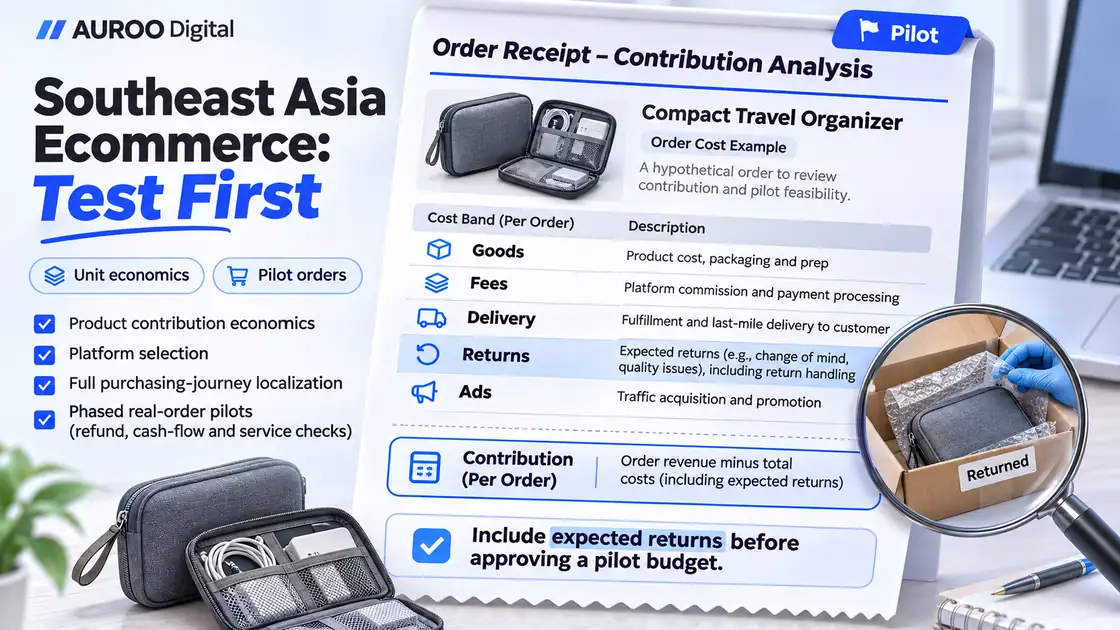
Evaluate Southeast Asian ecommerce by country, including demand, payments, delivery, returns and service capacity. Calculate order contribution and allowable acquisition cost before validating purchasing and fulfilment through a small pilot. Regional growth does not prove that a particular product will be profitable.
To apply this approach to your website or marketing project, explore AUROO Digital’s website development and landing page optimization, with scope, deliverables and review methods agreed around your needs.
This article outlines a small-scale validation approach centered on market selection, product economics, platform combinations, and fulfillment. Rather than launching across several countries at once, select a market and product combination, demonstrate viable unit economics, and then replicate gradually.
1. Turn macro trends into questions to validate
Google, Temasek, and Bain’s e-Conomy SEA report series provides a starting point for regional research.[1] Distinguish definitions such as digital economy, ecommerce, video commerce, platform transaction value, and business revenue. Regional GMV is not revenue merchants can automatically capture.
Connections between short videos, livestreaming, and platform shopping mean merchants should assess content production and conversion handling rather than merely listing more products. Mature payment and logistics tools lower some operational barriers but do not eliminate acquisition, returns, compliance, or support costs.
Trends become more useful as hypotheses: do target customers need demonstrations to understand the product? Do they rely on local-language reviews for trust? Do delivery or payment options cause checkout abandonment? Validate these through competitors, interviews, and small order samples.
2. Use a screening matrix to choose the first market
Set mandatory thresholds first: whether the product may be sold, the entity qualifies, a practical import and delivery route exists, and payments work. Markets failing these requirements should not take priority merely because they have large populations.
Among qualifying markets, compare demand, pricing room, competition, logistics, language resources, and support capacity. Research Singapore, Malaysia, Thailand, Vietnam, the Philippines, and Indonesia separately rather than assuming a single label makes a country suitable for expensive or inexpensive products.
Internal scoring can help prioritize, but weights should follow company strategy. Businesses emphasizing reliable delivery can increase logistics and support weights; demonstration-heavy products can emphasize local content capability. Scores organize evidence rather than represent success probabilities.
| Assessment area | Evidence to collect | Main decision question |
|---|---|---|
| Demand and competition | Searches, competitor prices, reviews, and interviews | Is there unmet demand? |
| Unit economics | Net receipts, fees, returns, and acquisition | Does each sale generate contribution profit? |
| Fulfillment and payments | Actual delivery, settlement, and refund tests | Can customers receive products and pay smoothly? |
| Local capability | Language, content, support, and partners | Can the team operate sustainably? |
3. Calculate product economics before setting prices
Order contribution profit can be calculated as net sales revenue minus variable costs for goods, platforms, payments, commissions, delivery, expected returns, and advertising. Fees may use different calculation bases; verify platform promotions, creator commissions, and merchant subsidies separately.
Illustrative calculation: net order revenue is HK$200, goods cost HK$70, platform/payment fees and commissions HK$20, delivery HK$25, and expected returns and support HK$10. Pre-advertising contribution is HK$75. To retain HK$25 per order, average affordable advertising acquisition cost is HK$50. These figures do not represent any country’s or platform’s rates.
Stress-test unfavorable exchange rates, higher delivery charges, more returns, and deeper discounts. Is profit still acceptable? Combining every optimistic assumption makes small trials appear safer than they are.
4. Choose platforms according to acquisition and operations
Shopee, Lazada, and TikTok Shop can be considered, but verify seller eligibility, categories, fees, and service scope separately by country and entity.[2][3][4] Do not copy one site’s rules to another market.
Focus on how products are discovered, trust established, and purchases completed. Search and catalog operations emphasize titles, categories, reviews, and promotions; content-led shopping depends more on videos, livestreams, creator partnerships, and ongoing output. These capabilities require different people and budgets.
Independent stores offer different levels of control over content, data, and experience but usually require solving acquisition and trust independently. Start with one main channel to validate demand; expand platforms according to incremental value and inventory/order coordination capability.
5. Localize the complete purchasing journey
Product pages need language, units, sizes, and actual delivery information users understand, plus applicability, warranty, and return details. Translating titles alone cannot address differences in voltage, sizing, usage habits, or after-sales expectations.
Create content around local questions using accurate, authorized product evidence. People familiar with the local context should review festival and religious language rather than treating cultural symbols merely as promotional material.
Support must cover presales, delivery delays, returns, and disputes. Define response arrangements and escalation ownership, record recurring questions, and feed them into pages and product selection. Reviews are both conversion assets and evidence of product and service weaknesses.
6. Validate logistics and compliance before stocking
When comparing cross-border direct delivery, platform fulfillment, and overseas warehouses, calculate speed, customs clearance, tied-up inventory, returns, and unsold-stock disposal. Warehouses can improve some delivery experiences but introduce capital and inventory risks; compare more than per-item shipping costs.
Send samples first to test packaging, tracking, arrival condition, and complete fees before scaling. For food, beauty, health-related, or powered products, verify market- and product-specific eligibility, labeling, and promotional requirements. Permission to open a store does not mean every SKU may be sold.
Confirm import, tax, consumer, and data requirements with the relevant official authorities or locally qualified professionals. Record verified conclusions by SKU, country, responsible party, and validity period rather than accepting only “it can be done.”
7. Control risks through phased pilots
First verify products, entities, payments, and delivery paths. Then use limited SKUs to obtain real inquiries and orders. Next observe refunds, reviews, and repeat purchases. Only afterward decide whether to expand content, advertising, and stock. Evidence should govern progression; calendar time is merely a management tool.
A pilot dashboard should include net revenue, advertising spend, contribution per order, dispatch and arrival, refunds, support issues, and inventory. Track advertising and repeat purchases by order or customer-entry cohorts so campaign peaks do not obscure later returns.
Stopping conditions may include persistent fulfillment failures, missing essential qualifications, or unacceptable unit economics despite reasonable optimization. Treating stopping and adjustment as legitimate pilot outcomes prevents further investment merely to defend the original judgment.
Frequently asked questions
Select a question to view the answer and make a more informed decision.
Is starting with the largest population more sensible?
Not necessarily. Assess demand alongside competition, delivery, costs, and company resources.
Must we establish an overseas warehouse immediately?
Not necessarily. Suitable direct delivery can validate demand, provided delivery times are communicated truthfully and target-market requirements are met.
Does revenue growth justify expansion?
Also check contribution profit, cash flow, refunds, and service quality. Growth can amplify losses too.
References
[1] Google, Temasek, and Bain: e-Conomy SEA report portal
[2] Shopee Malaysia Seller Education Hub