Ecommerce Growth
Customer Loyalty and Channel Incentives: Are Rewards Profitable?
Membership grows and coupons are redeemed, but month-end profit barely changes. A difficult loyalty question remains: did the reward create another purchase, or did a customer collect a discount on an order they would have placed anyway?
A customer loyalty program needs a clear behavior to encourage. Define who should do what, then estimate the additional contribution the activity could produce.
Start with a transparent cost example
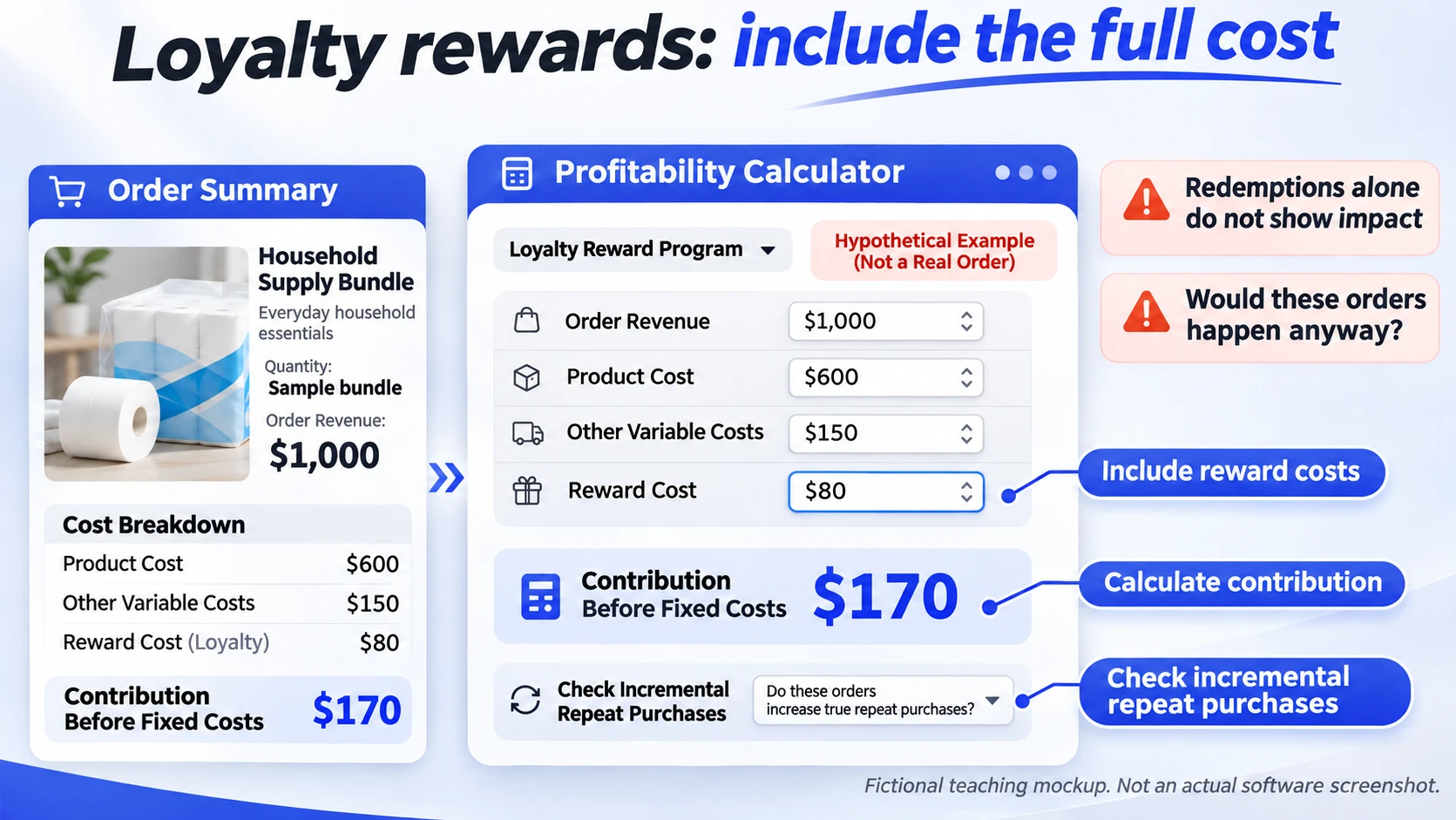
Consider a hypothetical order with revenue of $1,000, product cost of $600, other variable costs of $150 and reward cost of $80. Subtracting those costs leaves $170 before fixed costs. The calculation is 1,000 − 600 − 150 − 80 = 170.
This is an illustrative calculation, not a real order or client result. It does not establish that the reward generated the order, and the remainder is not net profit.
Our view is that customers buying more because of rewards and a company earning more from rewards are different outcomes. Calculate incremental value before celebrating participation.
Be specific about the behavior you want
A consumer program might encourage repeat purchases. A distributor program might encourage product training, additional sales locations or qualified opportunities. Different participants and tasks need different rules. Increasing subsidies for people who would already buy may simply erode contribution.
Estimate what remains after the reward
Consider product margin, returns, service, fulfillment and the cost of issuing and redeeming rewards. A fixed reward based only on revenue can miss substantial differences between orders. Use cautious assumptions for participation and redemption, and define how exceptional or invalid orders are treated.
Comparing participants with similar nonparticipants may be informative, but participants can already be more willing to buy. That selection difference limits what the comparison proves. Where appropriate, a properly designed randomized test can offer stronger evidence. Define its period and primary measure before starting.
Monitor contribution after relevant costs, complaints and unusual claims alongside repeat purchases and revenue. More redemptions alone do not demonstrate a successful loyalty program.
Make rules understandable and workable
Explain eligibility, how rewards accumulate, expiry, redemption and dispute handling. For channel incentives, clarify performance ownership, reward reversals after returns and duplicate submissions. If sales cannot explain the rules, customers are likely to struggle too.
Activity pages should clearly state who can participate, what they need to do and the restrictions. Google’s helpful content self-assessment supports checking whether information deserves a reader’s trust. Actual program rights and local requirements need their own verification.
Simple rules and fulfilled promises can do more for trust than continually adding new mechanics. Customers should not need to study a complex system to understand their benefit.
Pilot with a small customer group
Suppose a consumables supplier wants to encourage replenishment. Identify the behavior to improve separately from contractually scheduled orders. Review order contribution, returns and support costs as well as purchase frequency. Be cautious about counting routine purchases as new value.
If redemptions cluster or unusual claims appear, inspect the rules and data before changing entitlements repeatedly. This hypothetical example focuses on whether the program produces the intended behavior at a sustainable cost.
To connect customer retention content and ecommerce reporting, talk to AUROO Digital.