Ecommerce Growth
Ecommerce Pop-Up Shop Ideas: Online and Offline Conversion
Introduction
An ecommerce pop-up can be a physical experience, a temporary online store or a live event. Choose the format around a defined goal and budget. Prepare a dedicated landing page, source tags and inventory plan, then distinguish attendance or visits, purchases and contribution after event costs.
To apply the approach to your website or marketing project, explore AUROO Digital’s website development and landing page optimization, with scope, deliverables and review methods agreed around your needs.
Unlike conventional stores with long leases, substantial capital investment, high operating costs, and limited flexibility, pop-ups are temporary, lightweight, flexible, interactive, and repeatable retail spaces. Running for days or weeks, they require no long-term lease or heavy fit-out and keep staffing manageable. For online-only brands, they do much more than sell offline. They turn online traffic into real experiences, spread word of mouth, strengthen brand perceptions, test products, and build owned audiences, addressing the lack of physical experience, weak trust, and unclear brand identity inherent in online-only retail.
Many merchants mistakenly think pop-ups suit only traditional offline brands and are unnecessary for ecommerce, or equate them with temporary stalls and discount clearance, wasting their marketing value. In fact, leading ecommerce brands, quality-focused Shopify sellers, and emerging cross-border brands in 2026 routinely connect online and offline through creative, immersive, contextual pop-ups. These deliver low-cost traffic, high-conversion sales, widespread social exposure, qualified audience development, and product-market validation.
A successful ecommerce pop-up creates settings, conversations, experiences, and memories. Offline immersion feeds online traffic and repeat purchases, creating a mutually reinforcing growth cycle. Drawing on 2026 industry trends, Shopify’s official retail approaches, successful pop-up examples, and integrated ecommerce principles, this article explains creative concepts, location selection, space design, traffic generation, conversion, online integration, cost control, and performance review. Covering beginner pitfalls, creative improvements, and sustained operations, it follows standard Word formatting and can support brand operations, entrepreneurship learning, team training, and industry research. It helps online-only brands build popular, high-converting, cost-effective pop-ups from scratch.
1. Why Ecommerce Brands Need Pop-Up Shops
Most online-only growth problems arise from missing experiences, weak trust, and an insubstantial brand identity. Images, video, and text cannot let customers touch products or fully experience their quality and character. Decisions depend on online endorsement, while repeat purchases depend on discounts rather than loyalty. Pop-ups address these three weaknesses and unlock additional value, becoming an important part of integrated growth.
1.1 Overcome Experience Barriers to Strengthen Trust and Conversion
Online shopping inherently leaves information gaps. Incorrect sizes, disappointing materials or results, and misleading presentations drive returns and weak conversion. Experience-dependent categories such as beauty, apparel, home products, accessories, and wearables are especially difficult to evaluate online. Pop-ups let customers experience first and order afterward: touching, testing, and trying products reveals quality, design, and performance directly. This resolves purchasing concerns, increases immediate conversion and average order value, and reduces online refunds.
1.2 Use Limited-Time Scarcity to Create Urgency and Immediate Sales
Pop-ups are inherently time-limited, limited in quantity, and temporary, unlike permanently available online stores. This naturally creates fear of missing out. Exclusive short-term offers, limited editions, offline benefits, and visit rewards stimulate impulse purchases, move inventory, and increase short-term sales. They are particularly useful for seasonal products, launches, slow-moving stock, and niche bestsellers, offering an efficient, lightweight way to clear inventory and reach sales targets.
1.3 Turn Offline Experiences into Online Traffic and Lasting Relationships
Online competition is intense, paid traffic costs rise annually, and free traffic becomes harder to obtain. Footfall, distinctive settings, and visitor sharing give pop-ups authentic social content. Visitors voluntarily post recommendations on Xiaohongshu, Instagram, TikTok, and WeChat Moments, generating free traffic for online stores. Offline visitors can also join owned communities, email lists, and memberships, retaining them online and nurturing repeat purchases rather than relying on one-dimensional, continuously consumed traffic.
1.4 Test Products and Markets Affordably and Reduce Risk
Online testing of new products and geographic markets can be expensive, slow to report results, and poor at revealing genuine needs. Pop-ups are an extremely low-cost market research tool. Without major advertising or long-term commitments, brands can quickly establish a presence in a target area and collect direct feedback on product experience, price acceptance, preferences, and purchasing problems. This validates products and regional potential, informs online iteration, advertising, and expansion, and substantially lowers experimentation costs.
1.5 Give Brands a Physical Identity and Escape Price Competition
Brands relying on online discounts can become trapped in price competition without premiums, character, or memorable features. Designed settings, immersive experiences, personal service, and creative interaction make brand identity tangible and communicate its principles and value. Customers move from buying cheaply to identifying with a brand and paying for value. This supports premiums and the transition from a product-selling store to an emerging brand.
2. Popular Creative Ecommerce Pop-Up Formats in 2026: Appealing, Effective, and Practical
Conventional stall-style clearance pop-ups are outdated and can weaken brand identity rather than attract attention. Effective 2026 pop-ups center on context, immersion, interaction, themes, and lightweight execution. Combined with ecommerce’s online strengths, these principles produce eight creative formats that online-only merchants can deploy quickly without major capital investment.
2.1 Themed Immersive Experiences (For Reaching New Audiences)
Themed immersion is among the most shareable and recommendation-friendly formats. A single theme combines brand character, product style, seasonal interests, or holidays into a coherent environment. Each setting and item reinforces the atmosphere, rather than creating a cluttered store. It suits most categories, including beauty, fashion, home, cultural products, and designer toys. Examples include a calming home-life pop-up for minimalist home products, a fresh summer makeup experience for beauty, or a lightweight camping environment for outdoor products.
Its advantages are photogenic settings, strong social appeal, and a high willingness to share visits. Visitors voluntarily post photos and videos, building conversation and free exposure for online stores. This fits the ecommerce cycle of online discovery, offline conversion, and cross-channel acquisition.
2.2 Exclusive Product Launch Pop-Ups (For Getting New Products Started)
Create a limited-time space dedicated to a new ecommerce product as its offline launch venue, with early in-person experiences followed by limited-time online sales. Displays, interactions, benefits, and content all focus on the launch. Trials, demonstrations, personal explanations, introductory offers, and limited merchandise create exclusivity.
Cross-border independent retailers can quickly test overseas reactions, collect genuine reviews, and produce authentic user-generated content (UGC). This improves online product pages and advertising materials, addressing the lack of reviews and creative assets that makes online launches difficult and improving launch success.
2.3 Limited Clearance Pop-Ups (For Moving Slow Inventory)
For seasonal, slow-moving, and end-of-line stock, turn clearance into a themed event through presentation, urgency, bundles, and exclusive discounts. Rather than relying only on low prices, limited clearance sessions, offline bundles, and gifts with purchase increase order value, move stock, and release cash.
This also avoids the brand damage and pricing confusion of online discount clearance. A temporary offline event preserves normal online prices and positioning, balancing inventory turnover with brand value.
2.4 Interactive Experience Pop-Ups (For Engagement and Repeat Purchases)
Emphasize experience, interaction, and participation, reducing direct sales pressure and involving users. This suits products requiring education or contextual demonstration, such as smart home products, fitness equipment, skincare devices, outdoor tools, and baby products. Hands-on trials, DIY activities, themed photo spots, challenges, and expert guidance let visitors experience usefulness and value directly.
Examples include free skin analysis and personalized skincare plans, DIY interior styling, or fun sports challenges. Deep interaction increases dwell time and goodwill, identifies high-intent users, and lays a foundation for sustained online repeat purchasing.
2.5 Collaborative Cross-Category Pop-Ups (For Affordable Audience Expansion)
Partner with compatible niche brands, popular intellectual properties, local creators, or arts organizations with overlapping audiences. Joint pop-ups exchange traffic, complement audiences, and upgrade brand perceptions. A partner’s reputation and reach help brands move beyond existing circles, attract qualified new users, and gain relevance and conversation value.
The main advantages are shared costs, amplified attention, and traffic in both directions. Small and medium brands can run polished, popular events without bearing all expenses, making this suitable for beginners with limited budgets seeking rapid awareness.
2.6 Mobile Pop-Ups (Flexible, Accessible, and Widely Deployable)
Mobile pop-ups use converted vehicles, portable displays, or movable stalls instead of fixed premises. They can visit shopping districts, campuses, communities, exhibitions, and markets, adapting to different audiences and peak periods. Very low investment, high flexibility, and limited risk make this a good first choice for solo operators and small-budget brands.
Locations can change with market interest and footfall, capturing offline visitors precisely. Novelty and conversation appeal encourage attention and sharing, meeting lightweight brands’ need for broad channel coverage.
2.7 Members-Only Pop-Ups (For Existing Customers and Repurchase)
Create a private space exclusively for existing members, community users, and loyal followers. Offer offline discounts, gifts, one-to-one service, early product access, and member salons. Compared with public pop-ups, these emphasize exclusivity, recognition, and scarcity to deepen existing relationships.
Retaining customers costs much less than acquiring new ones. Private pop-ups improve engagement, average order value, and repurchase, reactivate dormant owned audiences, and generate affordable revenue for stable long-term operations.
2.8 Virtual Online Pop-Ups (No Venue, No Venue Costs, Broad Reach)
Brands with lightweight online operations and no offline budget can use livestreams, social platforms, and virtual environments to create temporary online experiences. Limited-time streams, virtual displays, online check-ins, exclusive offers, and limited-quantity flash sales reproduce offline scarcity in a dedicated online event.
Virtual pop-ups have no venue costs or geographic restrictions and can run regularly. Social sharing, creator collaboration, and user participation quickly increase sales and attention. They are an accessible way for beginners to test the format and gain operating experience.
3. Building an Ecommerce Pop-Up from Scratch: Practical Steps for 2026
Success depends on detailed execution as well as creativity. Many weak events copy conventional retail while neglecting ecommerce’s needs for online integration, traffic capture, and audience retention. The following seven stages—preparation, location, setting, promotion, onsite conversion, online integration, and review—align implementation with ecommerce operations to deliver sales, traffic, and brand benefits.
3.1 Define Objectives and Audience Precisely
Start with a clear operating objective to avoid following trends and wasting resources. Four common objectives are brand exposure, product testing and discovery, inventory monetization, and existing audience retention. Each requires different locations, concepts, benefits, and operations. For exposure, prioritize busy, conversation-worthy shopping areas and visual/social appeal. For clearance, choose cost-effective, conversion-friendly markets or communities and emphasize offers and immediate sales. For product testing, choose settings where the target audience gathers and prioritize trials and feedback.
Use online customer profiles to define age, purchasing habits, interests, and activity settings. Design themes, products, interactions, and benefits accordingly, preventing audience mismatch and ensuring relevant traffic and efficient conversion.
3.2 Choose Locations with Low Costs and High Returns
Location determines traffic volume, relevance, cost, and social appeal. Avoid automatically choosing expensive prime districts; prioritize affordable, well-matched, shareable venues. Eight good-value 2026 options are temporary booths in premium shopping districts, urban lifestyle markets, university campuses, community plazas, exhibition booths, popular photo-friendly streets, shop-in-shop partnerships, and temporary stalls at tourism sites.
Assess four criteria. First, audience fit: visitors should closely match online customers. Second, value: prefer short, flexible leases without substantial extra fees; venue costs should ideally remain below 30% of the total budget. Third, shareability: fashionable, photo-friendly locations help social promotion. Fourth, convenience: accessible transport, open sightlines, steady footfall, and sufficient display and activity space. Verify leasing rules, admission requirements, construction standards, utilities, and opening hours in advance to avoid violations and extra charges.
3.3 Space and Visual Design: Lightweight, Attractive, and Memorable
The guiding principle is minimal structural renovation, effective decoration, a strong theme, and a good fit. Use furnishings, lighting, posters, stands, and props to create immersion without heavy construction costs. Maintain attractive, photogenic, recognizable design. Visual style must match the online store and brand identity so offline visitors immediately recognize the online brand.
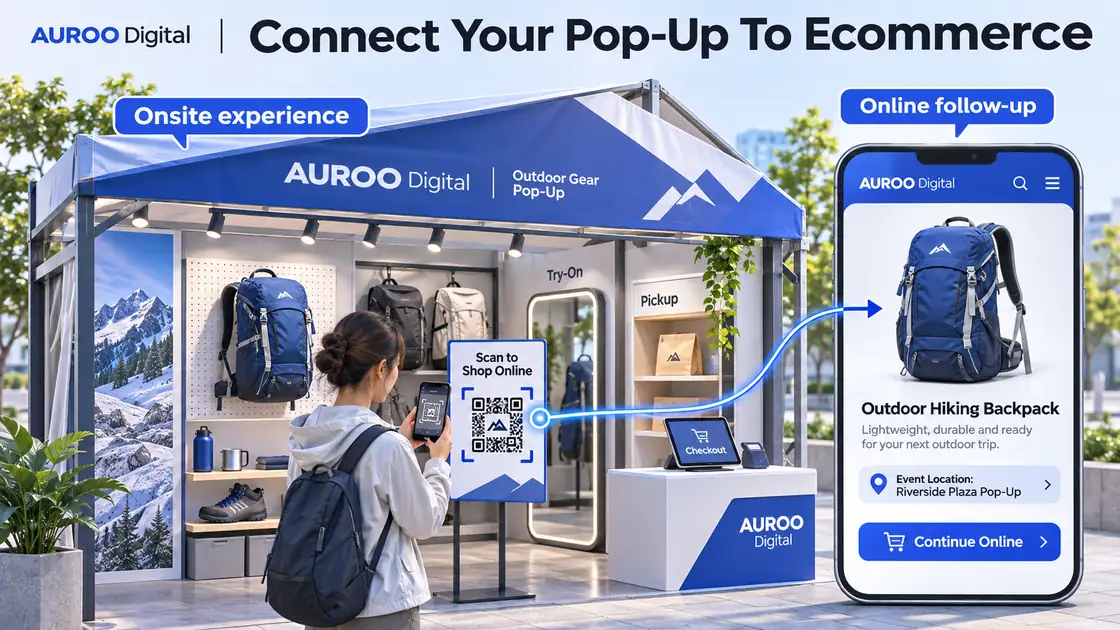
Five practical techniques help. First, make signage visible and clear, showing the brand, theme, and limited-time message from a distance as free offline advertising. Second, organize displays by setting, category, function, or promotion, placing launches, bestsellers, and exclusives prominently. Third, create photo and interaction areas with backgrounds and playful installations. Fourth, place store and community QR codes and event links on displays, posters, and tables to retain visitors online. Fifth, keep merchandising restrained and tidy, maintaining the online brand’s quality and avoiding clutter that cheapens perception.
3.4 Promote Across Channels Before Opening
Offline footfall alone is limited. Ecommerce’s advantage is using online traffic to support offline visits. Advance promotion activates followers, social audiences, and local users, building attendance from opening day and avoiding empty venues and losses. Begin 7–15 days before the event and build momentum in stages.
First, announce the event through store homepages and product pages, WeChat Official Accounts, communities, and Moments, sharing dates, location, and exclusive benefits to reactivate existing users. Second, post setting previews, product teasers, and benefit guides on Xiaohongshu, TikTok, Instagram, and WeChat Channels with local and industry topics. Third, collaborate with local niche bloggers, venue reviewers, and specialist creators, sending products and inviting early visits in exchange for preview content. Fourth, use small, targeted local and interest-based advertising budgets to reach likely buyers and increase attendance.
3.5 Onsite Operations: Increase Sales, Order Value, and Retention
Onsite execution determines returns. Maximize conversion, retention, and sharing while balancing immediate revenue with long-term assets. Create urgency through short-term discounts, offline spending reductions, limited gifts, free-order visit rewards, and double points. Improve service by training staff in product benefits, online promotions, and after-sales policies so they can offer expert trial guidance, combinations, and purchase options that build trust.
Use tiered offers—single-product discounts, bundles, gifts above a threshold, and membership top-up benefits—to increase order value. Invite interested nonbuyers to scan codes, follow the store, or join communities, offering small rewards or coupons for later online conversion. Encourage visitors to post on social platforms and receive gifts upon showing their posts, generating free sharing and further visits.
3.6 Connect Online and Offline into a Growth Cycle
This is ecommerce pop-ups’ defining advantage and the key to maximizing value. Connect data, traffic, transactions, and repurchase throughout. Offline users can scan codes to order online, join promotions, and earn points, overcoming onsite inventory limits. Online users can book offline trials, claim in-person benefits, and join visit activities, improving engagement.
During the event, capture settings, experiences, bestsellers, and visitor activity to create authentic UGC. Publish it to stores, social channels, and advertising libraries to enrich online content and improve conversion. Bring visitors, participants, and buyers into one owned audience system and continue sharing launches, offers, and benefits, nurturing repeat purchasing and extending the value of a single event.
3.7 Review Data and Improve Future Operations
Afterward, review performance comprehensively to support regular deployment and improvement. Core metrics include total exposure, social conversation, footfall, orders, sales revenue, average order value, conversion, acquisition costs, new owned audience members, UGC volume, and user problems and feedback.
Identify strengths and weaknesses, high-converting products, popular activities, effective acquisition channels, and central needs. Improve future themes, locations, benefits, and operating models. Archive strong materials, reviews, and visitor posts for ongoing online discovery, branding, and store content, allowing one event to generate repeated long-term returns.
4. Creative Improvements for Distinctive Ecommerce Pop-Ups in 2026
As pop-ups proliferate, generic settings and activities struggle to attract attention. Distinctive ideas and memorable features are essential for wider reach, conversation, and conversion. The following advanced techniques suit ecommerce brands, can be implemented affordably, and help distinguish them from competitors.
4.1 Connect Free Samples and Experiences to Targeted Conversion
For consumables such as beauty, home products, food, and personal care, offer free samples or services to lower trial barriers and attract visitors. Link them to immediate post-trial discounts, offers for sharing experiences, or sample-value credits against full purchases. This converts trial traffic into orders rather than merely giving products away. Use Shopify POS to record sample distribution alongside sales and assess trial conversion, improving product strategy.
4.2 Co-Create Authentic UGC Reviews
Encourage visitors to film product experiences, write genuine reviews, and share impressions on social platforms. Repost through official accounts and reward users with discounts, gifts, or points. This quickly builds authentic content for stores and trust, amplifies exposure through voluntary sharing, and makes users participants in brand creation, strengthening belonging and loyalty.
4.3 Create Scarcity with Time-Limited Exclusives
Develop offline-only products, colors, bundles, and merchandise specifically for the pop-up, without online sales or later reproduction. Exclusive scarcity increases purchase and visit motivation, drives immediate transactions, and supports premium positioning rather than price competition, giving the event a distinctive, irreplaceable appeal.
4.4 Use Smart Technology for Immersion
Introduce lightweight tools such as AI skin analysis, AI outfit recommendations, 3D previews, and intelligent product demonstrations. These provide professional, technology-enabled experiences beyond conventional staff explanations, strengthen sophistication and expertise, and encourage younger users to visit and share.
4.5 Support Public Causes to Build Reputation
Connect the event to a cause by donating a fixed amount per order or supporting a project for each visitor check-in. Publish progress and donation details to communicate responsibility. This improves goodwill and reputation, softens the promotional impression, adds humanity, and encourages recognition and sharing by platforms and local users, benefiting both sales and word of mouth.
5. Common Ecommerce Pop-Up Mistakes and a 2026 Prevention Guide
Many brands spend heavily yet achieve little revenue or attention because they copy conventional stores and neglect ecommerce needs. The following common, damaging mistakes help beginners identify wasted investment and losses and aim for positive returns from each event.
Mistake One: Overinvesting in fit-out while neglecting operations and online integration. Beautiful spaces cannot compensate for weak acquisition, conversion, retention, and online connections. Sparse traffic and poor sales waste the pop-up’s marketing potential.
Mistake Two: Choosing locations by footfall alone. Expensive prime locations with large but irrelevant audiences produce low intent, poor conversion, and imbalanced returns.
Mistake Three: Disorganized products without a clear bestseller. Excessive, unfocused stock unrelated to the theme makes choice difficult, weakens memory, and prevents clear communication of key benefits, hurting conversion and recognition.
Mistake Four: Relying only on low prices without creativity or experience. Treating pop-ups as clearance stalls without settings, interaction, service, or shareable features weakens positioning and reinforces price competition.
Mistake Five: Pursuing immediate sales while neglecting owned audience capture. When visitors are not retained online, traffic and assets disappear after closing, wasting qualified prospects and preventing lasting returns.
Mistake Six: Insufficient advance promotion. Depending solely on natural footfall can leave a venue empty, with weak attention and low conversion.
Mistake Seven: Repeating events without reviewing data. Failing to analyze results, identify problems, and improve activities repeats mistakes and prevents better formats or incremental returns.
6. Future Trends and Long-Term Operating Value in 2026
As ecommerce integration deepens and online/offline boundaries blur, pop-ups are becoming regular, systematic operating modules rather than isolated campaigns. Three trends in 2026 indicate how brands should invest over time.
First, lightweight regular deployment. Capital-intensive, long-running formats are declining as mobile, themed, and virtual pop-ups with short cycles, flexibility, and low costs become mainstream. Brands can respond regularly to holidays, seasons, trends, and inventory to stimulate new traffic and sales.
Second, digital and intelligent operations. AI experience tools, digital data management, and connected online/offline data are becoming standard. Instead of relying on intuition, teams use tools to understand needs, optimize assortments, and improve conversion precisely.
Third, brand value comes first. Pop-ups are moving beyond selling alone toward branding, audience development, market testing, and reputation building, helping ecommerce businesses overcome online competition and develop distinctiveness.
Regular pop-ups connect the full online/offline journey and accumulate brand, audience, and content assets. They reduce reliance on continuously purchased online traffic and enable sustainable compounding growth with distinctive advantages in a competitive ecommerce market.
Conclusion
As online-only growth reaches its limits in 2026, pop-ups are essential tools for overcoming bottlenecks, filling experience gaps, building brand assets, and reaching new markets. Their lightweight investment, low risk, flexibility, shareability, and compounding value suit small and medium retailers, independent sellers, and emerging brands, helping them escape price competition, narrow traffic sources, and weak identity.
A successful ecommerce pop-up is an integrated marketing event built around settings, centered on experience, driven by sharing, and aimed at growth. Precise positioning, creative spaces, multichannel traffic, detailed operations, and online/offline connections allow a single event to increase sales, reach new audiences, retain users, generate materials, and test markets, supporting lasting growth.
Future ecommerce competition will center on integrated experiences and brand strength. Brands that proactively create pop-ups, connect channels, and carefully manage offline traffic will capture opportunities and accumulate advantages, advancing from short-term sales gains to long-term brand value.