Ecommerce Growth
Conversion Rate Optimization for Beginners: Steps and Metrics
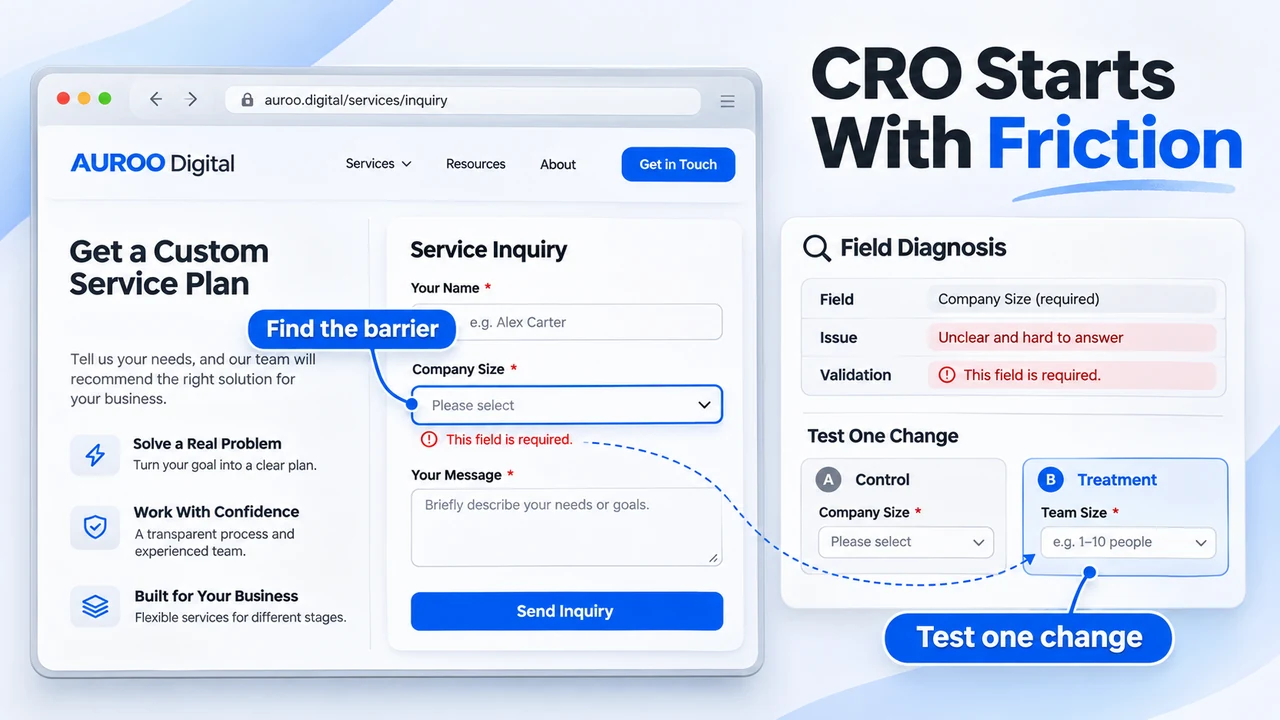
CRO starts with a conversion definition and reliable data, then identifies information, trust or usability barriers and tests a clear hypothesis. On low-traffic sites, fix broken forms, mobile issues and unclear service explanations first. Short-term changes from insufficient samples do not establish a reliable test result.
To apply the approach to your website or marketing project, explore AUROO Digital’s website development and landing page optimization, with scope, deliverables and review methods agreed around your needs.
Conversion rate optimization (CRO) directly addresses this problem. Where acquisition brings people in, CRO makes better use of existing visitors. By systematically analyzing behavior, reducing friction, improving pages, and communicating value, it generates more meaningful conversions without additional traffic costs, steadily increasing revenue, leads, and retention.
For beginners, CRO is a data-driven, user-centered, practical, reviewable operating process, rather than technical mysticism or random page changes. This introductory guide explains concepts, underlying principles, tools, workflows, optimization techniques, testing, common mistakes, and long-term implementation, helping newcomers maximize traffic value.
1. CRO Fundamentals: Understanding Conversion Rate Optimization
1.1 What Is CRO?
Conversion rate optimization is the ongoing process of using analytics, research, page iteration, and controlled testing to increase the proportion of website or page visitors completing a target conversion action, ultimately improving business returns. Its principle is to improve traffic quality and utilization rather than blindly chase visitor numbers, maximizing each visitor’s value.
Established industry definitions describe CRO as a long-term, recurring operating system, beyond a one-time redesign or button improvement. It spans the journey from arrival and browsing through interest, decisions, and conversion. Traffic operations bring more people in; CRO helps more of those people stay and buy.
1.2 What Counts as a Conversion? Defining Business Objectives
Beginners often equate conversion with a sale. In reality, conversions include all predefined user actions valuable to the business. Objectives differ by model and operating stage, so precise definition is the first step.
Common conversion objectives include:
Ecommerce/cross-border independent stores: adding to cart, checking out, paying, repeat purchases, order confirmation, and positive after-sales reviews.
SaaS/business services: free registration, trial applications, demo bookings, lead forms, paid upgrades, and business inquiries.
B2B lead generation: resource downloads, form submissions, telephone inquiries, following a WeChat Official Account, joining communities, and booking meetings.
Content/publisher websites: time on page, completed reads, likes and comments, direct messages, membership purchases, and sharing.
Conversions fall into two categories: ultimate conversions, which directly generate revenue, such as purchases and payments; and preliminary conversions, which build audiences and nurture demand, such as registrations, leads, and downloads. Beginners should track both, balancing immediate returns with long-term audience development.
1.3 Calculating Conversion Rate and Understanding Related Metrics
The fundamental calculation is simple and consistent: conversion rate = (visitors completing a conversion ÷ total unique visitors) × 100%.
For example, if a site receives 1000 unique visitors in a day and 20 complete payment, purchase conversion is 2%. If 50 submit lead forms, lead conversion is 5%.
Distinguish three related metrics to avoid misreading results:
Bounce rate: in GA4, the proportion of sessions not classified as engaged, rather than simply visits without a click or scroll. Check the property’s engagement settings and read this alongside traffic intent and completed actions.
Exit rate: the percentage ending their visit on a particular page. High-exit pages are important funnel leakage points requiring attention.
Average time on page: a duration measure whose definition depends on the analytics tool. Longer time may reflect interest or difficulty finding an answer, so it does not independently establish audience fit or conversion intent.
1.4 Why Beginners Need CRO
Many beginners prioritize advertising and content acquisition while neglecting conversion, entering a cycle of more traffic, higher costs, and lower profits. CRO addresses underlying operational problems in four ways:
First, reduce acquisition costs and improve traffic utilization. Traffic is a central online cost. Better conversion produces more results from existing visitors without extra advertising or content acquisition spending, lowering customer acquisition cost (CAC) and improving margins.
Second, identify real problems and improve products and services. Behavioral data reveals exit points, decision concerns, and experience weaknesses. These insights guide page content, selling points, and service improvements so strategies match actual needs.
Third, steadily improve returns and compound growth. Small, continuing improvements to experience, processes, and value communication create lasting gains. The cycle of optimization, higher conversion, review, and further improvement compounds results.
Fourth, replace blind experimentation with data-based operations. Intuitive redesigns produce unpredictable, difficult-to-review results. Standard CRO uses data and feedback, making actions measurable, testable, and reviewable.
2. Essential CRO Principles for Beginners
Effective CRO requires underlying logic as well as tactics. Every change serves two goals: increase willingness to buy and reduce conversion resistance. Page redesign, copy improvement, and simpler processes all implement these principles.
2.1 The Core Conversion Formula
A widely used conceptual formula guides beginner CRO: conversion probability = (perceived value × trust × relevance to needs) ÷ conversion friction.
It suggests two actions: increase the numerator by strengthening value, trust, and relevance, and reduce the denominator by removing obstacles.
Perceived value: can users understand within 3 seconds what problem a product or service solves and what benefit it brings? This determines whether they stay. Many beginner pages fail because visitors cannot tell what the offering is or whether it is useful.
Trust: confidence in an unfamiliar brand or product, supported by reviews, sales figures, certifications, cases, and after-sales guarantees. Insufficient trust drives hesitation and abandonment.
Relevance to needs: how well page content and selling points match visitors’ intentions. A mismatch between acquisition messages and destination pages drives bounce and poor conversion.
Conversion friction: the time, actions, and thinking needed to convert, including long forms, complicated checkout, unclear guidance, slow loading, and missing information. More friction means more abandonment.
2.2 The Psychology of Conversion Decisions
Online conversion follows a psychological decision process. Beginners should match that rhythm rather than design for themselves. The journey has five stages:
First, attention: visitors scan the first screen and decide within 3 seconds whether it is relevant. Prioritize clear value, an explicit subject, and direct recognition of their problem.
Second, interest: relevant visitors explore value, advantages, and solutions. Use concrete benefits and contextual explanations instead of empty promotion.
Third, concern: interested users question effectiveness, value for money, support, and risk. Add credibility, answer common questions, and resolve doubts.
Fourth, desire: once reassured, users want to purchase, register, or submit details and need clear direction. Provide explicit buttons, immediate incentives, and scarcity cues.
Fifth, action: users convert, while process smoothness affects retention and repurchase. Simplify actions, reduce effort, and improve completion experiences.
The beginner’s task is to identify abandonment causes at each stage and address weaknesses and obstacles precisely.
2.3 Core CRO Rules for Beginners
Follow four principles to avoid common mistakes and establish a systematic approach:
Rule One: Follow users, beyond aesthetics. Beginners often prioritize attractive, impressive design while overlooking needs and usability. Effective pages reduce friction, communicate value, and support conversion; appearance alone does not ensure usability.
Rule Two: Use evidence and avoid assumptions. Do not judge buttons or copy solely by preference. Base changes on data and feedback, discover problems through analysis, and verify effects through testing. This distinguishes CRO from ordinary redesign.
Rule Three: Make small, continuous improvements. There is no permanently perfect page. Avoid sweeping redesigns and prioritize small, frequent, testable iterations that improve results while limiting unknown risks.
Rule Four: Optimize the whole funnel. Loss can occur during browsing, clicking, cart additions, checkout, or payment. Examine every leakage point across the journey instead of focusing only on homepages or landing pages.
3. Beginner CRO Tools: Accessible and Easy to Use
CRO does not necessarily require complex technology or coding. Many entry-level tools are straightforward and free, meeting everyday beginner needs. Four categories cover monitoring, behavior analysis, testing, and experience improvements.
3.1 Analytics Tools: Measure Problems and Find Leakage
Purpose: collect traffic, conversion, bounce, page popularity, and journey data to identify exactly where the funnel loses users.
Google Analytics (GA4): a widely used free website analytics tool and a beginner essential. It measures visitors, conversions, page traffic, behavior, and device sources, supports custom conversion goals, and reveals losses at each stage, forming a basic monitoring foundation.
Baidu Analytics: a free tool for Chinese websites, with simple functions and accessible operation. Beginners running corporate and content sites can quickly review visits, conversions, regions, and devices.
3.2 Behavior Analysis Tools: Understand Users and Real Problems
Purpose: quantitative metrics show that users leave; behavioral tools help reveal why. Heatmaps, recordings, and click tracking reconstruct actual browsing.
Hotjar: a lightweight beginner option whose free version meets daily needs. Heatmaps, recordings, click tracking, form analysis, and polls reveal attention, ineffective clicks, and exit points, exposing experience weaknesses.
Microsoft Clarity: a completely free behavioral tool without feature restrictions, suitable for all websites. It provides recordings, heatmaps, and abandonment analysis with simple setup and operation for beginners.
3.3 A/B Testing Tools: Verify Improvements
Purpose: run original and revised pages simultaneously, randomly assign visitors, and compare results. Controlled testing supports scientific iteration instead of subjective experimentation.
Google Optimize is no longer available. Google ended Optimize and Optimize 360 on September 30, 2023. See the official sunset notice. Select a currently supported testing tool by traffic needs, integrations, cost and statistical method.
Optimizely: an experimentation platform whose features and costs depend on the selected product, plan and implementation. Verify current pricing and included testing capabilities rather than assuming a free beginner tier.
3.4 Experience Tools: Fix Fundamental Usability Issues
Purpose: resolve loading, mobile adaptation, and performance problems, removing basic friction before further CRO work.
Google PageSpeed Insights: a free speed tool that detects loading, performance, and mobile issues and provides recommendations. Speed is a central conversion factor; every additional second of delay can significantly reduce conversion.
Canva/Chuangkit: visual design tools that let beginners create polished posters, banners, and benefit images without professional design skills, improving presentation and value communication.
4. A Complete Beginner CRO Workflow
Follow the standardized cycle of “diagnose—plan—improve pages—A/B test—review and iterate” to build a sustainable process and steadily improve conversion.
4.1 Step One: Diagnose Data and Locate Problems
Finding the right problem comes first. Beginners often change copy, buttons, or images blindly while missing major leakage. Combine quantitative data and behavior analysis to identify weaknesses throughout the funnel.
1. Build the Funnel and Identify Leakage
Map the full journey for your business. An ecommerce example is homepage → product list → product details → cart → checkout → information entry → payment. A B2B lead journey might be landing page → details → cases → form → lead submission.
Use GA4 or Baidu Analytics to examine progression and exit rates at each stage. Prioritize the most severe leakage points for the best value and fastest impact.
2. Use Behavioral Data to Understand Causes
Hotjar and Clarity heatmaps and recordings help investigate three issues: little attention to the first screen suggests unclear value or weak appeal; few clicks on conversion buttons suggest poor visibility or copy; substantial form or checkout abandonment suggests excessive effort and friction.
3. Collect Direct User Feedback
Metrics show behavior; feedback reveals deeper motivations. Lightweight surveys, support records, reviews, and direct messages can identify recurring questions, concerns, and dissatisfaction, providing essential optimization material.
4.2 Step Two: Set Priorities
Diagnosis produces many issues, but beginners have limited resources. Rank changes by high return and low difficulty, implementing inexpensive, quick improvements first to demonstrate results and build confidence.
Suggested priorities:
First priority (immediate): slow loading, broken mobile layouts, forms that do not submit, and inactive buttons; also unclear first-screen value, missing benefits, and inconspicuous calls to action. These basic problems are easy to fix and can materially improve results.
Second priority (short-term): insufficient credibility, empty copy, abstract benefits, and unanswered questions. These low-difficulty content changes quickly strengthen trust and motivation.
Third priority (long-term): major layout restructuring, product system changes, and funnel redesign. These are complex and risky and should be introduced gradually later.
4.3 Step Three: Improve the Whole Page
Apply conversion principles and decision psychology across four areas: value communication, trust, friction reduction, and action guidance. The following techniques cover first screens, copy, visuals, forms, workflows, and mobile experiences.
4.3.1 Improve the First Screen: Retain Users Within 3 Seconds
The first screen determines whether visitors stay. If value is unclear within 3 seconds, bounce rises. Focus on a clear subject, core value, and explicit audience.
A reusable structure is headline (problem or benefit) + supporting subheading (advantages) + main CTA (clear action) + real-world image.
Weak examples use empty brand publicity, abstract slogans, and irrelevant visuals. Strong examples address needs directly and explain the problem solved and benefit gained. For a cross-border product page, replace vague “high quality, great value” claims with “Overseas stock dispatched within 48 hours, no customs worries, comprehensive after-sales support.”
4.3.2 Improve Copy: Persuade Through User Benefits
Self-focused copy that describes brand strengths without explaining user benefits can contribute to poor conversion. The principle is to move from “what we have” to “what you receive”.
Lead with the problem and then offer a solution. Replace abstract adjectives with data, context, and outcomes: for example, replace “effective” with a specific, verifiable explanation of the product’s use and relevant limitations. Remove irrelevant publicity and lengthy introductions to reduce reading effort. Match the audience’s language and avoid excessive jargon.
4.3.3 Build Trust and Resolve Decision Concerns
Unfamiliar visitors have no automatic trust. Add credibility throughout the journey: certifications and authorization; customer counts, sales, satisfaction rates, and rankings; authentic reviews, cases, buyer photos, and testimonial screenshots; support, return, privacy, and authenticity guarantees; and evidence of team, supply chain, stores, and partners.
Keep every claim, figure, and case genuine and verifiable. False endorsements destroy trust and cause lasting harm. Organize recurring concerns about pricing, results, support, and shipping into an FAQ to reduce decision effort.
4.3.4 Improve CTA Buttons to Increase Clicks and Action
A call to action (CTA) is the central conversion entry point. CTA wording, visibility and relevance are useful test candidates; any conversion effect needs measurement on the specific page.
Replace generic “Click now” or “View now” with benefit-led text such as “Get your free resources,” “Book a trial,” or “Order with free shipping.” Make buttons stand out through contrasting colors, suitable size, and visible placement, repeating them on the first screen, after content, and at the page bottom. Limit competing CTAs and focus on the central goal to avoid choice overload.
4.3.5 Simplify Forms and Conversion Workflows
Forms and checkout are final hurdles and major abandonment points. Check whether each field is necessary and test simplification against form completion and lead quality.
Keep only essential fields; for lead capture, start with name and contact details and collect other information later. Provide clear real-time error and missing-field feedback. Reduce navigation steps, complete tasks on one page where possible, and allow conversion without forced registration. Reassure users beside forms with statements about confidentiality, no unwanted contact, and free access.
4.3.6 Optimize Mobile Experiences
Check the actual device mix; poor mobile experience can prevent visitors from completing the intended action. Ensure automatic screen adaptation, readable text without manual zoom, appropriately sized touch targets without accidental taps, compressed images and fast loading, and simplified content. Retain core value and actions while removing unnecessary modules for quick mobile browsing.
4.4 Step Four: A/B Test Changes
Do not immediately release every proposed improvement to all visitors. A change that seems better may conflict with habits and lower conversion. A/B testing helps assess whether a change improves results, has no clear effect or causes harm.
A standard beginner A/B process:
1. Choose one variable. Change only one element per test, such as CTA copy, the main headline, or form fields, so results can be attributed clearly.
2. Set a control. Version A is the original control; version B is the revised treatment. Randomly assign visitors fairly between them.
3. Plan the sample and duration. Define the primary outcome and decision criteria before launch, using the statistical method supported by the tool. Allow enough observations and relevant business cycles; elapsed days alone do not establish a reliable result.
4. Compare and decide. Check data quality, uncertainty, the primary outcome and relevant guardrail metrics against the agreed criteria. Do not deploy B solely because its observed rate is higher. If evidence remains inconclusive, record that outcome and decide whether a longer or redesigned test is justified.
4.5 Step Five: Review and Iterate Continuously
CRO is a recurring operating system. After deployment, monitor performance, conduct a light weekly review and a deeper monthly review, and ask whether conversion is improving, major leakage is shrinking, new problems are emerging, and feedback reveals recurring concerns.
Maintain an optimization log recording changes, test results, and metric movements. Build experience and a business-specific methodology that continually compounds conversion gains.
5. Common Beginner CRO Mistakes
Persistent weak results often reflect mistaken assumptions rather than a lack of techniques. The following eight common, damaging errors cause ineffective or harmful optimization.
Mistake One: Appearance Over Usability. Excessive effects, large high-resolution images, and complex layouts slow loading, obscure priorities, and hinder reading. Attractive pages can create severe friction. Usability comes first.
Mistake Two: Changing Everything at Once. Simultaneously altering copy, layout, buttons, and processes prevents attribution and learning and increases risk. Use small iterations and single-variable tests.
Mistake Three: Copying Competitors Blindly. Leading brands’ layouts, copy, and workflows may not suit your audience, positioning, or traffic. A successful competitor change can fail or backfire in your business.
Mistake Four: Optimizing Only the Homepage. Product details, forms, checkout, and landing pages are central conversion points. Isolated homepage work can miss friction on those downstream pages.
Mistake Five: Relying on Metrics and Ignoring Feedback. Numbers show outcomes but not underlying reasons. Ignoring inquiries, comments, and surveys risks optimizing metrics while drifting away from actual needs.
Mistake Six: Abusing Scarcity and Marketing Tricks. False inventory, deadlines, and sales claims may lift short-term results but destroy trust and reputation over time. Promotional conditions must be real.
Mistake Seven: Treating Optimization as Permanent. Needs, markets, and competitor strategies change. Without continued iteration, conversion gradually declines.
Mistake Eight: Confusing Traffic Problems with Page Problems. Low-quality visitors or mismatched acquisition keywords cause weak conversion that page changes alone cannot resolve. Check traffic relevance first.
6. CRO Strategies for Different Business Settings
Conversion logic, needs, and leakage differ substantially by setting. Adapt general techniques to the following four common beginner scenarios.
6.1 Ecommerce and Cross-Border Independent Stores
Main concerns include price comparison, authenticity, support, difficult checkout, and low trust. Show concrete results, specifications, contexts, authentic reviews, and real photos on product pages. Simplify ordering, checkout, and payment. Clearly state delivery times and return and support policies. Use genuine limited stock or time-bound events moderately. Match main images and titles to search intent to improve visitor relevance.
6.2 B2B Lead Generation Websites
Visitors may doubt capability, question results, and hesitate to share details. Strengthen credentials, partner cases, testimonials, and team evidence. Shorten forms and offer free resources, solutions, or consultations. Explain service processes, implementation outcomes, and support in detail. Add FAQs covering pricing, timelines, and cooperation models.
6.3 SaaS Websites
Visitors may not understand functionality, fear complexity, or doubt paid value. Explain features simply with screenshots and demonstrations. Highlight free trials, experiences, and beginner benefits to lower trial costs. Compare existing alternatives and competitor advantages to show differentiation. Display user growth, business cases, and update histories to demonstrate reliability.
6.4 Content Landing Pages
Main problems are unclear value, reading abandonment, and missing direction. State the benefit on the first screen. Use short paragraphs, highlighted points, structured sections, and relevant visuals. End with clear actions such as following, messaging, downloading, or interacting. Match content to acquisition messages so expectations and experience align.
7. A Long-Term Beginner-to-Advanced CRO Plan
CRO expertise develops gradually. Follow staged implementation rather than rushing into advanced techniques to improve results consistently.
7.1 Beginner Stage (1-2 Months)
Goal: establish a basic system and resolve fundamental experience issues. Install monitoring and learn core metrics; fix performance, responsiveness, and broken buttons; improve first screens, CTAs, forms, and credibility; and learn basic A/B testing. Build initial experience and steadily raise conversion.
7.2 Intermediate Stage (3-6 Months)
Goal: optimize funnels precisely around user needs. Analyze every stage and its leakage; customize copy and content using profiles and feedback; run multivariate tests comparing layouts, copy, and visuals; and establish a comprehensive log and review process to develop your own methodology.
7.3 Mature Professional Stage (Over 6 Months)
Goal: implement segmentation and detailed CRO. Segment by source, geography, and behavior and customize landing pages and strategies. Improve acquisition, nurturing, conversion, and repurchase throughout the lifecycle. Use large-scale data analysis to uncover latent needs and guide product, service, and content improvements, connecting CRO with overall growth.
Conclusion
CRO is a scientific operating system centered on users, grounded in data, and advanced through iteration. Beginners need not achieve perfect conversion immediately. Set aside assumptions and follow the cycle of identifying problems, making targeted improvements, testing scientifically, and reviewing continuously. Start with basic experience, value, trust, and simpler workflows, then improve steadily through small changes.
With traffic becoming more expensive, CRO is essential to online businesses. Acquisition establishes a growth foundation, while improving existing traffic value supports lasting profit. Mastering the methodology means each page iteration and detail improvement continually increases traffic value, enabling limited audiences to generate greater growth through affordable operations with compounding returns.