SEM
Google Ads Qualified Lead Tracking: Connect Ads with Sales Feedback
A lower cost per form submission does not necessarily mean better acquisition. If many inquiries are outside your service area, have no relevant requirement or cannot be contacted, platform reporting and sales reality diverge. Qualified lead tracking starts with a shared definition of value, then connects website activity with downstream outcomes.
1. Agree on lead stages with sales
Separate form submission, contactable inquiry, qualified lead, opportunity and closed sale. Define qualification using operational criteria such as a relevant requirement, a serviceable market and a valid contact. Categorize rejection reasons consistently. An early-stage buyer with an unknown budget is not automatically worthless. Stage definitions should reflect the actual sales process and be understandable to both marketing and sales.
2. Connect the form and CRM with a stable lead ID
Assign an internal identifier and record source, landing page, submission time and permitted advertising match information. UTM parameters support source analysis but do not replace platform-specific conversion matching requirements. Test that submissions arrive, sales receives a usable record and stage changes remain traceable. Keep personal information out of URLs and analytics event names. Collect and share customer data only in accordance with applicable requirements and platform policies.
3. Choose a currently supported import route
Use supported Google Ads data connections and enhanced-conversion options to measure qualified or converted leads. Google’s documentation describes changes to upload interfaces and settings during 2026. Check Data Manager and its API, account availability and current documentation rather than implementing an old Google Ads API upload tutorial. This article covers the operating workflow; it does not prescribe an account-specific integration or imply that every CRM connection works identically.
4. Make bidding goals explainable
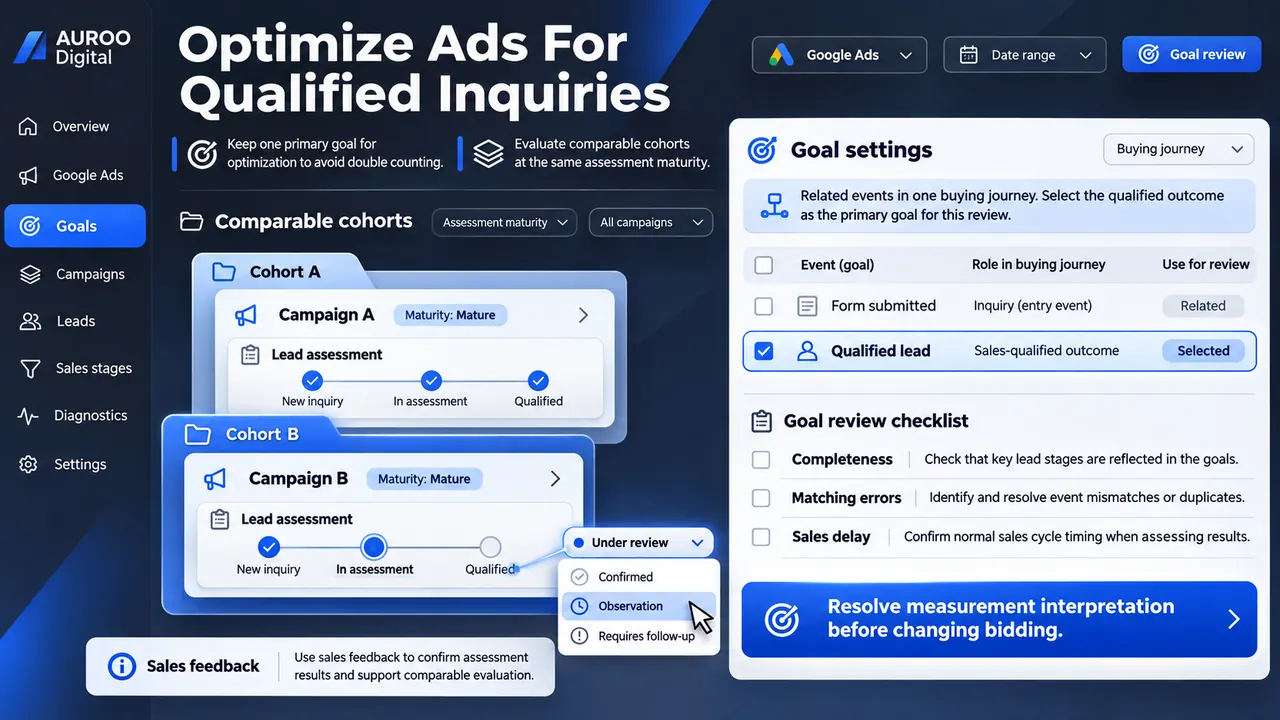
Distinguish diagnostic events from outcomes actually used for bidding. Treating both a form submission and its qualified stage as independent primary goals can double-count value along one buying journey. Review account goals, campaign goals and counting settings before changing them. If qualified leads are sparse or delayed, validate the data first. Do not relabel a page view as a sales outcome simply to increase reported volume.
5. Compare cohorts with similar maturity
Here is a calculation example, not a client result. Campaign A spends $1,000 for 20 forms, of which four qualify. Campaign B spends $1,000 for 10 forms, of which five qualify. Form costs are $50 and $100, while qualified-lead costs are $250 and $200. B looks stronger on qualification cost, but that conclusion is premature if its leads have not completed the same assessment period. Also review opportunities, closed sales and contribution, rather than stopping at qualification.
6. Run a weekly data and feedback review
Look for missing records, repeated uploads, incorrect stage timestamps and outdated rejection reasons. Record import errors, matching diagnostics, assessment delays and changes to qualification rules. When changing a campaign, write down the hypothesis and observation period. Review search terms, locations, ad promises and landing-page information together. Better measurement supports better decisions; it is not a guarantee of cheaper leads or more sales.
Implementation checklist
- Use one agreed qualification definition.
- Trace forms through CRM stages.
- Verify a currently supported import method.
- Review primary goals and counting for duplicated value.
- Compare mature cohorts and retain rejection reasons.
Frequently asked questions
Should every historical customer record be uploaded?
No. Define the purpose and minimum necessary data, verify platform requirements, and use an appropriate validation process first.
Should bidding change immediately when qualified leads are sparse?
First check definitions, completeness and delay. Decide using account evidence and the sales cycle; there is no universal switching threshold.
Sources checked on November 5, 2026. The practical workflow and fictional examples are AUROO Digital editorial guidance.