SEM
Meta Ads Optimization: Creative, Tracking and Profitability
Optimize Meta ads by validating business goals, conversion events and order or lead quality before testing creative and changing budgets. Reconcile platform reports with sales, refunds and sales-team feedback. More engagement, cheaper clicks or higher platform ROAS alone do not demonstrate improved profit.
To apply this approach to your website or marketing project, explore AUROO Digital’s social media advertising and creative services, with scope, deliverables and review methods agreed around your needs.
For ecommerce and lead generation businesses, this article sets out a complete approach covering objectives, tracking, creative, testing, and budget scaling. Available features, placements, and account permissions depend on the current interface. Creative restrictions or historical user data from older articles should not be treated as current rules.
1. Let Business Outcomes Determine the Advertising Objective
For sales, evaluation should focus on purchases and profit. For leads, distinguish submissions, qualified needs, and closed deals. Traffic or engagement objectives can serve specific tasks, but cheaper clicks do not mean the system will automatically deliver customers of equivalent quality.
First establish target acquisition cost, average order value, refunds, gross margin, and sales cycle. Estimate future value conservatively for one-off products with little repeat purchasing. Subscription and repeat-purchase businesses must also validate retention using actual customer cohorts, rather than scaling budgets on an idealized lifetime value.
Before advertising, write a testable objective, such as “Increase inquiries that meet our location and needs criteria within the agreed cost range,” and define what will be counted. Creative, pages, and reports will then share a common evaluation standard.
2. Match the Ad Format to the Communication Task
Single images suit one proposition; video demonstrates processes and explains differences; carousels show multiple products or steps; catalogs connect product information with relevant needs. Available formats and displays depend on the account. There is no need to divide budgets equally merely to cover every format.
Creative should answer four questions: who benefits, what problem is solved, why the claim is credible, and what happens next. Demonstrations, genuine usage experiences, specification comparisons, and service processes provide different forms of evidence. Unauthorized testimonials and exaggerated promises cannot substitute for trust.
On mobile, first check the opening screen, subtitles, key text, and safe areas around buttons. Video should make sense without sound. Landing pages must match the ad’s prices, offers, and product information. Do not assume short videos always perform better; let business tests establish the result.
3. Configure Pixel and Server-Side Events Correctly
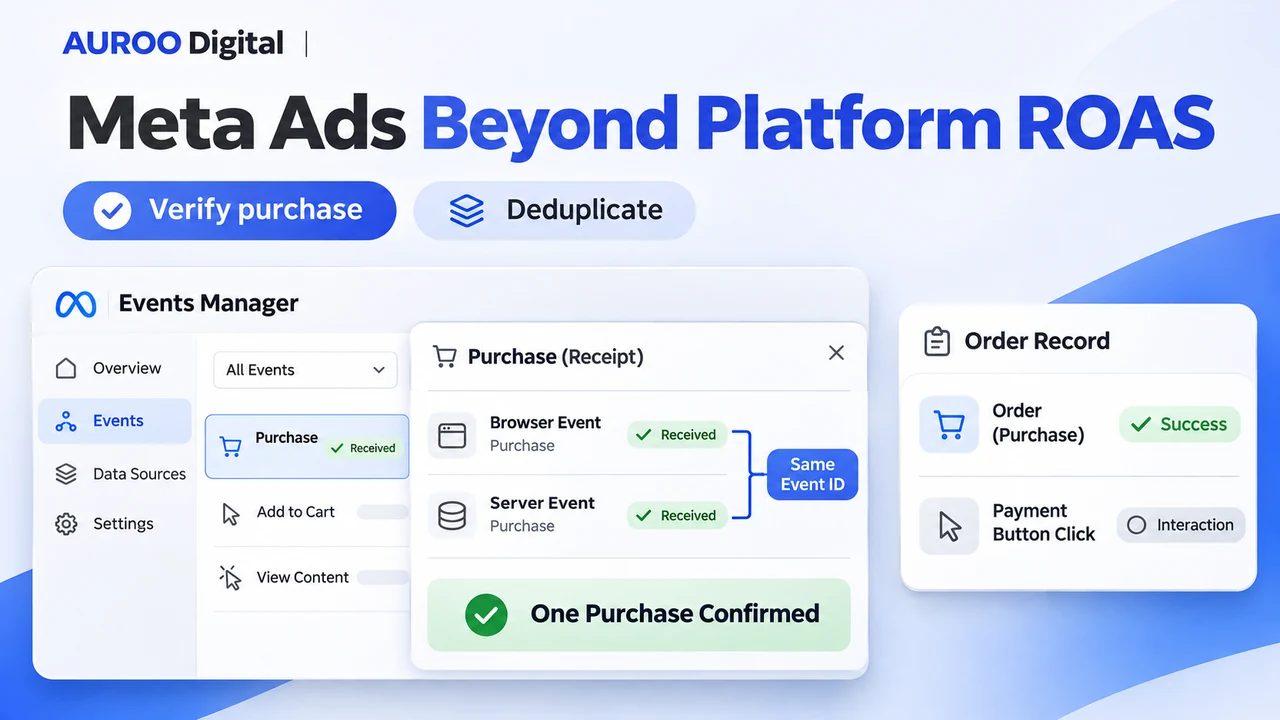
Meta Pixel provides browser-side events; Conversions API can add a server-side connection. When using both, follow official implementation requirements to check matching, deduplication, data freshness, and event coverage.[1] Server-side reporting does not remove the need to respect customer consent and data-use rules.
Purchase tracking should use an explicit success state. Verify event names, amounts, currencies, and order deduplication. Clicking a payment button does not mean a successful purchase; refreshing a thank-you page should not create a new real order. Lead events must likewise distinguish clicks, successful submissions, and qualified CRM statuses.
Before launching, complete test orders and leads, comparing platform events, the business backend, and analytics. An Events Manager message saying an event was received does not establish that amounts and attribution are correct. Set failure alerts to avoid continuing optimization with distorted data after tracking breaks.
4. Use a Small Number of Clear Structures to Build Interpretable Data
Account structure should reflect meaningful business differences, such as markets, objectives, product economics, and customer types. Excessive audience and ad-set fragmentation can leave each combination with too little information. Excessive consolidation can hide regional differences in costs and fulfillment.
Observe new-customer acquisition separately from existing-customer activity. Remarketing may convert more easily, but some of those customers would have purchased anyway; not every attributed sale is incremental. Set exclusions and audience expansion according to current product permissions and real data, rather than mechanically copying old account practices.
Do not repeatedly restructure because of normal short-term fluctuations. Set observation windows and record external changes in inventory, prices, site outages, and campaigns. The system’s need for data does not require waiting indefinitely: address uncontrolled spending, tracking errors, or clearly irrelevant traffic promptly.
5. Establish Creative Hypotheses and Testing Discipline
Begin each test with a hypothesis, such as “Showing how the product works reduces purchase concerns more than showing only the finished result.” Define the primary metric, budget, observation period, and stopping conditions before creating variants. Changing the product, audience, offer, and page simultaneously makes differences difficult to explain.
Platform A/B testing tools can support more disciplined comparisons. Performance differences between ordinary ads do not automatically constitute a randomized experiment. Account for sample size, delayed outcomes, and variability; two sales are insufficient to declare a stable winner.
Frequency alone cannot diagnose creative fatigue. Consider reach, clicks, conversions, costs, and how long an asset has been running to distinguish audience saturation, competitive changes, and page problems. Refresh message angles and supporting evidence before merely changing background colors.
6. Interpret ROAS Through Profit
ROAS usually divides attributed revenue by advertising spend, without automatically deducting product, shipping, refund, payment, or agency costs. Ecommerce businesses should also monitor net revenue, contribution profit, and the share of new customers. Lead businesses should extend measurement to sales acceptance and deal quality.
Illustrative calculation: revenue is HKD 10000, leaving HKD 4000 after product, fulfillment, and other order-dependent costs but before advertising. The contribution margin is 40%. All else equal and ignoring fixed expenses, break-even advertising ROAS is approximately 2.5. Higher refunds or discounts change the required ROAS; 2.5 is not a universal benchmark.
| Measurement Layer | Primary Metrics | Common Misinterpretation |
|---|---|---|
| Creative appeal | Meaningful views and clicks | High click volume always means high quality |
| Conversion path | Submissions, purchases, and page conversions | A button click equals a sale |
| Acquisition quality | Qualified leads, new customers, and sales | Every attributed customer is incremental |
| Business results | Net revenue, contribution profit, and payback | Platform ROAS equals net profit |
Differences between platform attribution, website analytics, and financial revenue are common. First align dates, windows, refund treatment, and deduplication. To assess incremental advertising impact, use more rigorous control designs where feasible rather than treating attribution models as causal proof.
7. Scale Budgets Alongside Supply and Service
Before increasing spend, check tracking stability, order quality, stock, shipping, and customer service. A combination that works at a lower budget may not retain the same costs when scaled. Marginal acquisition costs may rise, and additional traffic may expose new page or fulfillment problems.
Keep records while scaling, comparing similarly mature customer cohorts and net business outcomes. If acquisition costs rise, examine new audiences and customer composition before deciding whether to adjust creative, pages, or budgets. Do not use deeper discounts to disguise weaknesses in the profit model itself.
Frequently Asked Questions
Select a question to view the answer and make a better-informed decision.
Can Conversions API recover all missing data?
There is no guarantee. Implementation quality, matching, consent, and users’ environments all affect the outcome.
What ad frequency indicates fatigue?
No single number applies to every business. Assess changes in results alongside the purchasing cycle.
Do ads need optimization every day?
Check for anomalies daily, but base structural and strategic changes on evidence. Do not make changes simply to maintain an activity frequency.
References
[1] Meta Blueprint: Optimize Meta Conversions API Course
[3] Meta Pixel and Conversions API Event Deduplication Documentation