SEM
Baidu Advertising Guide: Costs, Planning and Lead Measurement
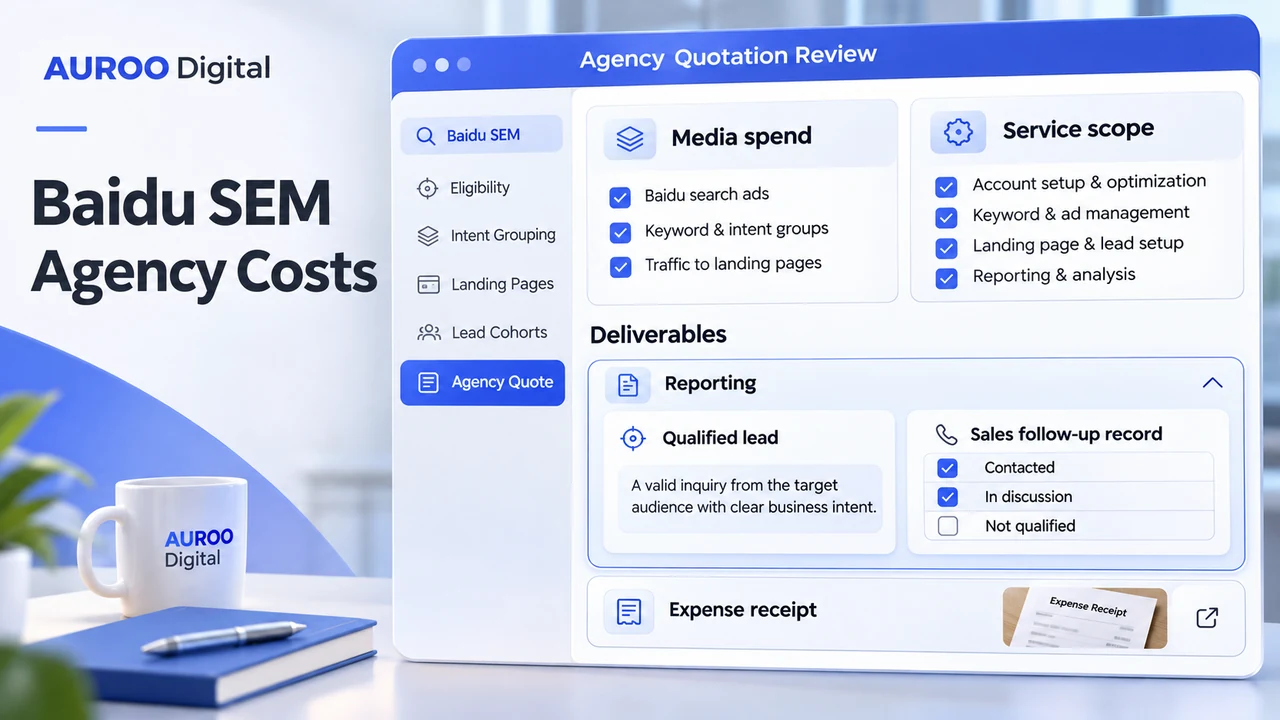
When choosing a Baidu SEM agency, compare media spend and management fees separately. Confirm account ownership, keyword and negative-keyword maintenance, landing pages and lead reporting. Assess budgets using qualified lead costs and sales cycles; verify eligibility through the actual account-opening channel.
To apply the approach to your website or marketing project, explore AUROO Digital’s Baidu SEM and PPC management services, with scope, deliverables and review methods agreed around your needs.
For Hong Kong and cross-border businesses entering mainland China, challenges usually center on eligibility and account preparation, local search intent, landing page experience, and connecting sales data back to campaigns. This article offers a method for internal project approval, agency quotations, and project acceptance, without promising fixed rankings or acquisition costs.
1. Determine whether Baidu fits your current business
Start with how customers express their needs. If prospective customers actively search for product categories, specifications, prices, or suppliers, search advertising can capture explicit demand. If a product concept is new and users do not yet know how to search for it, content or other touchpoints may need to educate them first, followed by monitoring search demand.
High-value B2B sales typically involve inquiry, proposals, procurement, and payment. Evaluate advertising against sales cycles and gross margins rather than treating a form submission as completed acquisition. Consumer businesses must consider payments, delivery, returns, exchanges, and local service capacity so advertising does not amplify unresolved fulfillment problems.
2. Prepare business credentials, pages, and data before opening an account
Account documentation and eligible industries vary with the business entity, region, and business type. Verify qualifications, authorizations, the account-holding entity, funding, and landing page requirements through Baidu Marketing and the actual account-opening channel, then prepare materials accordingly.[1] For industries requiring additional review, confirm eligibility before producing large amounts of creative material.
Verify website deployment requirements separately from advertising account requirements. Do not conflate ICP filing, operating permits, and every advertising account eligibility condition. Agencies must explain why each document applies to the current entity, who submits it, and what happens if it is rejected.
Businesses should retain control of account administration, data, domains, and analytics tools. Contracts should specify whether media and service fees are separate, the invoicing entity, treatment of remaining balances, rights to creative assets, and account handover after termination. Getting ads to run is only the starting point; transparent transfer of control supports long-term cooperation.
3. Organize keywords and ads by search intent
Group keywords by intent, such as brand, category, need, and comparison. For industrial equipment, “brand and model” and “equipment maintenance solutions” imply different background knowledge, so advertising messages and page emphasis should differ too. Grouping should align promises with needs rather than merely tidy the account.
Initially prioritize keywords directly related to the business and establish a process for maintaining negative keywords. Use actual search term reports to identify unrelated demand, including job searches, document downloads, DIY repairs, and locations you do not serve. Do not increase budgets solely because clicks are cheap or overlook sales potential because search volume is low.
Monitor branded and non-branded keywords separately. Branded searches may reflect awareness built through other channels; combining them can overstate advertising’s ability to generate new demand. With limited budgets, avoid excessive segmentation that leaves each group with too little data to assess.
4. Landing pages must deliver on advertising promises
An ad promising “industrial equipment selection advice” should lead to a page explaining applications, technical specifications, service scope, and the consultation process. A generic homepage makes users search again for answers, affecting lead quality and conversion efficiency.
A credible page should provide verifiable business information, product and service boundaries, intended audiences, genuine supporting evidence, and clear calls to action. Case studies should use only authorized, verifiable information. Without evidence, explaining the delivery process clearly is more persuasive than inventing customer names or growth percentages.
Design form fields to support sales qualification. B2B forms may collect the type of need, region, and project stage, but excessive mandatory fields can reduce submissions. Compare “cost per qualified lead” and “sales acceptance rate” rather than pursuing form conversion rate alone. On mobile, check loading, taps, form errors, and post-submission feedback.
5. Move from clicks to qualified leads and sales
A basic funnel covers impressions, clicks, visits, submissions, qualified leads, sales acceptance, opportunities, and closed sales. Define each stage and its deduplication method clearly. Calls and instant inquiries also need a practical recording process; otherwise, entry points cannot be compared fairly.
| Metric | Calculation | Question it helps answer |
|---|---|---|
| Click-through rate | Clicks divided by impressions | Does the message match search demand? |
| Landing page conversion rate | Valid submissions divided by visits meeting the defined criteria | Do the page and form work smoothly? |
| Cost per qualified lead | Advertising expenditure divided by qualified leads | Does the traffic bring genuine demand? |
| Customer acquisition cost | Investment within the agreed scope divided by new customers | Is customer acquisition economically viable? |
Suppose HK$20000 in advertising generates 100 forms, 40 qualified leads, and 4 new customers. The cost per form is HK$200, the cost per qualified lead is HK$500, and advertising-only customer acquisition cost is HK$5000. This illustrative calculation excludes agency fees and sales costs; reporting only HK$200 can obscure the real acquisition burden.
For longer sales cycles, create cohorts based on when leads entered and compare them at similar maturity. Do not divide this week’s spending by this week’s closed sales to judge new leads that have not received sufficient follow-up.
6. Base budget optimization on evidence and stopping conditions
Initially validate tracking, traffic relevance, and sales feedback before increasing budgets. Record the hypothesis for each adjustment—for example, “exclude unserved regions to improve sales acceptance”—along with the metric, observation window, and other possible influences.
When performance is weak, check tracking, search terms, regions and devices, pages, and sales follow-up in sequence rather than immediately blaming bids. If sales response is slow, increasing high-intent traffic may simply generate more unhandled leads. Preserve uncertainty when data is insufficient, and do not present random fluctuations as optimization findings.
Internal alerts can cover spending, invalid lead proportions, and critical conversion anomalies, but thresholds should reflect the business’s tolerance rather than supposed universal industry standards. Before increasing spending, confirm that fulfillment and sales capacity can accommodate the additional demand.
7. Assess agencies by deliverables and account governance
When requesting quotations, ask for explanations of account structure and keyword logic, a landing page diagnosis, tracking plan, sample optimization logs, and reporting fields. Prioritize teams that explain measurement definitions, acknowledge limitations, and accept account transparency.
Monthly reports should explain where budgets went, the quality of opportunities generated, what affected results, and what will be tested next month. Impression and click charts alone do not demonstrate business optimization. Contract acceptance should focus on deliverables and process quality rather than unverifiable promises of “guaranteed results.”
Frequently asked questions
Select a question to view the answer and make a more informed decision.
Can Baidu advertising and Baidu SEO replace each other?
No. Paid advertising and organic search use different mechanisms. They can work together to address demand, but their investment and results should be accounted for separately.
Does account approval mean pages and creative assets remain compliant forever?
No. Changes to documentation, products, creative assets, or platform rules may require renewed checks.
What budget is appropriate?
Work backward from target acquisition costs, the expected conversion path, and evidence needed for the trial, and set a spending limit. There is no universal minimum effective budget for every industry.
From planning to a managed campaign
This guide explains Baidu advertising decisions and evaluation criteria. For account audits, Chinese keyword research, campaign management and qualified-lead reporting, see our Baidu SEM agency and PPC management services. If you are comparing suppliers, use the Baidu SEM agency selection checklist. For unpaid search, explore Baidu SEO services; paid and organic results should be measured separately.
References
[1] Baidu Marketing official products and account-opening portal
[2] Baidu Marketing Help Center: official rules and operating guidance