Ecommerce Growth
Ecommerce Promotion Profitability: Calculate Your Allowable CAC
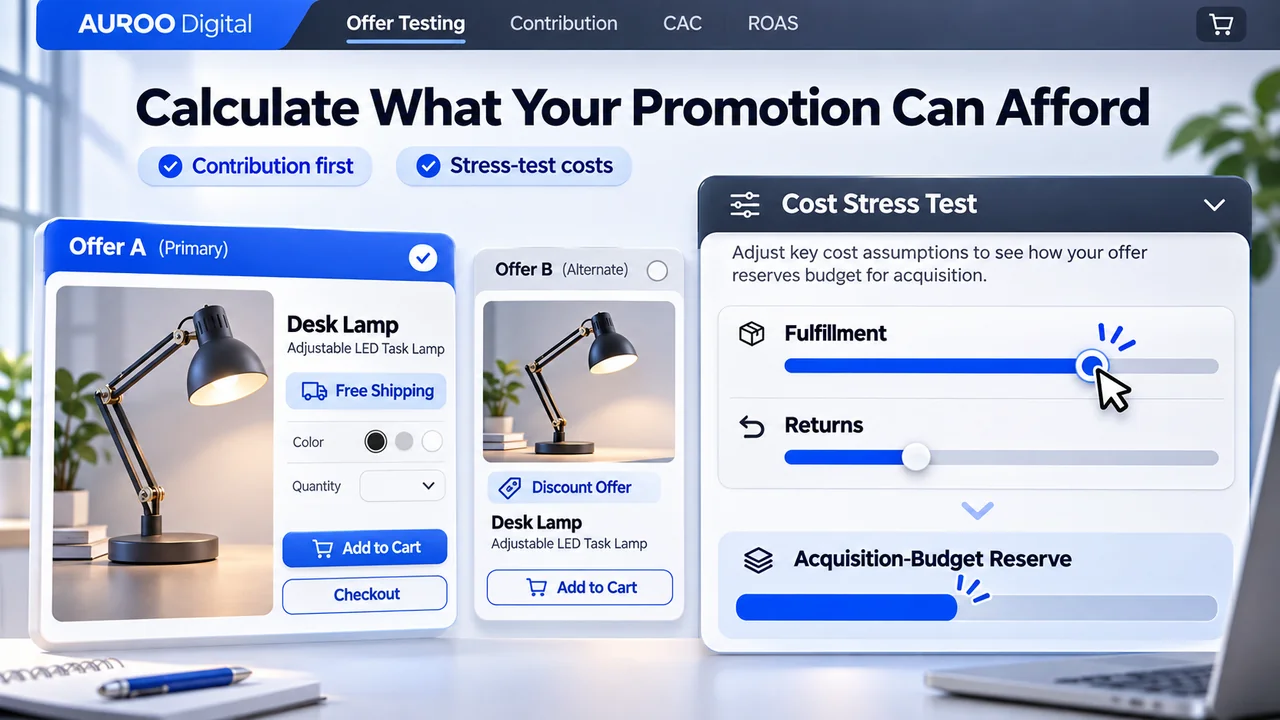
A promotion can increase orders while reducing what each order can contribute toward acquisition. To assess the offer, compare revenue after discounts with costs that change when an order is placed. The simplified model below helps marketing, operations and finance discuss a budget; it does not replace the company’s accounting policies.
1. Align revenue and cost definitions
Specify the currency, exchange rate, tax treatment and revenue boundary before comparing campaigns. Start with revenue after the advertised discount, then account for expected refunds and the net effect of returns. Separately identify taxes collected on behalf of authorities that are not business revenue, with finance confirming the treatment. Record shipping income and shipping expense separately; a customer contribution does not remove the underlying fulfillment cost.
2. Separate variable costs from gross margin
Review product cost, packaging, pick-and-pack, delivery, payment or marketplace fees, and expected net return and service costs. Refunds reduce revenue, while returns can also create reverse-logistics costs and recoverable inventory value. Use one consistent model so the same loss is not deducted twice. Contribution before advertising is not net profit: staff, software and other fixed operating costs still need to be covered.
3. Work through a complete example
This fictional example uses US dollars, excludes taxes from revenue and assumes consistent cost definitions. A $100 item sells for $85 after discount. Product cost is $30, fulfillment $12, payment and platform fees $3, and the expected net effect of refunds and returns $5. Contribution before advertising is $85 − $30 − $12 − $3 − $5 = $35. If the business reserves $15 per order for fixed costs and operating profit, the model allows $20 in advertising cost per order, not $35.
4. Distinguish cost per order from new-customer CAC
Advertising cost per order divides ad spend by attributed orders. New-customer CAC needs a defined acquisition-cost numerator and a denominator of newly acquired customers. These are different measures. Converting the per-order allowance into allowable new-customer CAC requires explicit new-customer, customer-count and acquisition-cost assumptions. In the example, a $20 advertising cost per order implies a simple revenue ROAS of $85 ÷ $20 = 4.25. That is a scenario calculation, not a universal benchmark or proof that the company is profitable after every expense.
5. Stress-test the discount and major costs
Build conservative, base and optimistic cases for fulfillment and returns. If revenue stays $85 but fulfillment rises to $16 and the net refund-and-return allowance rises to $8, pre-ad contribution becomes $28. Keeping the same $15 reserve leaves only $13 for acquisition. Do not cover a weak first order with speculative repeat revenue. Model lifetime value separately only when repeat behavior, margins and timing are supported by evidence.
6. Test a limited offer before scaling
Set a budget within an acceptable loss limit, plus a review window, stock ceiling and fulfillment capacity. Track platform-attributed revenue, actual order revenue, spend and mature refund data separately. Segment by product, market and new versus returning customers so stronger products do not hide a weak offer. Use a provisional return allowance while data matures, then reconcile it. Scale using updated contribution and cash-flow capacity, not the launch-day ROAS alone.
Implementation checklist
- Align currency, taxes, shipping and refund treatment.
- Include relevant variable costs in pre-ad contribution.
- Separate cost per order from new-customer CAC.
- Include a conservative promotion scenario.
- Use mature returns and actual order data for budget decisions.
Frequently asked questions
Does high ROAS guarantee profit?
No. Revenue ROAS does not normally deduct product, fulfillment, return and fixed operating costs.
Is free shipping better than a discount?
Model both with consistent assumptions, then test order conversion, basket value, contribution and returns. Conversion rate alone is insufficient.